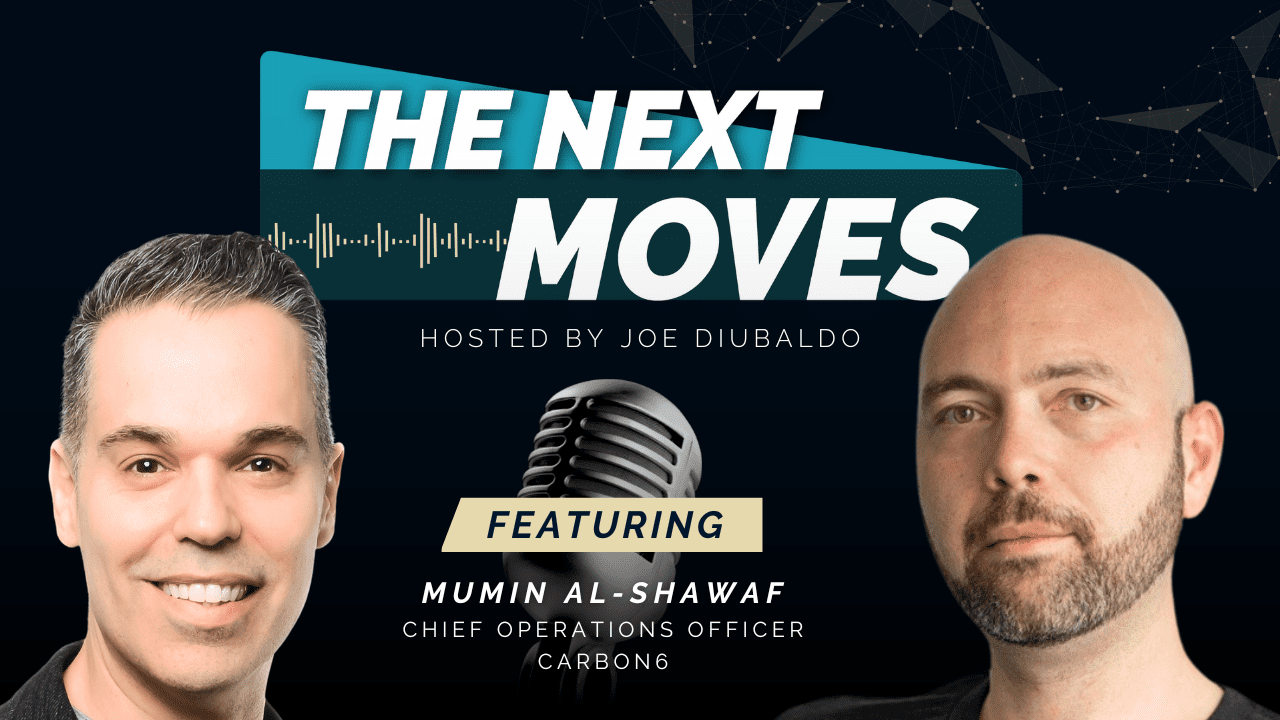
00:07 Joe: Hello everyone, my name is Joe Diubaldo and welcome to the show. For close to 25 years I’ve been a recruiter, I’ve been an entrepreneur, and I’ve been someone who’s made it his life to help people build better careers and better companies. I love this job. This job is addictive and it’s addictive for the simple reason there’s so much learning — I get a chance to learn from people who invite me into their lives and into their companies during times of massive transformation. Along the way there’s one key lesson that always stands out — we all get stuck. We get stuck as we think about what to do next. And I think that’s where I might be able to help you get unstuck, to help you plan the next move and then the move after that. And for that reason I’m inviting people in to speak about the big moves, the decisions, the changes, and the setbacks. And we can listen to them and see what we can learn. My guest today is Mumin Al-Shawaf and we have the pleasure of speaking with Mumin who is a friend of mine and he’s a distinguished tech executive. He has an incredible track record driving all these different functions and organizations. I seldom see someone who has played different roles with as much breadth as Mumin has. He’s taken two companies from startup to IPO. He’s done it by operating and working in functions like operations, product development, sales, M&A, and customer success — often leading these organizations under massive pressure and significant growth targets. He’s currently the COO of Carbon6 and he continues to lead that organization and support their strategic vision. His career is one that I’ve managed to learn from. And if there’s one thing that I really admire about Mumin, it’s his ability to ask us questions about what’s next and to challenge our thinking on how we’re going to accomplish those things that we’re planning to do. So let’s dive into his career journey and let’s talk to him and see what lessons we can learn.
02:08 Mumin: Thank you Joe, glad to be here.
02:15 Joe: So I think it’s always important that people understand why we’re talking and to do that — where you’ve come from and the things you’ve been a part of over your career, because they’re quite interesting. So give us a quick rundown of what you’ve done with your life.
02:31 Mumin: As you know, I’m a trained programmer. I finished computer science back when dinosaurs used to roam the Earth. I was trained as a software engineer and a programmer and I started my career in development. At some point in my career I realized that I love programming, I’m good at it, but there’s a part of me that was missing. What I was really more interested in was — when this software is released, how are you going to sell it, who is going to be interested in it, how are they going to use it? And I got to a point where I made a decision that there is something missing and I wanted to go — I didn’t see myself being a software engineer and being the best software engineer in the world. I came to that realization in my early 20s. And I found there’s a part of me where I want to be interacting with people, I want to talk about value, I want to lead people. So at that point I knew I needed to make a career change. And with not a lot of clarity — you know, early in your 20s you have no clue what’s going on in the world, you just think you are smart.
03:45 Joe: We’re not smart.
03:45 Mumin: Yeah, no, as you age you realize how not smart you are.
03:54 Mumin: Exactly. So I studied software engineering and the big skill in software engineering and programming is — when you are deep, you have to be good with numbers and you understand numbers and all of that stuff. But the other part of it is they teach you in computer science how you can take a big problem and break it into smaller components, solve those smaller components, and then put it together as a big software. And that skill set is where I based my entire thinking about my career. That skill set can be transferred to business, because when you look at business it’s usually you have a big problem and then you start tackling the small pieces of it and you put it together. And then I looked at the other side — I love leadership and I love business. But I realized very quickly that I have zero training, I have no clue what that is. And then I started looking at what does it take for you to be a leader. And I didn’t focus on it in terms of like “how can I lead a customer success team or how can I lead a sales team” — it was “what’s a leader at that fundamental level, what are the skills that you need to look at?” And I remember I put the list together — all of the things that you need to look at for you to be a good leader. If you start doing research, like personal mastery, self-awareness, self-regulation, interpersonal skills, strategic, influencing — all of that stuff. Like some of this stuff I’d never heard of in my entire life. Just throw it down — “okay great, so there are a lot of things that I need to go and learn.” And what I found — at that point I was at NetSuite — was I’m going to be able to go and add a lot of value in how can I go and help them with process. Because as I told you, process writing, process taking something complex, breaking it down into smaller components — that’s something that I have some backbone in and I liked it. So I remember at the time I said okay, if you want to be the best at that, what do you need to do? And I went into it and I started learning a little bit more — if you want to get into process optimization, who are those people? And I remember at the time it was Lean Six Sigma. And I was like “what the heck is Lean Six Sigma?” And I started researching that. It’s funny — when I was talking to our VP at the time at NetSuite I saw a book behind him and it was “Six Sigma for Services.” I was like maybe there’s something with that.
06:56 Joe: Which organization was this with? That’s NetSuite, okay.
07:04 Mumin: Yeah, the VP James B. at the time. And I remember I looked at that book and I went back and did more research and said okay, it seemed like it’s a thing. And if I want to acquire these skills at that point, either I’m going to go and learn from someone or I need to accelerate it. And to me, to accelerate, there are programs where you can become a certified Lean Six Sigma. I looked at what that means and I remember at the time I found this program where you can become the Black Belt Six Sigma and it was like $15,000 to get into that program. And as a broad 21-year-old I was like — do I need to make that investment or not? And I remember I thought — I probably should invest in myself if I want to do this and I like it. I need to invest in myself. So I remember I went to James, the VP, and I told him “I want to go and do this. But if I do this, I would like you to give me the opportunity to go and apply what I learned to go and help you.” And he said “absolutely, go for it, I’ll pay half.” And I remember I took that course — and even though we went to the same MBA program and we covered some of that in that path — I remember that course fundamentally switched the way I think about business. Because when you look at Lean Six Sigma, it’s not about just the process optimization and all of that stuff. It opens up — remember that list I told you about, like change management and influencing and all of that — it gave me all the foundation of what is going to take for you to identify problems. And Six Sigma by the way is very heavy on data and very heavy on looking into the data — trying to identify the problems and measuring the problem. So it was really in my wheelhouse — the data and the process. And I remember going through that course and coming back and I was able to go and drive some serious improvements at the organization.
09:22 Mumin: Just because I chose to — a lot of people when I talk to them and when I see people in my career and people that report to me, they’re all sitting on the side and waiting for what’s their next promotion.
09:40 Joe: Yeah. I’ve always wondered about that because there’s the specialist track and then there’s the leader track. And so many people are saying that they’re waiting to be identified as a leader. But it sounds like what you did was say “I want to be leading — what does that look like and how do I acquire those skills?” So it seems far more conscious to me. Am I right?
09:57 Mumin: Very conscious. It was extremely conscious. I didn’t wait to be the leader. I went in and I said “what are the skills that I need to acquire?” Because I said “this is what I’m strong at and I wanted to be the best in the world at it.” And it’s a journey, right — I’ve been on this journey now for 20 years and I’m still learning. But it was a conscious decision that I want to build my skill set in there. And I looked at where am I strong and I said “how can I take my existing skill sets and apply them in the area of leadership where I can excel even further?” Like if you think about it there’s this concept of skills layering where you can — for example if you are good in data analysis, you can be the best in the world in data analysis. But where you can become more unique is when you are able to go and layer skills on top of that, even if you’re not the best in the world at it. If you take that person who is very strong in data analysis and then you layer on that they know a little bit about the industry and they know how to present really well in front of customers — now you are building a very unique persona where as the whole you are a very unique person in terms of what kind of value you can add to the organization.
So the way I built my career is there’s the focus on “I want to be the best leader that I can be.” And in a very systematic way I start creating a plan. If you want to be a good leader there is a journey on self-awareness, there is a journey on how to motivate, there is a journey on how you can present data. I remember that was one of the hardest parts for me — because I was very strong in data, when I wanted to present, the storytelling was a struggle for me. Because I’m always leaning toward what’s strong in terms of presenting the data and “this is what you need, everyone should believe me now because of the data.” But how can you use the data to tell the story to ignite the feeling in people so you can motivate them and move them or influence them? So these are a lot of skills you have to layer.
12:36 Joe: I want to double click on that for a second — the skill layering. And this is important for all of us because we are trying to do more often, or we’re looking at a job and saying “hey, I’d love to be doing that job.” But what you’re articulating is that there’s a layering of skills that’ll enable the success for the individual in that job. And it sounds like you found yourself stuck in that moment where you had the competency of data analysis. Did you find yourself failing when you were trying to do presentations or the next level work? Were there things — and how did that unfold?
13:16 Mumin: There are moments where the learning will click. I don’t know if that makes sense, but sometimes you will go in very confident, you will go in and you will present, and then the presentation doesn’t go well and you’re going to say “what the heck happened in that moment?” And then you will start looking around at the people you trust and say “where did I go wrong?” And they will tell you where you went wrong. And it’s still not going to click. Or sometimes it will click but you will not know how to fix it. Someone will tell you “well, you went deep into the data and you lost everyone — your audience doesn’t care about the data, they want to jump to the recommendations. And you should not give one recommendation, you should give two or three and then tell them to choose.” So all of these techniques — it will click but you will not understand. Now, what’s the key is once you identify that there is a problem, don’t leave it for luck. You know where you need to go and dig deeper. Knowledge is available everywhere. So for example in this scenario I remember saying “I need to learn how to present.” And I remember there’s a book that was written by one of our professors at Kellogg — it’s called “How to Wash a Chicken.”
14:50 Joe: Absolutely — the title is funny.
14:50 Mumin: But I went in there and I read that book and I devoured it. The book is amazing on how you can go and present. And then you take it and you say “okay, these are new techniques, I like this technique, let me dig deeper a little bit — what can I find here?” I found also another technique that I learned when I wanted to build that skill was — before I present, I pre-present.
15:15 Joe: You’re just talking about preparation — like spending a lot of time working through. And are you talking about doing it in front of individuals?
15:24 Mumin: Exactly. So what I would do — after I learned some of these techniques and I went and said “now I need to go and apply it” — I take these techniques and I make a presentation, a second version of the presentation where I think I actually nailed it. But then you go and say “hey John, I’m going to present this and I want to run this by you. I want you to give me feedback on where am I missing.” So you will get that feedback and then you will take it and you will talk to someone else and get that feedback. This is some of the techniques on how you can nail the presentation. And every single one of them, because you go and say “I need help,” they will give you help and they will give you feedback one-on-one at the moment as you’re presenting. And you do that multiple times.
16:15 Joe: This is more of like the deliberate training — you’re talking about a level of preparation that people don’t do most often. They don’t. And they likely don’t get the feedback loop from showing someone the presentation ahead of time and hearing them tell you “hey, I would look at this in more detail, I would avoid these topics.” And ideally someone who is that audience that you’ll be presenting to. I don’t think any of us take this seriously enough. And we all know that when you’ve prepared constantly and then you’ve had people evaluate the presentation and then you incorporate that evaluation and make it better — what comes out of that is compelling. And for everyone listening — whoever doesn’t think that this is happening by the best presenters, and that people walk on and just wing it and it’s exceptional all the time — I think the clinical approach that you’re talking about is something people should listen to. So when you’ve been talking about leadership and the development of skills and competencies — I think we all look at that when we’re saying “what does it take to be a leader.” But I want to make this more complicated. You were acquiring these skills while you’re going through hyper growth in more than one company. What did these companies start at when you were there, what did they end at, and then talk about how you keep growing with that kind of pressure happening inside the organization.
17:53 Mumin: Absolutely. So the companies — some of them I joined very very early, let’s say pre-Series A, around the seed. I’ve never started with a company where they were just an idea and they wanted to go and do product-market fit. The majority of the companies that I joined — there’s a product-market fit and they want to start scaling. So that’s my sweet spot around there. But one thing — I remember when I first started with Carbon6 we were very early. When I joined Carbon6 we were in single digit revenue — low single digit frankly. And I remember I had a conversation with the CEO and I told him: when a company is growing, people are left with two choices. Either they are going to be able to break through the ceiling and grow with the requirements of the business, or they have to step out.
19:04 Joe: You mean step out of their role or step out of the company altogether?
19:04 Mumin: It depends — can the role change? And I’ve seen people move away and do a different job and I’ve seen people where they continue to grow. Almost every single company that I was part of — when they started small and started going on the journey of $10 million, $20 million, $50 million, $100 million — the executive team changed. Like in the previous company, Top Hat, the executive team changed four times. Because the persona and the skill for someone to take a company from a million dollars to two million to three million to five million, and then above that — the skill set changes. And the personality, who you are and what you can deal with — it also changes. So for me it was very high pressure. Going from a company where you are starting at $1.5 or $2 million revenue and riding it all the way until it’s close to $100 million — the requirements will change. And the pressure on “where am I today and where do I need to be” — you can’t leave it for luck because the business is going to evolve very quickly. And you are going to have to ask yourself “what value am I adding, what value do I need to add in the future, and what opportunities might come that I want to be ready for?”
So if I want to go back to Top Hat — when I first started with Top Hat I was in the finance team. The CFO at the time used to work with me at the previous company at Alqua and after we exited he called me and said “do you want to come and join this business? You’re going to have to take a massive pay cut and we might run out of business in three months.” I was like “great, sounds great, I’m in, let’s do it.” So when I joined I told him “so what do you want me to do?” And he said “come in — I need your help in finance, we need to go and raise a round.” And I remember at that time I had never done finance before — zero. I had no idea what a financial model actually looks like, I had never calculated LTV for an investor, I had never built a presentation for an investor before. But the reason he wanted me to come and work with him is because he knows who I am and he saw what I’d done in the previous company — I was more on the customer success side. And I remember that was very very hard. I had to go and learn all of these things. There’s a price — it just doesn’t happen with luck. I remember I would come in and ask “how do you calculate LTV?” And then I would go in and start hunting the data. And I have to go and learn all these complicated Excel functions — there was no ChatGPT at the time — I had to go learn all these Excel functions to be able to clean it, organize it, and all that stuff.
22:43 Joe: So that’s a very odd place to find yourself — inside of finance. And I’m curious — you said he knew you, and along the way you had gone and done your MBA as well, and there might have been an appreciation of some new skill. But that’s a big jump for him to make, to invite you into that role. Why do you think you were selected?
23:14 Mumin: Because of my analytical skills and because he knew about my work ethic. Skill development and work ethic. And when I stepped in I told him “I want to learn the skill.” I told him “in my career, part of what I want to do is I want to be able to understand finance very well.” Because you learn it in the MBA but it’s nowhere close to when you have to take finance and actually translate it into day-to-day tasks and make that beautiful model actually happen in reality — it’s a completely different skill set. So I came in and I had to work with them on the financial calculation stuff and building the deck and helping them with raising capital — all new things for me. But at the same time while I was doing that I was trying to go and acquire these skills as fast as possible. Think of it like you are binge learning as fast as possible. Because there’s one piece of statistics I read at some point in my career — you can Google it — if you spend 20 to 100 hours on a skill and you acquire that skill, you will be better than 50% of the population. And if you spend close to 500 or 1,000 hours, you will be better than 70 or 80% of the people. And that skill — that stuck with me. Especially when we go back to the skill layering and how can you start binge learning so you can fill that gap very quickly.
And then you go in and you start executing very well. And all of a sudden in these startups they say “there’s a position we need to fill quickly — who can take that position?” And automatically they will think “who has the skill to be able to step in and do this?” And I remember that was at Top Hat — when they said “we have a sales organization, we don’t have a leader, we need someone to step in.” They came to me and said “we want you to go and run sales.”
25:54 Joe: I see this as I look at your background — you’re brought in as the Senior Director of Operations and Finance, you spend 18 months there, and then you’re the Head of Sales. That could not be more divergent in terms of a path.
26:02 Mumin: Exactly. Exactly. So there’s faith that you can do these roles and also there’s availability — you’re available to do the role. And does it become something where “where’s the biggest fire?”
26:17 Joe: Is that what happened?
26:17 Mumin: Sometimes it’s the fire and sometimes it’s the need. The majority of leaders will ask someone they trust and have faith in their ability to step in to go and fix that problem rather than trying to go and hire someone from outside where they have no idea what’s going to happen. Because not every hire is going to be a great hire. But if there’s someone that can do the job, the probability that this person is going to go and move something in the right direction — I have more faith in that predictability. And then if that person steps in temporarily and helps me achieve what I need to achieve, I can go and get someone who has more expertise in the domain later on. And that’s basically what happened. Like when I moved to sales, after that I moved to customer success. So I ran sales for about a year and something. And at the time sales did really well. But sales works — you have customers. If you don’t take care of customers the bucket has a hole. So now “okay, we need someone in customer success — who’s the best that we know that can actually move the needle?” And that’s when they looked at it and said “that’s the person.” And I was like “okay, I will take that, let’s go.”
27:51 Joe: So for you it’s interesting — you actually end up with this detour into operations and finance and then coming back to how it all started for you. I guess after the initial development role where you were an engineer, after that you moved on to customer success. So you’re coming full circle. The idea that in these startups you’re actually doing all these different roles — they talk about founders who often run customer success first. They’ll be the engineer but then someone has to run customer success, someone has to be doing sales. And you’re getting this rotational program just by fact that there’s an absolute need for this to be done by someone.
28:35 Mumin: For sure. And the other one is — who is the person that has the highest probability of actually fixing this in the company? And that’s how they make the choice.
28:51 Joe: Let’s look at this as a lesson I want to take away — which is people are often concerned about taking a role where they haven’t been successful before. This doesn’t seem to be, at least from what I’m hearing from you, a major concern of yours.
29:08 Mumin: Because for me I look at every function I step into — there are two layers. There is “can I be a great leader that will understand the business, understand the levers, build the right team, figure out the right tactical and executional things that we need to do to actually drive the right things?” So you have that piece, that link. And then there’s the layer which is the expertise in that function — the domain expertise. So you step into sales — I’ve never run a sales organization before. I’ve been a salesperson but I’ve never run a sales organization before. To me that piece — versus the leadership piece — you can’t be a good leader if you’re weak on that top section, on how to be a good leader that is able to execute. You will fail miserably. But from my perspective if you are solid on the leadership side, the domain expertise is very easy to go and figure out.
30:07 Joe: I find it fascinating. You’re talking about the way that you break down a function — leadership competencies and then domain knowledge below it. And where there’s a gap on the domain you binge learn and try to build that competency.
30:23 Mumin: Yeah. Or you hire.
30:23 Joe: Or you hire. And I have to ask the question — where have you been humbled and been completely smoked? Where you’re like “oh, that didn’t go well.” Where you didn’t realize how difficult one of these roles was. Where was the humbling moment where you underestimated the complexity or the pain?
30:53 Mumin: There are some scenarios where you know you can take it to a very specific level and then after that you have to step away and say “we need to go and hire someone that was more experienced than this.” But this is where you know your limits. So for example — where it worked really well for me is because we’re always in this under $100 million. But like if I am in a situation where they are going to ask me “Mumin, come in and step in and you’re going to go and run the sales department for a company that is multinational” — I will fail. I will say I cannot do that. I can help get someone with the experience and here are the skill sets that I can go and bring to help them. And that happened — when they asked me to go and jump into marketing, very quickly at Top Hat, I was like “I can go and get this operational stuff working, I can go and get this done. But no way will I be your marketing director. I cannot be the person that figures out brand, figures out the messaging.” It cannot be me. But short term — you need to know where your strengths are or not. But short term I’d be able to go and fix the pipeline. I will fix the marketing pipeline, the metrics, make sure the leads are coming in and flowing in the right direction. This is my strength and I will be able to fix that in six months. The moment you want to go into the brand building — I can’t do that.
32:39 Joe: I think the inputs and the outputs for you — the analysis of what goes in and measuring what comes out and then tuning that — is the competency that you bring to everything. And then when you run into marketing, there is an element to marketing that — it is an input-output driven function to a degree, like all of them are. But those inputs have some different flavors than what a lot of people are used to. I want to — you’ve talked about hiring quite a bit. And you know I love this space and you’ve tried some interesting approaches with hiring that had both positive, I assume, and some not-so-positive outcomes. But I’m curious — where were some experiments run, what were they, what were the outcomes, what were the unintended consequences? Because you’ve had to go into these organizations that are going through rapid scaling and I remember hearing some of the stories of how you had to grow the BDR team or how you had to do something. Can you share some of those?
34:00 Mumin: Yeah. Hiring is a very important skill if you want to go and build an organization. You have to know how to do it. And one of the major learnings I got from it is you will never nail it and get 100% right all the time. Everything that you’re going to do is going to improve your odds. And the reason I’m mentioning this is I run across people or leaders where when they start hiring people they have this persona of “I’m really good at it and whoever I’m going to hire is going to be great.” And in reality — “I’ve got this, I know what I’m doing.” And you’re like “okay yeah.” And like so they come in and they start the job and you will find very quickly there are gaps. And then when you point out these gaps, that leader who has this “I am so good at it and I always get it right” mindset — they will start going in the direction of “I’ve got to fix this very quickly because I have a track record I cannot ruin.” So that humbling — the reason I always say that and I always give that lesson to everyone that I work with is — you will make mistakes and it’s okay. The most important part is once you make a mistake in hiring, take action quickly. Especially if the fit is not skill — the fit is culture.
So that’s one of the biggest lessons I learned. And then when I look at how do I do this selection, how do I get the right person — the way I look at it, there are basically three things mainly. The first one is their skill. I want to go and assess their skill — do they have the skills required for the job today? And this is one of the situations where — in some scenarios, if I’m going to mass hire — I do it differently. If I have a support job position and I need to go and hire 50 people, do I want to do the first interview then the second interview then give them the tech assessment? Or should I go and start with that? Because if someone is not meeting the technical assessment part there is no point. So I always try to go and figure out a case study that fits the actual job that they are going to do and I give them the opportunity to demonstrate their skill in that job. A lot of companies and a lot of people I know just don’t do that — they look at the resume and have the conversation. And then when that person is on the job — big mistake.
The second thing I look at is their passion about the job. There are some people that are good at their job but they’re not really passionate about it. And you look at passion in terms of — for example, I’ve seen people who for fun will code or will create these interesting things that have nothing to do with the job where they’re just doing it for fun. They’re passionate, they want to learn more about it. Those two are very important. The reason they are very important is — if you are passionate about something, really passionate about it, and you have a skill level, and it’s your job — if you’re passionate, the skill is going to start skyrocketing faster. If you’re not passionate about it and it’s just a job, your trajectory is going to be much slower. So passion to me is extremely important, especially for the early or more junior and mid-level roles. Because if I want to think about where this company is going and what’s the bench — I need people with passion for the job, something they love and they want to be the best at.
And the third component — this was the hardest part where I struggled with nailing this one — which is culture fit. And everyone talks about culture fit — “will this person fit or whatever?” But it’s always wishy-washy. Like “what is culture?” You have a bad culture or you have a good culture — what does that mean? But with time I realized — honestly, there is a company culture, there is no bad culture or good culture. There’s a culture. This company — they are intense, they are fast, they are chaotic. But that’s the culture. Right now you cannot hire someone that thrives on stability, that thrives on “I have work-life balance expectations” and take that person and make them work in this culture and expect them to thrive.
40:03 Joe: So what was your culture and hire in it — you have to accurately describe it?
40:10 Mumin: You have to accurately describe it. And you have to say it in vivid detail. Because culture, when you look at it, is really “what do we believe in?” And from those beliefs, what behaviors arise? Like do we believe that we are hitting our deadlines to ship and we will do everything to make that happen? And the thing about this is what we believe in will drive the behaviors. And those beliefs are often different by team.
40:43 Joe: 100%. And you have subcultures.
40:43 Mumin: You have subcultures. But in the end you need to bring the right person into the right company. And what I’ve seen before in other companies where they really don’t know what their culture is and they try — they don’t accurately describe it, they don’t describe it properly — it becomes like a more inclusive for everyone culture, which basically means you have no culture. And I’ve seen that fail miserably. So that’s the third component — I will actually ask the person in the interview what are they optimizing for. And there’s no right answer. If they are optimizing for the maximum amount of money they can get because they have a mortgage to pay — I’m not that company. I’m a startup, I’m not going to pay you above market. So I need to know that because even if you accept the pressure, later you are going to leave because you are optimizing for money. If you are optimizing for work-life balance today — as a startup, work-life balance of “I would clock out at 5 and come in at 9” — that is not us. And if it’s not, I want to know that. And if it’s not a fit, I don’t want you to come into this organization and then I’ve failed you in terms of not setting your expectations. And this becomes a very broken relationship between you and this person that’s going to come in.
So for the hiring in general — the things that I look for are the skill (and I really look at the skill, not just the technical skill but the skills required for the job — like part of it is I’m hiring a project manager and part of that is they need to go and present very well in a very organized way, so the case study tries to go and focus on that), the passion, and the culture fit. And this is hard — it’s really hard for you to go and write that case study. You need to think about it very carefully about what this job is going to entail and how can I actually measure if this person will thrive based on their skill sets here or not.
43:18 Joe: So much to unpack there. And why it’s interesting is because everyone has their own algorithm and you’re talking about the measurement of skill and competency, which is absolutely necessary. Because without that there’s just too wide a chasm to be crossed by someone. And the way of drilling into that is to actually build the case study and — I agree that they are difficult to do and they have to represent almost a simulation of what it’s like to do the job. We’ve incorporated that into our hiring here. I wonder how people are going to feel about these simulations long-term, about the effort with the multi-stage hiring process and then having that. Because we have it so that absolutely everyone goes through it and you don’t escape it. I wonder about it from two streams — are candidates going to opt in, are they going to want it? And the second thing is — are you going to be disciplined about using it as a data point? Because I’ve seen and felt the temptation at times to not use it, and you can go into these justification modes. So keeping that discipline and rigor around it is hard especially under pressure for hiring.
44:30 Mumin: So in the beginning you need to — in the first interview, to get to know you, learn who you are — you see the first checklist. It’s very critical for you to go and increase the demand from the candidate side: “I really want to be part of this, I want to be part of this company, I want to be part of that culture.” So that is going to be very critical. You raise from the beginning on that first interview the excitement that is going to carry them through the process. And I’m not saying we’re going to have to do 70 interviews or five or ten — you shorten it. But what I found is when you raise the excitement about the opportunity and the company and the job in the beginning, people will be motivated to go and do the second part. If you don’t do a very good job in the beginning, people say “ah, do I want to do this?” The second thing — even if you do it and they don’t go through the second one, do you want that person? It’s a very valid question — do you want the person that wants to be part of this company but they are not willing to go and showcase their skills and competency?
46:01 Joe: So they get us excited about them — there’s no magic box. And sitting across from people as they look for that easy button to press, what you understand is you can increase your likelihood of success like you said, but it is going to be — we like to say you’re going to make the best and most informed decision given what you have in front of you for information, as long as you’ve followed the structured approach. I think one thing I’ve learned is that we have these internal algorithms and we have scorecards and I want to be explicit in the scorecard that you use when you’re making a decision. Because I’ve heard it from you previously on the decision to move to different companies. And I think for people listening there’s value in that — like how do you assess an opportunity and decide where to go? How have your decisions been made? Do you have an idea — can you share it with us?
46:58 Mumin: So I look at it from two layers. First — who you are and where do you thrive? For example, there are some people that will only thrive or enjoy working with big companies with big resources and poor organization. For me, I know I don’t thrive there. I know that for a fact because when Oracle bought us I wasn’t really motivated in the same way. And when I was with Microsoft I decided to go for a startup. So I know for me it is I need to go into that stage of companies because that’s where I thrive, where I can apply my skill set the best. So that’s the first filter. The second filter is — if I’m going to join a company, I want to make sure that this company has a path to being a unicorn. And the way I look at it, I look at four variables when I want to join a company and if it has a path to unicorn.
The first thing I look at is the category. The category is very important because if the category doesn’t exist the odds of this company succeeding are very low — it’s going to require a lot of money for them to be able to educate. So I don’t think that is something I want. Now if I look at the category and it exists but there’s no clear winner — if there’s a clear winner you’re going to have to look for a niche. But if there’s no clear winner and there are some stars coming up, that is a really good sign. So when you see there are two companies, each one of those companies at $20 or $30 million and there’s no clear winner — that’s a very good opportunity. Because there’s a category that is validated and someone is going to win. So that is the first criteria I look at — what’s the category — and I try to go and understand that.
The second one is — what is the runway? What’s the total addressable market? If there is a category that exists but the total addressable market is $500 million, then okay, you’re going to be the king of nothing very small. So you need to look at where there is a $10 billion market where you know there is a way for some winners to be there. So I look at the total addressable market — it’s very critical for you to have enough for this company to become a unicorn.
The third bucket I look at is — what is the flywheel? Does the company understand the flywheel — how the customer is going to come in, how they’re going to get the value, how they’re going to grow, and how it’s going to feed the flywheel? And if the flywheel doesn’t exist or it’s like a one-sale thing where you do it once and then you have to go back and try to sell it again, or the scaling of it is very very expensive — it’s very hard for this company to become a unicorn. But even early on, if you can just see where the flywheel is — even if it’s not very clear but you know here are the components, there’s an entry product they come in and use, there’s an upsell path — and you understand that there’s this, then the way you’re going to start thinking about it is “we understand what the flywheel is, now we just have to start figuring out is it the right flywheel and how we can optimize it.”
And the last component I look at is — do they have a moat? If there’s a good category, a massive TAM, and a flywheel that is scalable — is there anything here that is going to go and protect or slow down the other competitors? That’s going to extremely increase the odds of you actually winning. So these are the four things I look at. And then I look at the people — who are the people that are going to lead this company, what’s their track record, have they done it before? All of these things will help you mainly on — is that the team that’s going to optimize the flywheel? And usually when you look at those four elements and you do your homework and try to understand the space and be honest with yourself — a lot of companies are not going to check all the boxes. And then at the end you’re looking at the team being like “can these people execute, are they the right people?”
51:51 Joe: Okay, that’s awesome. I love that scorecard. Moving — this was a blast actually. I reserve the right to come back to you and ask you for some more of your time on any one of these based on what people are enjoying and reacting to. I like how clear and concise you are in your thoughts. I also really enjoyed the part of this on the skill development and how you break out the creation of competency within an individual — both for yourself and for people. And one thing I want to leave people with is — Mumin looks at me all the time and pushes me. Mumin will have a conversation with me and say “what’s next?” and “why do you think that what got you here now will continue to get you further?” So I really appreciate you continuing to push me and I love the way you think.
52:38 Mumin: Okay, all right man. Take care.
52:38 Joe: Take care.