
Amazon Music

Spotify

Apple Podcasts
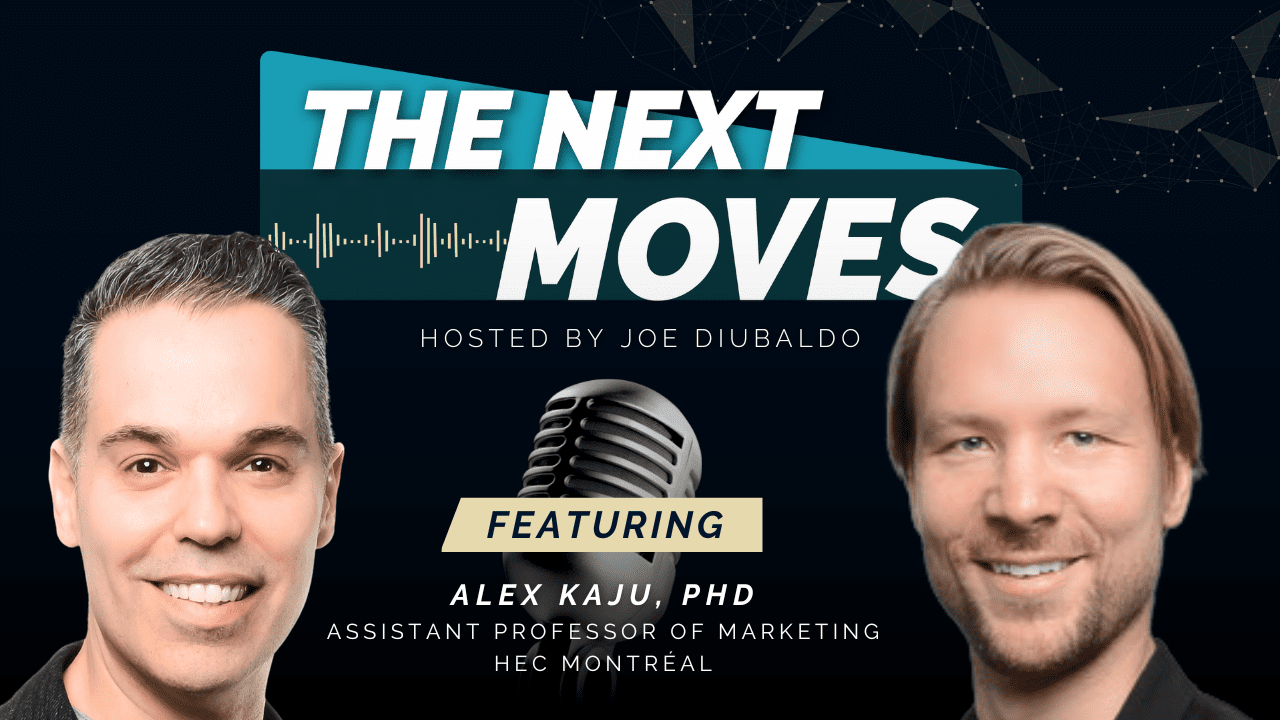
What drives human behaviour? Why do we make the choices we do? These are the questions that have fuelled Alex Kaju’s career – a journey that has taken him from the football field to academia, from marketing to behavioural science, and from industry to consulting. Now an Assistant Professor of Marketing and Consumer Psychology at HEC Montréal and a consulting behavioural scientist, Alex’s path is anything but conventional.
Born and raised in Toronto, Alex had aspirations of becoming a professional football player. He studied kinesiology at the University of Toronto, hoping to use his education to maximize his athletic potential. But a wakeboarding accident changed everything. A severe ankle injury left him sidelined for years, forcing him to reconsider his future.
That pivot led him to business school, where he discovered an unexpected passion for behavioural economics. One book, Dan Ariely’s Predictably Irrational, completely reshaped his perspective. He became fascinated with why people make the choices they do, particularly when those choices don’t seem rational. That curiosity led him to pursue a PhD in the psychology of judgment and decision-making.
During his doctoral studies, Alex took on a consulting role that would profoundly shape his approach to applying behavioural science in the real world. He started working with Clarity Recruitment helping hiring managers navigate the psychology behind decision-making. The insight was clear: hiring isn’t just about finding a candidate who checks the right boxes, it’s about understanding human behaviour, risk perception, and unconscious biases.
One of the key takeaways from his work in recruitment was the distinction between search mode and choice mode. In search mode, individuals cast a wide net, evaluating options without committing. In choice mode, they must commit, often facing the psychological weight of uncertainty and loss aversion. The problem? Many people unknowingly blend the two, making decision-making messier and more complicated than it needs to be. His research showed that setting clear criteria before evaluating options leads to better decisions.
Alex’s expertise took him beyond recruitment and into the corporate world. He became Head of Behavioural Science at Novartis in Dublin, where he focused on how behavioural insights could optimize workforce performance. From improving employee engagement to refining goal-setting strategies, his work helped shape HR practices for a global organization.
A simple but powerful framework he champions is the EAST model, which is essentially making decisions Easy, Attractive, Social, and Timely. Whether it’s encouraging employees to schedule performance reviews or helping consumers make better purchasing choices, small behavioural nudges can have a significant impact. The lesson? If a desired action isn’t happening, it’s likely because one of those four elements is missing.
Now, as an academic, Alex teaches students about consumer behaviour, decision-making, and marketing psychology. His research highlights how predictable our decisions often are and how understanding those patterns can drive better business strategies. From why people choose a certain coffee size to how brands can leverage social proof to influence purchasing decisions, his work sheds light on the often-overlooked mechanisms behind human behaviour.
One of the most fascinating insights he shares is the role of the compromise effect; our tendency to choose middle-ground options when faced with extremes. This simple principle explains why many coffee shops strategically place a mid-sized drink between two price points, making it the most popular choice.
Reflecting on his own career, Alex emphasizes two key pieces of advice:
Take the meeting. Some of his biggest opportunities, whether in academia, consulting, or industry, came from simply reaching out and having a conversation.
Embrace change. Whether it was shifting from sports to academia or moving across continents for a new job, every pivotal moment in his career stemmed from a willingness to take a leap.
For those intrigued by the intersection of psychology and business, Alex offers a simple test: If you find yourself constantly asking why people behave the way they do, you may be wired for behavioural science.
Alex’s journey is a testament to the power of curiosity, adaptability, and applying scientific insights to real-world challenges. Whether optimizing hiring decisions, shaping corporate strategies, or teaching the next generation of business leaders, his work continues to unravel the complex tapestry of human behaviour – one decision at a time.
If you need support finding finance or accounting talent:
00:00 Alex: Ideally when you go through the search phase, what you want to do is you want to predefine criteria. We want someone with minimum three years experience in this exact field, we want their salary to be X, we want them to have this sort of education from this type of school, and maybe a fourth criteria. And then optimally what we should do is we should go through the slush pile of CVs and just say yes, no, yes, no, yes, yes, yes. It should be sequential inclusion. And so when you’re on your own job search, we can reverse this — what you should be doing is you should say I want a job in Toronto, I want to be paid this much, I want to be at a firm that is of this prestige level or above, and I want the title to be XYZ.
00:47 Joe: Welcome to the Next Moves. My name is Joe Diubaldo and for the past 25 years I’ve been helping people build careers and build amazing companies. The truth I’ve learned is that we all get stuck at different times. And I want to help you get unstuck, plan your next move, and the move after that. I think the best way to do that is to look at the choices that some of our guests had in front of them and the moves that they made. The person that I’m talking to today is a friend and a former colleague. His name is Alex Kaju. He’s an assistant professor of marketing and consumer psychology at HEC Montreal. And he’s also a consulting behavioral scientist. Alex is not your typical academic — he’s multi-dimensional. I have known him for how long now — probably, I want to say, 10 years?
01:49 Alex: Because it rounds out, but it’s probably like eight or nine years for sure.
01:49 Joe: We worked together for seven. It’s probably been 10 years. And I look at you and I think — born and raised in Toronto, you’re an athlete, you worked in LA cutting videos with rock stars, you play guitar, you did your MBA, you did your PhD, and you help me figure out a lot of why people make decisions — good or bad — in their career or when they’re hiring. We spent a lot of time solving for that. So I want today to be more just a broad discussion, but I think people should hear a little bit about you. I did a high level there but you want to give a quick intro?
02:28 Alex: Yeah, sure. I just want to say we had a lot of fun solving a lot of these problems in hiring. When you and I met — let’s say it was 10 years ago — I was actually looking for help with my CV. A friend of mine had met you and said “hey Alex, you’ve got to meet this guy Joe.” I was looking for work in between my MBA and my PhD. I was very interested in getting a PhD in behavioral economics, behavioral science. And you and I sat down — even though you were very much in accounting and finance at that point, I think there were four or five employees at Clarity — and we started jamming. You said “okay, don’t worry, we’ll help you find a job, we’ll get you set up doing something, but what’s your PhD going to be?” And I said “oh, behavioral economics.” I sat back waiting for you to be so impressed, and you were like “oh, what’s that?” And I thought — oh shoot, okay, I’ve got to go a little bit deeper here. “It’s also known as behavioral science.” That didn’t move you at all. And I was like “okay, it’s the psychology of judgment, decision-making, and behavior.” Again, I’d been reading the books at this point, I was very much into the text. And you said “okay, yep, you’re going to have to help me a little bit more here — what the heck does that mean, what are you going to be learning?”
03:31 Joe: I wasn’t that bad. I knew some things.
03:31 Alex: No, you weren’t that bad — I like the story, the story is more apocryphal this way. It’s more memorable. Don’t let the truth get in the way of a good story. But I remember saying — “well, it’s this — we look at the psychology of how we choose between different options with different attributes and risk profiles over time.” And a light bulb went off in your head. I remember you saying “that’s what I do.” And that was when we kind of said — and within five minutes I think you said “do you want to come consult for me?” We can figure this out — we have different candidates with different skill sets, different CVs, different psychologies, risk profiles, things that they’re going to do — and then we have the whole time horizon, and we also have the client side and the candidate side. And for the next seven years we started conquering problems in the behavioral science of hiring, the psychology of hiring, in a way that still to this day very few companies have ever done.
04:27 Joe: I think you have an interesting background and I’m not talking about just what you’re doing now. Give the breakdown — where were you born, where did you go to school, what did you do in undergrad, afterwards, some of the jobs you had. Let people know because I think you’re an interesting animal.
04:52 Alex: Great. So born and raised in Toronto — love the city, I have a lot of time for it. Went to high school in North York, then ended up playing football in college. Chose to go to a school that had a great Kinesiology program, which I was very interested in at the time. I wanted to play in the CFL — that was kind of the big goal throughout high school. So you take Kinesiology so you can learn how to make yourself a better athlete and then you go do the athletics. Unfortunately, in my second year I decided to go wakeboarding a couple of weeks before training camp, tried to do a spin, landed awkwardly, and I’ll never forget when I took my foot out of the boot — I saw the bottom of my foot. You’re not supposed to see the bottom of your foot. That’s a bad thing. So we get to the hospital, the doctor comes in with the clipboard and says “well, thankfully you didn’t break anything” — and then he goes “well, actually not so thankfully, because you tore everything else.” And he goes “good bones though, you’ve been drinking your milk.” You know, you break your bones it’s four to six weeks — maybe. You tear your ankle up? It was a year before I walked again and two years before I ran. So that was the end of the football career.
In the aftermath of that, you’re figuring out what are you going to do — you’re not going to be a CFL football player. It allowed me to find my second career a little bit faster than some athletes might. What I realized was that a lot of the books that I used to love reading — books on motivation, leadership, communication, sticking to it, getting it done — that I was using to become a better athlete, a lot of them were written by business school professors. I thought okay, this might be cool. And the other way I kind of tell the story is — where do all dumb jocks go? They go get an MBA and then they go work in sales or finance. So I was right on that path. I was going to become a salesman or a finance guy, maybe go work in consulting. And then it was during the second year of my MBA that I took a course in behavioral economics. I’m sure you can find Dan Ariely’s Predictably Irrational somewhere around here — I read that book and it lit my hair on fire. I’d always been a halfway decent student, but I went from sitting at the back of the class, kind of studying the night before and getting through, to moving right up to the front of the class. My friends were the ones throwing spit balls at me at this point. I realized you could read every book on the syllabus and enjoy it and want more. And so at the end of the semester — this was 2011 — I went up to the professor and said “what do I do next? I’m obsessed with this, this is my future.” And she said “I don’t know Alex, honestly there isn’t that much for you to do, especially not here in Toronto. Maybe you get a PhD.” And again, if we go back to dumb jock CFL guy, limping around on a bad leg, depressed as heck, not sure what he’s going to do with his life because he can’t play for the Toronto Argonauts — to going to get a PhD. This was quite a surprise. But I was able to make enough friends, I was passionate enough about the subject that I could drag along all my intellectual shortcomings and get through. I did the PhD and that’s actually when I met you — before the PhD — and then we worked together throughout the duration. After Clarity I decided to go and become the head of behavioral science at a pharmaceutical firm called Novartis. So I moved out to Dublin for just under two years and was their head of behavioral science, working within their global people and organizations division. Essentially what we did was very much what we did at Clarity — we looked at the psychology of people and organizations, basically HR by any other name. How do we get people to have more meetings with their manager? How do we get people to write and fulfill their annual goals? How do we get people to report vacations, to be happier, more motivated, and better at their jobs? I did that for two years and it was great. But I always wanted to come back and I always knew academia was kind of in the cards. So my final step was to get a job at HEC Montreal, which is a business school affiliated with the University of Montreal — they’re standalone now. I’ve been there for just over two and a half years and I teach marketing, introduction to marketing, marketing communications — again all with a focus on the psychology of judgment and decision-making, which is my real passion.
09:14 Joe: It’s your real passion. And I think I want to take you back to that moment where you said you’re in a class, you’re used to sitting at the back of the room, you’re disinterested, and suddenly you are lit on fire. What is it about this discipline — the study of human behavior, of judgment and decision-making — that connected with you?
09:38 Alex: We can get into that, but even before I discuss the details — what I often tell my students, and I think it’s important, is that as you’re going through life, if something interests you, don’t ever ask why. Just pursue it. Pursue it until it’s not interesting. Some things will keep being interesting. People got into chess during the Queen’s Gambit days and some were really into it for a month and then stopped. But if something is interesting to you, pursue it with reckless abandon. I don’t have that many laps around the Earth, but I have enough to know there aren’t that many things that you’re truly and genuinely interested in. I’ll start by saying I don’t really know why, but I’m really happy that I was at a point in my life where I could continue to pursue it. You know, there are certain sports — I love playing tennis but I don’t get as much time on the court as I’d like. I think a lot of people get to a certain age and they just haven’t amassed enough things that they’re interested in. We used to see this all the time at Clarity — people would say “oh, I’m really interested in the strategy of the firm more than the accounting and finance bits, but my background is CFA or CPA, this is where I’m stuck, I’m not going to go pursue anything else.” And it just breaks my heart, because they did this from undergrad and they’re still doing this. Meanwhile there’s a strategy angle that they should be pursuing — they should go and maybe do a secondment or a rotation in the ops department, something like that. So the first piece of advice is just — if you’re attracted to it, don’t ever ask why.
11:06 Joe: I feel like what you’re saying too is that there’s an overlay now in reality that you can’t unsee. There’s a filter or a context or interpretation that you have because of this understanding — it’s all around you. I’m not saying that everything you see you’re analyzing from a human behavior perspective, but maybe you are. I know our time together has me in a place where the things that we researched and studied and spoke about — especially within the area of recruitment — have become an overlay and I put the decisions I see through that filter. And I would guess that for you, having a much more broad exposure outside of hiring, you’re sometimes just watching everything and being like “okay, I understand that, I understand that — or that was unexpected even for me, why did that happen?” Do you have those moments?
11:55 Alex: I certainly do. But I think more than that, what I find most unexpected is how predictable much of this stuff actually is. And maybe a bit of a primer is probably good for this. When we think about the psychology of judgment and decision-making, the reason that behavioral economics exists — why we added the word behavioral in front of it, and why this is a relatively new field — your listeners have probably heard of heuristics and biases, or maybe they’ve read one of the Daniel Kahneman books, Thinking Fast and Slow. The reason why we have the behavioral bit is because we don’t make decisions quite the way that economists think that we do. The economically rational decision model says — for any given decision, let’s say we’re trying to decide whether I should have gone to Starbucks or whether I should have brewed my own cup of coffee — well, essentially what I’d have to do to make that decision is decide how thirsty am I, how much money do I want to spend, what’s the taste difference between the two coffees, have I had Starbucks lately, how much money do I have in my bank account, how caffeinated do I want to be. And eventually this is this huge intractable calculation because you have to add a beta weight to it, it all needs to be a weighted additive optimal calculation. Everyone laughs when I do this example because obviously we didn’t do that. So what do we do instead? What behavioral economics and behavioral science — the psychology of judgment and decision-making — what does it teach us about how we actually make decisions? Well, we do try — we make an effort. When I ask people to describe how they chose their lunch or their coffee, they kind of say “yeah, you know, I thought about how much time I had and then maybe how much money I wanted to spend” and then they look up at me and they smile. And this is the moment when their brain breaks. They’re bounded in their rationality — they don’t know all the details they need to go into the calculation, and even if they had them they can’t make that calculation. And then even after that, we know that if we change the context slightly, people will make different decisions. I always give the example of — there’s a 200ml coffee for $2 and a 400ml coffee for $4. Which one do you pick? The group roughly splits. Then I say “was that a hard decision?” And they kind of go “not hard, but I didn’t really know how to make it.” And then all we do is throw in a second choice set — which is $3 for 300 milliliters — and everybody just shoots their hand up. $3, 300 milliliters. Easy. But it’s interesting how that context just dramatically changes how we make the decision.
14:21 Joe: The compromise effect — is that what you’re talking about?
14:30 Alex: The compromise effect. Yeah, that’s the legendary compromise effect — it’s all there for us, it’s one of the most powerful things out there. But back to the decision-making framework — we try to make a weighted additive computation, our brain breaks, we’re bounded in our rationality, and then we use simplified cognitive shortcuts to find satisfactory answers. Things like “I’ll have what she’s having,” “I’ll have what I had yesterday,” “I’ll do what the experts told me,” or “I’ll take the least risky option.” Again, these all have fancy scientific names like social proof, loss aversion, authority bias. And the job of a behavioral scientist is to determine how we’re making this weighted additive computation, where we’re bounded in our rationality, and then what simplified solution we’re using. There are hundreds if not thousands of these simplified solutions — they’re called biases if they’re systematically bad or suboptimal decisions, or heuristics if they’re systematically good. And I would argue the majority of our decisions are pretty great. We normally dress appropriately for work, we get the right amount of calories and taste in our lunch, we get our kids to school on time — the human brain is amazing. But we do see a lot of these suboptimal decisions that we can make consistently. Back to the point — what surprises me most is not really seeing how people are making decisions, but more how people don’t make decisions. And the best way for me to describe what people get wrong about their understanding of decisions can be simplified in a really good tool — a tool that in my opinion gives you 80 or 90% of a behavioral science PhD without actually doing any of the course work. This was invented by the Behavioural Insights Team out in the UK — one of the first behavioral science teams, originally created by the UK government, now they’re kind of standalone. Really great team doing great work. And it’s a framework called the EAST framework. If anyone’s interested, just Google EAST framework — it’s maybe a 40-page PDF, really really good quality stuff if you’re finding this interesting. The EAST framework essentially says that if you want people to do something, you have to make it Easy, Attractive, Social, and Timely. That’s it. And if you want them not to do something, you make it difficult, unattractive, solitary or not social, and you don’t give people any idea about the timing — when they should do it, how long it should take. What you’ll find is that the majority of behaviors that you’re not doing that you want to be doing, or that your customers are not doing that you want them to be doing — they will not be EAST. It’s such a simple framework, but if you’re exacting and demanding enough on looking at whether this is easy, attractive, social, and timely, you will find a fault in it.
17:13 Joe: I want to repeat this — Easy, Attractive, Social, and Timely. Break down timely for me so people really understand it.
17:20 Alex: Timely has two components. You want to make it as short as possible — that’s not always easy to do. And you want people to understand the temporal horizon — they have to know when they’re doing something. You can’t just say “I’m going to jog more often.” You have to say “I’m going to jog three days a week at 8 a.m. and with these people.”
17:44 Joe: So every day or not at all — I’m all in, that appeals to my personality. I’m excited by that.
17:51 Alex: And it doesn’t work for everybody. For those people, they need to amp up the attractiveness or the social component or the easiness component. I always tell people — this is the reason why Peloton is as great as it is. Because it’s really easy — it’s in your house. It’s attractive enough because they have programs. And if you want to just go cruise the south of France, you can do that. It can be social every once in a while — you want to get competitive, you have that sidebar with how fast did people do this, what were their watts. So Peloton or Strava are really good options for a lot of people.
18:23 Joe: Talk to me about a related idea that you framed up — which is the future you. I believe that I’m going to punt a little bit — like by this date I will be this — why do I do that? Why do I defer things into the future or believe that’s capable in the future versus right now?
18:46 Alex: It’s a good question. It’s the question that underpins all psychological and human change problems. We fall victim to a lot of different cognitive shortcuts that allow us to do this. One — we have optimism bias. Future me is going to wake up fresh and ready to go. He won’t have slept badly the night before a podcast, he won’t be under-caffeinated, he’s going to be so great, he’s gonna want to run a marathon and do all that homework and studying he was supposed to do. We believe that in the future we’re very optimistic about who we’re going to be and where we’re going to go. We also suffer from the planning fallacy. The planning fallacy means that when we plan how long something’s going to take, long story short, we don’t take into account all the unique factors that are going to crop up. We don’t assume we’re going to get a bad night’s sleep, we don’t assume one of our family members is going to be sick and we’ve got to take care of them for an afternoon, we don’t assume traffic. Basically add 50% to any plan that you’re going to do. And then that gets people more frustrated — it makes the plan much less attractive. “Oh, you’re going to get your accreditation in a year?” No, it’s actually going to take you two years. And then people go “oh well, that’s not attractive anymore.” All of a sudden the attractiveness goes down when we’re more honest. Finally, we suffer from the status quo bias. We are cognitive — and I would argue behavioral — misers. We really don’t like to change very much. We don’t like to expend effort and energy if we don’t have to. So unless it’s very attractive, very easy, very much compelled by other people, or we know exactly when we’re going to do it and all the other things fall into place — we’re just going to sit there going “ah, future me is going to be great.”
20:38 Joe: This reminds me — I think I’ve told you this, but when I was 19 or 20 I came back from the US, went to school at McMaster, and I started a magazine on food and nightlife. I booked time on the Toronto Star press with my parents’ credit card. I had never done design, I hadn’t sold an ad, and I booked it for six weeks out. I had this deadline and I learned to use — back then it was Quark, Illustrator, Photoshop — like I learned how to do first manual layouts on artboards that got photographed, and then after that doing the digital outputs of film, so that I could actually meet this deadline. Otherwise my parents’ credit card was going to get run for $4,000 and I would have had no revenue coming in. I actually was selling ads at the same time. So I had to build all these competencies because I had told everyone I was going to do this, I had a financial penalty if I didn’t accomplish it. That was one of the most rapid learning moments in my life. So these ideas of putting constraints — is that a constraint I’m putting on myself, or an incentive? Why is it that that moves me to action?
21:55 Alex: Fear, failure, shame, embarrassment — it’s the opposite of attractive. There’s a disincentive not to do it. The higher you can set your disincentives — now, I don’t think the disincentives are always the best way to do it, but they’ll certainly move you. In your case, you put the credit card down, you had to figure it out, otherwise it was going to be a waste of money. I prefer — as a general rule — if you want to do things, make them attractive. If you want to stop doing things, make them unattractive. That’s when you know you do the anti-charity. There’s this company that does anti-charity — you say you’re going to save for retirement, but you put $10,000 into their pot, and if you don’t save for retirement, they donate that to your least favorite charity. Just think about anything you hate, any sort of organization that you really don’t like — the anti-whatever. They actually do that. I don’t know if it still exists, it was around a couple years ago. But I think that’s good for stopping behavior. I don’t like negative incentives for starting behavior. But in your case it worked out.
23:00 Joe: Some of the things that we had studied and worked through were fascinating as it related to making a better career decision or a better hiring decision. One of them was the idea that you’re really in two different mindsets when you’re evaluating options — one is your search mode where you’re searching, and the other one is choice. I want you to break both of those down for people because I think it’s so important that they understand they exist in two different states and how to be successful in each of them.
23:30 Alex: People don’t think quite a lot about this. When we’re thinking about introducing a new option or making a decision, there are kind of two phases that we go through — we call these search and choice. In the search phase, what we’re doing is we’re trying to understand what’s out there. I’m interested in behavioral science — what the heck is out there? What are the firms, what are the jobs, what are the roles? In the search phase, what we’re trying to do is eventually ask ourselves the question: do I want to include this in my next choice set? So we’re essentially trying to define boundaries — boundaries of interest, boundaries of price, boundaries of durability, boundaries of quality, whatever it is. You’re buying a car — price, number of seats, gas mileage, quality. If you’re thinking about a career — location, salary, interesting jobs, company brand. Within that you’re going to decide what’s going to go into my ultimate choice set.
We did some really interesting research on this — you and I, way back in the day — looking at when people choose candidates. Ideally when you go through the search phase, what you want to do is predefine criteria. We want someone with minimum three years experience in this exact field, we want their salary to be X, we want them to have this sort of education from this type of school, and maybe a fourth criteria. And then optimally what we should do is go through the slush pile of CVs and just say yes, no, yes, yes, yes. It should be sequential inclusion. And so when you’re on your own job search, we can reverse this — what you should be doing is say I want a job in Toronto, I want it to pay this much, I want it to be at a firm that is of this prestige level or above, and I want the title to be XYZ. And as you go through LinkedIn, it should be an inclusion or exclusion decision. Very very simple. Boom, boom, boom — I like this one, this one matches, this one doesn’t. Inclusion means it matches, exclusion means it does not. You would never apply or try to find the role in one that’s excluded.
Now what did our research show? Our research shows that even our own recruiters didn’t want to do this. What they wanted to do was make a list of all the jobs that could possibly be interesting for them and look at them all simultaneously. And with a candidate they wanted to put all the CVs side by side. And what happens is you don’t actually have good decision criteria — you end up being biased by the different contextual changes. Again, this is the $3 coffee that sits in between the $2 and the $4. If the $3 coffee doesn’t exist, it’s harder to choose. If you add in a $7 coffee, it changes the entire choice set. What’s important in the search phase is to set your boundaries for what you want and then it’s an inclusion-exclusion decision. Because otherwise you’re jumping to the choice phase and you’re already introducing biases based on the choice set.
26:45 Joe: Let’s say you’re looking for a new job and it’s interesting — all the jobs that you’re looking at have these really high titles but they don’t pay very well. But how does that sit based on your criteria? Now your criteria might need some changing.
26:53 Alex: Absolutely. What you don’t want is to find yourself with a great title but underpaid, or paid really well with a title that doesn’t set you up for success, because you took all the options and you defined your criteria based on what you saw versus predefining them and then including-excluding. Maybe instead of eight jobs you have two. That’s the search phase — we’ve got to be really tactical. Set your criteria and then inclusion-exclusion over a certain period of time. I want to make a switch by September 2025.
27:27 Joe: So to be super clear on this — people don’t often do this — which is they lock in the criteria for how they’re going to make the decision, they frame the decision with a list of things that are important to them, the must-haves that you just can’t negotiate your way out of. And then to build that choice set you’re doing a yes or no — you’re looking at a job and it matches, it’s in, and if it doesn’t you don’t compromise, you kick it out. That lets you compile something where there’s a whole group of things you can choose from that match your criteria. Now how do you choose?
28:06 Alex: And I’ll just start by saying that’s not what people do. We know people will start going “oh yeah, but…” And I know they don’t do it, but they should. And that’s the important thing — as soon as you see yourself going “oh yeah, New York’s not that far, I can commute back and forth” or “oh, I can work my way up into the title — titles don’t matter” — wait, but titles did matter when you started the search. It’s just because this is the best company and they have a good salary. Okay, but was title actually one of your original criteria? We see people wobble on this all the time.
So how do you make a choice? Choice is about elimination. There are multiple different ways that we can make choices and each one introduces its own biases. We can make a lexicographic choice — whoever pays me the most, I’m going to pick based on one criteria. Or there’s weighted additive — you add weights to a couple of things and try to make a mini-calculation using pen and paper. There’s a straight-up non-weighted additive calculation. Or you can go all the way to a gut decision. The choice phase is all about elimination. I think the best way to do it is to set certain bars. In a job search, one of the best ways is to set minimum criteria. So your most important criteria is salary — eliminate the lowest salary. Your second most important criteria is brand — eliminate the lowest brand. Your third most important criteria is company prestige — eliminate the one with the lower company prestige. You will have a winner left over. That’s actually how we get to make an effective decision after we’ve moved into the choice phase and we have three offers in front of us from three different companies.
29:58 Joe: I would guess that we quite often in the middle of the choice phase start talking ourselves around the criteria, negotiating with ourselves based on how long we’ve been in the process and how many options there are. It probably becomes quite confusing and difficult to keep yourself rational.
30:20 Alex: If we have a decision and we’re facing a couple of options — two is great in a job opportunity, even three — the best thing we could possibly do is to come up with a decision strategy. Am I going to pick based on one criteria? Am I going to weigh all the criteria equally? Am I going to try to add some weights to the criteria? Or what we recommend in job search is to go elimination by aspect. Let’s say there are four different criteria — how much you’re paid, what your title is, company prestige, and how much you like the boss that you met in the process. You go in reverse order of how important it is and you start eliminating. The one that has the lowest salary — eliminated. Then you move on to the prestige of the company — one has the lowest prestige, eliminate them. Finally you go to the boss and then whatever the fourth criteria was. And then you’re left with one. We found that tended to work the best with the candidates we worked with. If you can’t do that, flip a coin.
31:08 Joe: Really?
31:08 Alex: Because research shows that people who flip a coin are often happier than people who linger over decisions, people who go back and forth. You can blame the coin if you want to, but you’re going to have a bit of a change. If you don’t want to flip a coin, then just pick the one that involves the most change. People are happier when they make changes than when they stay the same. So if your options are to stay at the old job or take the new job, to stay at the old gym or join the new gym, stay with the old guitar or buy the new guitar — make the change. But to be clear — the best thing is a weighted decision that’s a very clear set of criteria that you’re going to use and follow. That’s likely to make you feel best about your decision. The second thing is, if you can’t do that — flip a coin. You will be happier.
32:10 Joe: The question I want to ask — since we’re really talking about ideas to help people get unstuck — I want you to break down the moments and inflection points in your life where you’ve been stuck and you’re trying to figure out. This is personal. I want to know where you’ve had decisions to make that were hard. I would guess that being injured and not being able to play ball was probably something that affected you quite a bit and redirected you. Talk to me about those because I think we’re all going to see your choices, we’re going to see the decisions, and they’ll really resonate with some people. It’ll help them.
32:43 Alex: For me, the big decisions are actually ones that on the surface of them are big decisions. Going to business school after undergrad — which had never been in the plan — was an interesting change of pace. For me there was a level of attractiveness around that. I’d always been somewhat interested, and I think after I was done playing ball I would have been interested in something like that. Maybe not so much in business — I was more interested in journalism back in the day. But that choice was very much compelled by just the attractiveness of something new and something exciting. And honestly, don’t discount something like a school’s reputation or how cool the building was when I went to visit. It looked really neat. These things matter — you say “oh, it’s your business school, it shouldn’t matter how interesting the building is” — but these things matter to a lot of the applicants. They add a level of attractiveness, whether that’s prestige or whether it’s just “this is a cool environment to sit in and I would love to study here.” These things matter and I think they were very influential in that decision.
Much of this is chance, much of this is luck, and I think that’s going to underpin a lot of this. The next big decision was after the PhD — to stick around working at Clarity for a bit versus to get right into academia, and then eventually to go to Dublin to work for Novartis. Again — do as I say, not as I do. I didn’t think I was going to get the job at Novartis. Three months after I’d applied, no news — you know, you’re not going to be the head of behavioral science working over in Dublin, good luck. And then one morning I woke up three or four months later and there it was in my inbox. And that’s just kind of how things work sometimes. So you can make your decision criteria, you can decide you’re going to flip the coin, you can say you’re just going to take it if it comes. And that’s essentially what happened — we ended up just taking it, making the change, going after something. There was a single criteria which was “this is a fantastic job in a really interesting industry.” But I don’t know if there’s any real lesson you can take from that other than — sometimes fate allows you to use decision strategies, but other times you can only connect the dots in reverse. And I think that’s very much what I’m doing right now.
35:17 Joe: What were some of the best decisions that you made now that you’re where you are? That’s important for people to know as well.
35:24 Alex: That’s a great question. The best decisions, hands down, are to send that email and get that coffee. Send the email, get the coffee. Even right now — there are some professors I want to meet, they wrote some of the books back here, and I want to say “good book, if I’m ever at a conference I’d love to get a coffee with you.” Seems simple, right? But for some reason I’m kicking the can down the road. And you and I wouldn’t be here right now if — I’m sure I sat on that email before I sent it to you. “Ah, he’s a recruiter in accounting and finance, I don’t want to work in accounting and finance, I’ll just wait until I get my PhD.” There were a million reasons for me not to email you. Get that meeting before I got my PhD — I had a coffee with my advisor, I said “hey, I’m interested in this field, let me get to know you.” He got me into the program, he got me through the program. I was not their best student and I probably shouldn’t even have been accepted. But by his grace he let me in. And my university professorship right now — I sent the email, sent the application.
So for me there are kind of two things. One — meet the person. If there’s anybody out there who you want to meet, it doesn’t hurt you to send the email or to try to meet them. The people I’ve met have fundamentally changed my life like nothing else. So go out and meet people, especially in today’s job market. Send the email, get the coffee. The second thing is make the change. Again, you don’t want to be a flip-flopper, but I would argue the average person doesn’t do enough changing. If you’re somebody who’s had three jobs in three years, maybe you’ve got to stick around for a while. But I would argue that when a new gig comes up at the two, three, four year mark — make the change. I was lucky enough to move to Ireland, lucky enough to move to Montreal. All things that were difficult at the time, all things that took a lot of thinking — in retrospect they were some of the greatest things I’ve done in my life. The second piece of advice is make the change.
37:10 Joe: I love that. I remember one individual saying — what you’re trying to do by doing each of these small things is you’re increasing the surface area in which you can operate and in which opportunity can come to you. So increase the surface area. History is made in the practice, right? In the application of our efforts against something specifically — taking that next step. Do you have a piece of advice for those people that are considering a role in academia? Is it for them?
37:48 Alex: The first thing — are you curious about behavior? When someone says “oh last night I got stuck eating salads,” do you say “oh wait, what did you propose? Did you say I want pizza? And then maybe that’s how you would have gotten the burger — because you’d have the compromise effect. You’d have pizza, really unhealthy, salad, so healthy — okay fine, we’ll have burgers.” Are you really engaged in day-to-day human behavior? Is that something you find fascinating and would you be interested in experimenting? I think that’s the key, whether it’s in academia or whether you’re working as a behavioral scientist in industry — because it’s an emerging field. You have to be interested in human behavior. “Our employees aren’t doing one-on-ones with their managers — I need to find out why.” If you say “I need to find out why,” then this is a field for you. And that’s really the only criteria you’d need to be a great behavioral scientist.
If you want to go into academia specifically, I also recommend loving teaching. If you go to a big research school and you become an amazing researcher publishing in journals, teaching is not always the most coveted thing. But spend a lot of time doing it. Having come from an MBA background, I really appreciate the professors who take a lot of time and think a lot about their students. For me that’s an opportunity I don’t take lightly. And I think if you enjoy teaching it makes your life so much better — you don’t go through the semester going “oh I can’t wait for summer to arrive so I can do my research,” no, you’re excited to be there. So — are you interested in problems of human behavior and human psychology? Do you want to run experiments to try to solve them? And then I would add — do you like teaching? These are all required. So much of our field is going in and helping people in the lab or companies to solve their problems, and then teaching them how you did it, why you came up with the interventions you came up with, and how they can continue to do that in the future. If you can research and you can teach, it’s about as much fun as a field can get.
40:12 Joe: Thank you man. That’s it.
40:12 Alex: Thank you. Anything else you want to say?
40:12 Joe: No, this was fun. Well, I think we have to get you back to talk about some of the other topics because I’m sure there are going to be a lot of sound bites out of this, but there are going to be a lot of people that want to listen to the whole thing and probably come back with questions. I know I enjoyed it.
40:29 Alex: Hey, thanks a lot, Joe.

Here is your link to the 2026 AI Listening Tour Findings:
2026 AI Listening Tour (PDF) ↗Are you hiring? Get in touch with us to talk about better hiring.
Get in touch →
Here is your link to the 2026 Salary Guide:
2026 Salary Guide (PDF) ↗Are you hiring? Get in touch with us to talk about better hiring.
Get in touch →
Here is your link to How Finance Fuels Growth:
How Finance Fuels Growth (PDF) ↗Are you hiring? Get in touch with us to talk about better hiring.
Get in touch →
Here is your link to the Finance Team Org Charts:
Finance Team Org Charts (PDF) ↗Are you hiring? Get in touch with us to talk about better hiring.
Get in touch →