
Spotify

Apple Podcasts

Amazon Music
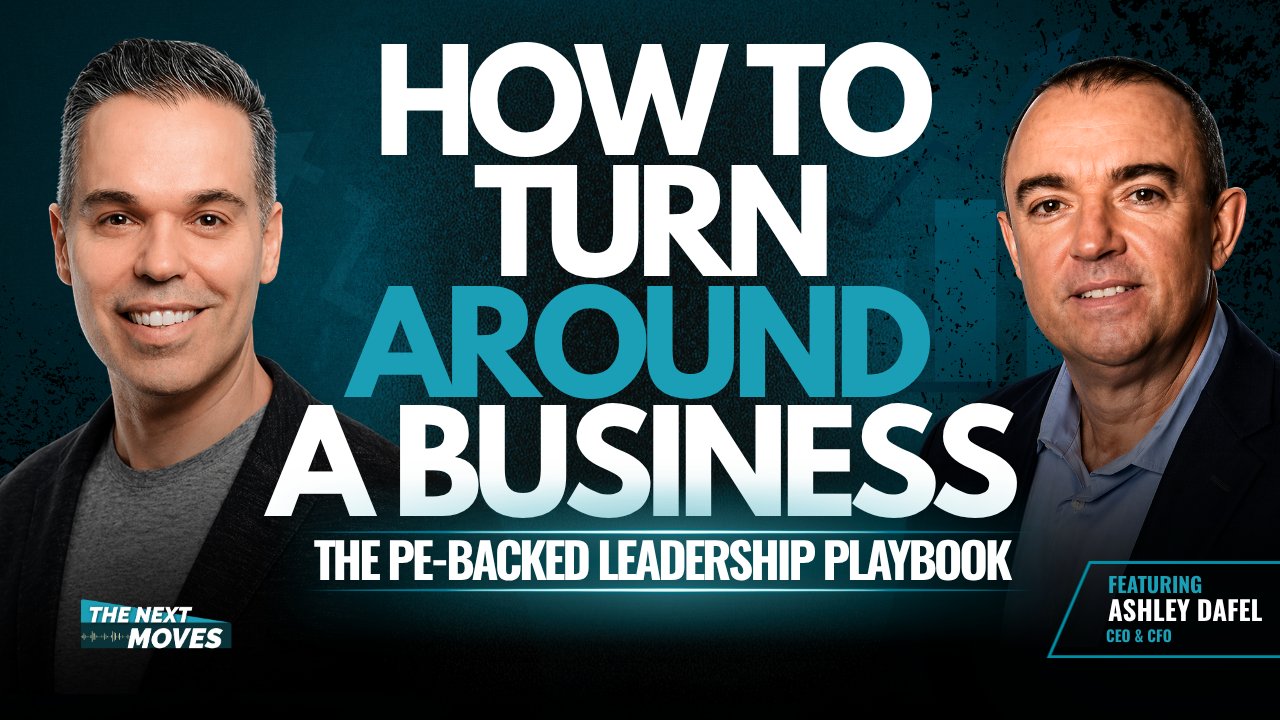
Ashley Dafel has been the person PE firms call when a portfolio company is in trouble — sometimes before they fully understand how much trouble. As a CFO-turned-CEO across multiple PE-backed organizations, he’s refinanced failing companies, fired half a customer base, shut down manufacturing facilities, and taken EBITDA up tenfold. None of it started with the numbers. It started with the questions he asked before he ever accepted the role.
Most finance leaders stepping into a PE-backed role focus on the financials first. Ashley Dafel would tell you that’s already too late.
Ashley has held CFO and CEO roles across multiple PE-backed organizations — including turnarounds where payroll couldn’t be made in his first two weeks. Over a career that’s spanned private companies generating hundreds of millions in revenue to multi-billion dollar enterprises, he’s developed a clear-eyed framework for how these engagements succeed or fail. It almost never comes down to technical skill. It comes down to what you understand before you walk in the door.
On this episode of The Next Moves, Joe and Ashley go deep on the real mechanics of PE-backed leadership: how to evaluate a mandate before you accept it, what to do when the team can’t deliver, how to fire your worst customers, and what it actually takes for a CFO to make the leap to CEO.
The PE firm’s position in the investment cycle tells you everything. Are they a short-term hold or long-term? Where are they in the fund? If they’re replacing management in year six of a seven-year hold, something is wrong — and you need to understand what before you join.
Understand the mandate with precision. Do they want a technical specialist, a business partner, or the eyes and ears of the PE firm? If what they need doesn’t match what you do, stop there. Ashley’s frame: he was never a CFO. He was always a Chief Business Officer.
Customer profitability analysis is the first move. Not systems. Not team restructuring. Not strategy decks. Pull contribution margin at the customer level and see who’s actually making you money. Ashley found that their largest-revenue customers had the lowest — often negative — margins. Half were eventually let go.
Firing bad revenue is harder than it sounds — and more important than it looks. Letting go of customers who are destroying margin feels like shrinking. It’s actually how you create the conditions to grow well. Top line went down. EBITDA went up tenfold.
Systems are never your constraint. Stop blaming them. In a turnaround, PE is not going to fund a new ERP. Get a proxy. Work with what’s there. The people who wait for better data don’t get the turnaround done.
Alignment between ownership, board, and leadership isn’t a nice-to-have. It’s the variable that determines execution speed. Without it, even a capable leader retreats — decisions slow down, risk tolerance collapses, and the whole engagement stalls. You’ll feel the misalignment before it’s visible. Pay attention.
The CFO-to-CEO move requires honest self-assessment first. Not confidence — self-awareness. Know your gaps, name them out loud, and go close them. The leaders who make the transition successfully are the ones who can do strategy on themselves before they do it on a company.
Vulnerability is a leadership tool, not a liability. Ashley shared what he didn’t know with entire teams, across 13 facilities, in three languages. The response was connection and commitment. People don’t need a leader who knows everything. They need one who’s honest about what they’re learning.
The playbook Ashley describes isn’t theoretical. It’s what he did — repeatedly, in organizations that were running out of road. The details shift by situation. The principles don’t.
Listen to the full episode and explore more conversations with operators, CFOs, and senior finance leaders on The Next Moves.
00:00 Ashley: The hardest thing to do in a business is fire a customer, to fire revenue. Get rid of revenue. But when it’s bad revenue, it’s not helpful. And if a customer sees no end, or you see no way of turning that bad revenue into good revenue, it’s destroying value to the company. What we found is the customers that tend to have the largest revenue had the lowest margins, if not negative margins. And what had happened is over time, previously the customer would say “we’re going to be generating all this business for you and we want a reduction in price” — and because people didn’t understand the implication of that, now you’re actually producing goods for this customer below the costs involved, generating negative performance for the business.
01:00 Joe: Hey everyone, welcome to the Next Moves. My guest today is Ashley Dafel and he’s an individual that I’ve known for the better part of almost 20 years. I love these conversations that I have with Ashley and I’ve always thought I should spend time recording them so I could share them, because the way he thinks about things has really affected the way I designed Clarity, built the organization, and the advice I give to clients. What I want you to see within this episode is really a playbook on how senior finance leaders can assess, accept, and execute a PE-backed role, including turnarounds — looking at it from starting with people. We’re going to talk about why they fail or succeed before you even hit the spreadsheets. This ties to your team capabilities, the mandate you’re given, and your capital partner at the table. Join me in welcoming Ashley.
01:51 Ashley: Thank you, Joe.
01:57 Joe: Ashley, you’ve always told me that the mandate matters — it’s the foundation for everything that follows. Before you even look at the organization, the numbers, the details — what conditions had to be true for you to even consider the role?
02:13 Ashley: First for me was looking at the private equity firm’s operating mandate — are they more of a short-term hold, 3 to 5 years, or a longer-term hold, 10 to 15 years? That tells you a lot about their mindset and how they want to add value. My preference was to steer away from the short-term holds because that was always mainly around just driving valuation as fast as possible, not always having the same focus on the real intended purpose of the portfolio company. Coupled with that — where is the PE firm in the investment cycle within that portfolio company? If they like to hold for, let’s say, seven years and they’re in year six and they’re replacing the management team, that alerts you that something’s going on. Dig in and understand why the PE firm is at this stage of the investment cycle making significant changes.
The second piece is around the operating mandate coming into the organization. Is it just to fix financials? Is it to be a business partner? Is it to be the eyes and ears of the PE firm? For me it was always about being a business partner — so if the PE firm was looking primarily for a financial accountant with depth in IFRS, that wasn’t me. Understand very clearly what the PE firm wants with this new CFO. My preference is not to call it a CFO but rather a chief business officer.
The third element is governance. Does the portfolio company have an independent board? Regular board meetings? An independent annual audit? Who chairs the board? How many PE people sit on it? What’s the experience of the independent board members — are they going to bring quality thinking and challenge the CEO and CFO on how they’re solving the organization’s struggles? If those governance mechanisms are not in place and not clear, that was a cautionary sign for me.
05:26 Joe: We’ve talked and you’ve found yourself in places where you’re even trying to make payroll when you take over. Were you on a short leash at that point, or was there explicit authority and freedom to change things?
05:46 Ashley: That particular situation was very late in the investment time horizon with the PE firm. They were trying to figure out what to do with this company. I was jettisoned in and, as you said, within my first two weeks we couldn’t make payroll. They had to do rapid refinancing.
06:05 Joe: Did you know that when you joined or was that new information?
06:08 Ashley: No. And that’s the other thing — half the time I don’t think PE quite understands the depth of those issues and challenges. So in that particular organization when I joined, there was a pretty broad mandate given to me. It was implied — you’re the last resort before we do a shutdown or push this thing into CCAA.
06:43 Ashley: And I said, “What does that really mean?” And they said, “You can do whatever you want. Just make sure you involve us. Keep us fully informed. We’ve got to this stage in the investment time horizon and we had the wool pulled over our eyes. Get in there, tell us what’s going on, fix it and clean it up.” I then said, “What does that mean from a finance team perspective?” And they said, “Just do what you have to do.” I said, “Does that mean I can spend money to save money?” They said, “Absolutely — just tell us what you need to turn this thing around.” So within 6 weeks — I was there for 2 weeks when we ran out of cash — we had refinanced all the debt. Then it was a focus on cash flow and rebuilding the team. I partnered very closely with PE. I didn’t hold anything back. We jointly developed a pathway to turn the company around.
07:50 Joe: I want to give a timeline here — you step in, you start uncovering what it looks like, you’re communicating back, this is over a matter of weeks. You have a finance team and a broader leadership team. Are you then constrained in your ability to execute the next stage of the plan by the capabilities of the individuals internally?
08:22 Ashley: Yes. In finance, the first thing — having run out of cash — was to get a cash flow forecast sorted out. When I started assessing the team pretty quickly, it was basically just a bookkeeping team. AP, a bit of tax, payroll. That was pretty much it. When I asked for a cash flow forecast after week one, I got a blank stare. So I knew pretty quickly. My first order of business was to get the cash flow forecasted and addressed. There were one or two shining stars and I pulled them aside and said, “This is all we’re going to focus on for the next two weeks — we’re going to put ourselves in the room and fix cash flow.” But in the back of my mind I was always running: I’ve got a team that can’t perform. I needed to prove to PE that I had this deeper challenge on the team. I needed to sort out the cash. I had the banking syndicate on my back saying “you made certain forecasts and promises, we want to see that delivered.” You’re trying to solve multiple things all at the same time. Once I was 80% happy with the cash flow forecasting variance, it became very apparent that I needed a complete change of the finance team.
10:18 Joe: If you look at the customer lens — you talk a lot about understanding the customer, orienting the organization to serve the customer — what were the material changes that this analysis drove? You’ve been in private organizations in the hundreds of millions of dollars and multi-billion dollar companies. What are one, two, three decisions that happened very quickly and changed the company?
11:05 Ashley: One of the things I asked for pretty quickly, once we got cash stabilized and once I started putting a strong finance leadership team in place — what I quickly needed to figure out was customer profitability. How were we performing from a contribution margin at a customer level? It didn’t exist. When I brought on a strategic planning analyst — I call it strategic planning analysis, different from FP&A, because I wanted that higher level of thinking — the first thing I said was we’ve got to solve customer profitability. We spent a lot of time figuring out profitability at the customer level and found fascinating results. The customers that tended to have the largest revenue had the lowest margins, if not negative margins. What had happened over time is customers would say “we’re going to generate all this business for you, we want a price reduction” — and because people didn’t understand the implication of that, you’re now actually producing goods below the costs involved, generating negative performance for the business.
12:41 Ashley: So we made some hard decisions. We went and revisited all those customers and offered alternatives. Number one — a significant price increase to meet the new margin profile we had defined. Or if the customer couldn’t handle it, a conversation around parting ways. It was about 50/50.
13:52 Joe: So 50% of the unprofitable customers you let go — and were half your customers unprofitable? So you’re really talking 25% of the total?
13:59 Ashley: Correct. 25% we let go. And at the same time, we said we can’t keep bringing these customers in — so we worked with the marketing and sales team to define the profile of customer we wanted from a margin perspective. We found certain segments were just not great customers. The automotive sector, for example — margins are horribly thin and there are significant penalties if you don’t perform. Why would we want to be in that business? Let’s go where there are higher margins, a stickier customer base, and it’s very difficult for customers to exit the relationship — for example, medical products. We redefined the verticals and segments we would play in, and within those segments, what margin profile we were looking for. That changed the thinking of the organization significantly — vectoring around margin profile as opposed to revenue profile. What fell out of that: we had 13 manufacturing facilities across the world, we now had excess capacity. So we said we need to consolidate operations into fewer sites. We shut down three facilities. We reduced overhead, raised the quality of the revenue, raised the quality of the customer base, and had a significant uptick on overall performance. We changed the whole profile of the company in terms of who we target and the kind of profile we want from those customers.
16:13 Joe: So you revector on customers, redefine based on revenue quality, and once you do that there’s a cascade of changes — including restructuring operations, dropping certain sites. What time horizon are we talking about for all of this?
16:41 Ashley: One year.
16:41 Joe: Oh my god. Within a year?
16:41 Ashley: And the reason why comes back to your original question — where are you in the time horizon of the investment cycle? They were right up against their normal exit time. It was get this thing fixed ASAP, we want out. We were one of the last two portfolio companies left in that particular fund. They wanted to close the fund up and wrap it up. Within a year, I completely changed the team, refinanced twice, actually managed to do a dividend — by refactoring the whole focus, doing the customer profiling, shutting down facilities. Year two and three was just tweaking and working off those fundamentals. I can’t mention numbers, but we took the EBITDA 10-fold.
18:02 Joe: My god. And topline revenue was similar or smaller?
18:09 Ashley: Actually topline revenue was less.
18:12 Joe: Because you got rid of the non-performing customers.
18:19 Ashley: We got rid of customers and shut down some facilities — got rid of some overhead. Better quality revenue. Lower revenue but much better EBITDA financial performance.
18:33 Joe: I think it’s important to note that you ended up as CEO of two organizations. That’s an interesting transition — did you see it as a different role?
18:45 Ashley: I did not. My mindset going into both organizations where I landed as CEO was one of chief business officer, not CFO. I’m not a CPA by background. And one of the things — when I was recruited into both those organizations and I spent time with the PE firm, I was very open and honest. I said, “If you want a technical specialist on tax and IFRS, I am not the person — let’s just not go there.” And in both instances they said, “We do not want that. You can go hire for that. We want a business partner. We want somebody who understands business, who can partner with the CEO, and who can partner with us.” My mindset was always I’m the chief business officer and I’m there to take financial data, analyze it, and use it to transform the business. Whether it be getting the finances done or solving the bigger business issue — wrong customer profile, wrong leadership teams. I did assessments on GMs. It was always just my mindset: I’m a chief business officer, not a chief financial officer.
20:21 Joe: You’ve talked about the owner, the PE firm, the board, and the leadership team. Getting everyone aligned early is a win and waiting too long is painful. How does getting alignment activate you, and a lack of alignment neutralize you? Where do you see the breakdown most often?
20:57 Ashley: If there is no alignment and no willingness from ownership, leadership, or governance to get that alignment, you beat your head against the wall. And that was key for me — going back to your original question of what must be in place to join. There’s got to be that willingness. I encourage people looking at these roles — they’re tough — make sure there is going to be alignment or at least a willingness to get there across those three elements.
21:38 Joe: How do you tell if it’s real?
21:40 Ashley: You feel it. And you’ll sense it through things like the board agenda. What gets on the agenda? Do we set aside 20 to 50% of board meeting time to discuss strategy, alignment, the tension between exit valuation and the purpose of the company? The first thing I’d always ask for: give me the last four board agendas. I don’t need the detail — just the topics and the amount of time. I’d quickly do an analysis of how much time goes to discussing alignment-related issues. I’d look at balance scorecards — how much time is spent on non-financial elements? Employee engagement scores are down and it’s a key scorecard element — how much airtime does that get and why is it down?
The other way you’ll feel it is through the PE partner who’s in the business — watch their tone and the questions they’re asking. And if you’re dealing with more than one PE person, how much alignment is there within the PE firm for the outcome of the portfolio company? If different partners are giving you different directives, you can quickly pick up whether PE is aligned or not. And your leadership team will start sensing it too — they’ll actually voice it to you: “We don’t feel aligned here, something’s missing.”
24:07 Joe: So with that dissonance between ownership, board, and leadership — what does that affect if not resolved?
24:21 Ashley: Trust. You start asking yourself — am I trusted in this role? And that leads to other questions: am I capable? Why are they doing this? And what that impacts — as you said, Joe — it leads to decision paralysis and action paralysis. If I’m not trusted, if I don’t feel a deep sense of trust and capability, then what am I doing here? The safest thing to do is retreat, slow things down, double-check everything — the risk tolerance goes much further down. It slows the whole execution speed of the organization. If I didn’t have the mandate I had — for example, “Ashley, if you think it’s right to shut down facilities, shut them down, just communicate with us, come back and say this is what I think we need to do, okay we’re aligned, go” — that’s huge.
25:45 Joe: So leaning into those hard conversations. If I look at the change in your career — we went to school together, did our MBAs — where you were then and where you are now is wildly different. I sit down with many finance leaders and they’re being asked to take on the COO job. CFO to COO is common. CFO straight to CEO is less common. For people thinking “can I do this” — what is that critical ingredient that lets them make that shift?
26:40 Ashley: Self-awareness, number one. Where am I? What are my strengths, what are my weaknesses? Be really honest with yourself. If I think about a COO or CEO role, what does that role need and how do I bridge the gap? And with self-awareness comes self-confidence — I can do this, I’ve got the smarts, I’ve got the ability — without fooling yourself. So it’s the awareness and the confidence together. I’d strongly encourage anyone in a CFO role who’s been highly technical and wants to move into a broader area — go broaden the skill set. Do an MBA. Choose one that’s going to help you focus on your weaknesses so you can bridge them. Do the self-critical analysis, figure out what your gaps are to get where you want to go, and go close them. And it’s difficult for me to say one particular thing because we’re all at different stages and have different skill sets. Do an honest self-assessment and close the gaps. Work on yourself first. Do strategy on yourself. If you can’t do strategy on yourself first, you won’t be able to do strategy in a company.
28:41 Ashley: I think you need to be vulnerable if you’re going to move into those roles. Understand your vulnerability and it’s okay to share it. Sometimes we think vulnerability can’t be shared because I need to be this macho leader. But it’s okay to go into a role and say “guys, I don’t quite understand this market here.” I did that in one organization — I went to the chief marketing officer and said, “I don’t quite understand this market, but I will learn it. Teach it to me. Help me understand.” When you share the vulnerability, it creates a magical connection moment — you’re not the be-all and end-all. No CEO or C-suite officer knows it all. Nobody like that exists. You need the team. When you show vulnerability, it signals trust immediately.
29:37 Joe: I think that one really needs to be punched home. Especially going to someone responsible for driving awareness, brand, conversions — and saying “I don’t fully understand this market, can you teach me?” I’ve had to do that in my own life and it’s incredible. Though I guess there’s a degree of trust that you have in that individual that they’re not going to back-channel it to the partners who could make decisions about you.
30:08 Ashley: Great point. I did it in meetings with everybody.
30:24 Joe: So we could all be vulnerable together.
30:27 Ashley: And then I’d say — okay, we’re not all great, we’re good, but not all great. Where do we all need help? We used to open meetings with “where do you need help from somebody else, how do we help one another here?” We created the vulnerable environment and supported one another. I did it to avoid the back-channeling — right in the middle of it, in the thick of it, we’re solving this as a team.
30:55 Joe: Excellent. I’ve got some rapid fires. A non-negotiable before accepting a turnaround role?
31:04 Ashley: Understanding the PE’s objectives. Be very aligned on them. If you’re in a turnaround role, ask: how long have I got? Are we talking one year, two years, three years, five years? What’s my mandate? And do you contract for that to manage your downside — if it’s different, am I taken care of through the options?
31:33 Joe: Absolutely.
31:33 Ashley: And you better do that through your options. If I’m going to drive value, what am I going to get? There is an imbalance of power in that relationship. You may not get everything you want, but make sure that if there is a stellar exit, you’re going to get your fair share of it.
31:55 Joe: What is a capability you hire before you decide to focus on systems?
32:02 Ashley: Strategic business planning partner. Taking FP&A up a whole bunch of levels. Unless you can get access to good data about the business — and assuming you’re on a short runway — you’re going to struggle. You need that data as soon as possible. In that particular example, I needed to sort out cash flow first and I got there working with a small committed team — 80% of the way there. But if I didn’t have the strategic planning partner who could help me with customer contribution margin, excess capacity, and capital utilization, I wouldn’t have driven the speed I needed to turn the organization around.
32:52 Joe: True or false: systems are never at the state you need them when you join a company.
32:59 Ashley: Oh, true. They’re never just there. And you’ve got to stop blaming systems. You can’t say “the system, the data” — I don’t care, figure it out, get me a proxy, do something else. Particularly in a turnaround situation, PE is not going to put new systems in place. It’s too risky. Take what you’ve got and figure it out.
33:22 Joe: A belief about leadership that you’ve changed your mind on.
33:30 Ashley: Vulnerability. Over the years I’ve learned to be more vulnerable. There was a turning point about 10 years ago — I read some work by Brené Brown on leadership, all about vulnerability, and I thought I’ve got to do this. When I took up my first CEO role, I stood in front of the entire team — we were in 13 facilities, three different languages, and I did a broadcast to the whole team. I said I’m going to try it. I was vulnerable. I told them what I did not know about the business. I told them how I was going to be there to support them and somehow close the gap. That sharing of genuine vulnerability — and it has to be genuine, people pick up on disingenuousness — brought instant connection in such a short period of time. I can’t tell you how many leaders reached out and said “we’re grateful you’re here, we’re going to help you, we’ll support you.” Vulnerability is critical.
34:34 Joe: Well said, Ashley. Thank you for doing this.
34:38 Ashley: Thank you, Joe. I enjoyed the time.
Here is your link to the 2026 AI Listening Tour Findings:
2026 AI Listening Tour (PDF) ↗Are you hiring? Get in touch with us to talk about better hiring.
Get in touch →
Here is your link to the 2026 Salary Guide:
2026 Salary Guide (PDF) ↗Are you hiring? Get in touch with us to talk about better hiring.
Get in touch →
Here is your link to How Finance Fuels Growth:
How Finance Fuels Growth (PDF) ↗Are you hiring? Get in touch with us to talk about better hiring.
Get in touch →
Here is your link to the Finance Team Org Charts:
Finance Team Org Charts (PDF) ↗Are you hiring? Get in touch with us to talk about better hiring.
Get in touch →