
Spotify

Apple Podcasts

Amazon Music
The through-line of the whole conversation is that recruitment done well is a design problem, not a sales problem. Build the structure, measure the right things, and the outcomes compound — for clients, for candidates, and for the recruiters doing the work.
If you’re a recruiter thinking about your next move, or a hiring leader who wants to see how this model works on a live search, this is the conversation to start with. When you’re ready to talk, Joe and the Clarity team are who to call.
Clarity is built as a company, not a practice. That means investment in research, technology, and a real leadership team, plus feedback loops that measure how effective each engagement was for both the client and the candidate. In practice, it shows up as data-backed advice: Clarity will tell a client their mandate is too broad, or that they need to hire more senior, and support the recommendation with what the discovery process uncovered. The goal is to improve the client’s judgment on the hire, not just fill the seat.
Yes. If something surfaces during a search that’s misaligned with what a candidate wants for themselves long term, Clarity will tell them so — even late in the process. The reasoning is that a placement made against a candidate’s real interests carries a high risk of failing, which serves no one. It’s uncommon enough that candidates often find it surprising, and it’s a direct expression of how the firm thinks about long-term relationships over single transactions.
Joe’s advice splits into an observation and a question. The observation: the organization should have a consistent feel, with values that operate as a real filter for how work gets done, not slogans on a wall. The question: which firm will actually build your capabilities — through training, technology, and managers who are hired and measured on their team’s success, not managing off the side of a desk. If a firm can’t be specific about how it will make you better, that’s a signal. The same standard Clarity applies to candidates, it applies to its own hires.
00:00 Joe: I think if we look at recruitment in the industry structurally, people — they’re not building companies. They’re really building these practices which are made up of an individual sitting on top of other people collecting rents on a desk. And if you look at what companies look like that are getting built, they have investments that they make and they make bets on things. And I figured out very early that organizations in recruitment were not making investments. They weren’t making bets. They weren’t building structures. They weren’t building real research, real software development functions in house. They weren’t looking at how to manage and develop people. And I started building an organization and it was expensive. It was hard to do. But it’s the kind of thing that compounded over time. So at a very early stage there was some design level thinking that went into Clarity and I think that’s something that isn’t done by people that choose to enter the industry.
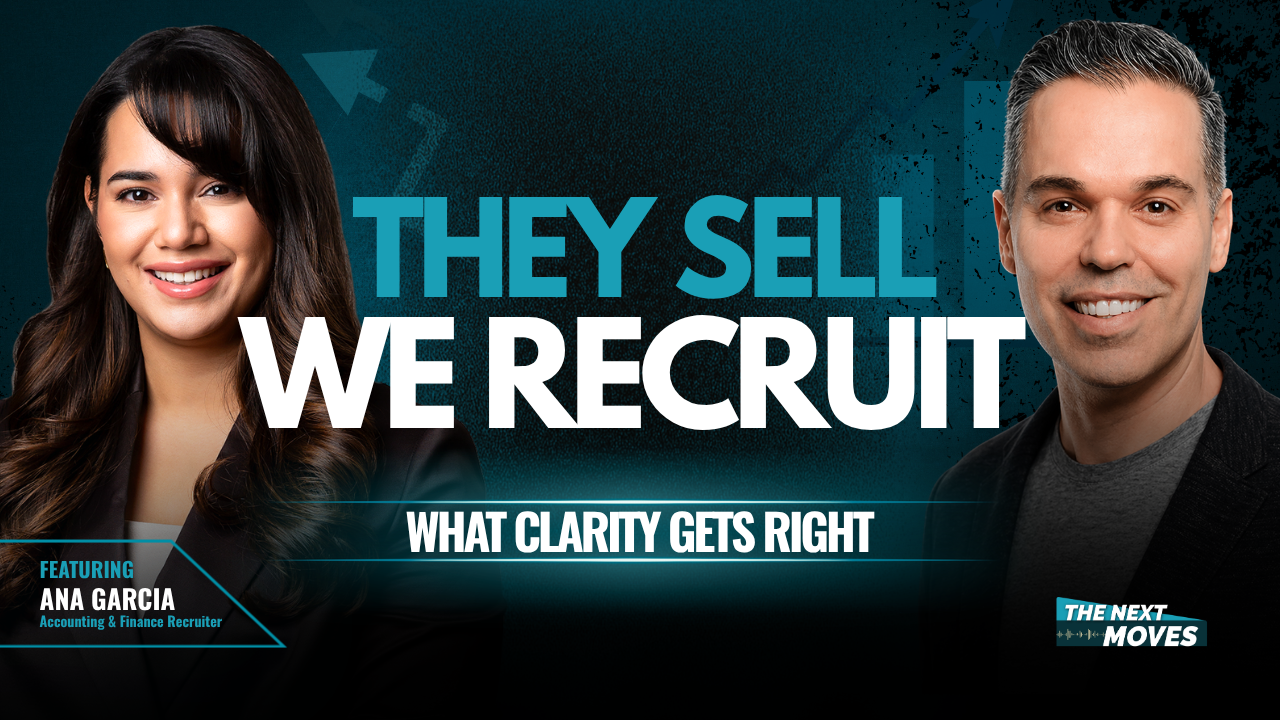
01:06 Ana: Welcome to the Next Moves. I’m Ana Garcia and if you’re a listener then my voice is a new one to you. Today we’re flipping the format. I’m sitting across from the person who typically asks the questions around here — Joe Diabaldo, the founder and CEO of Clarity Recruitment. Joe started Clarity because he thought recruitment could be done different and better for the people hiring, for the people being placed, and even the recruiters themselves. 15 years later he’s still running it, still placing CFOs and finance leaders across the Canadian mid-market. And based on the conversations we have on a weekly basis, he still holds the belief that the recruitment industry is still getting it wrong. So today I want to hear from him directly — what actually makes Clarity different, what it looks like from the inside, and who is this firm built for? Joe, welcome to the other side of the table.
01:51 Joe: Thank you Ana. This is different.
01:56 Ana: I want to start off with a question to really understand your perspective on what started Clarity. So in your view — what is recruitment still getting wrong and what has Clarity figured out that the rest of the industry has not?
02:08 Joe: I think if we look at recruitment in the industry structurally, people — they’re not building companies. They’re really building these practices which are made up of an individual sitting on top of other people collecting rents on a desk. And if you look at what companies look like that are getting built, they have investments that they make and they make bets on things. And I figured out very early that organizations in recruitment were not making investments. They weren’t making bets. They weren’t building structures. They weren’t building real research, real software development functions in house. They weren’t looking at how to manage and develop people. And I started building an organization. And it was expensive. It was hard to do. But it’s the kind of thing that compounded over time. So at a very early stage there was some design level thinking that went into Clarity and I think that’s something that isn’t done by people that choose to enter the industry. It’s typically people that are practitioners and they’re like “well I’ll just get a bunch of people working underneath me.” So I think that’s the starting point for it.
The second thing is when you build these structures, you start realizing that you can provide a better outcome because you’re giving feedback loops to people. You’re giving people a measurement of how they performed — not in things like “hey look what I built” but more like how effective was that engagement for the candidate, for the client, what would they have changed? And these data collection activities are fed back to our teams and then we iterate what we do. So I’m looking at this in a very different way, I think. And I’ve found people to work with that think the same way — which is iteration and compounding of the right activities over time because we’re designed the right way.
04:01 Ana: And I’m curious — when you say that feedback loop, what’s an example of maybe an engagement we’ve had in the last year where we took away feedback but we also gave the client feedback and what was the impact on the search and the person they added to their team?
04:13 Joe: I mean since it’s part of our process — we look at it through the lens of doing an effective discovery using our technology to deconstruct the role. And bigger than the role — people think responsibilities and requirements, and then what ends up happening is they forget the context of the organization. Which is — what is the environment under which someone needs to operate in this job? Why does it exist? Is the company growing? Is it declining? Do you have turnover in this team? If there’s a team of five and two people have left, where’s that institutional knowledge gone? How does it change the profile that you hire? And we take all of this and we consolidate it and we feed it back to our clients. And I like to think of it as the rationality of what they’re asking for. And we show them really the tension, the alignment, the misalignment in the role. And we say “you actually can’t have this — the role is too broad” or “you’re growing too quickly to hire someone that is a step-up candidate. You have to go for someone who is a performer that’s already doing it.” And when we give them this back and we show them the information that supports that opinion, they then change the requirement. They change their opinion on what they’re asking for. And they always thank us. I remember I was working with one organization — a private equity-owned asset in the transportation sector — and they asked me “why doesn’t everyone do this? Like, this feels like we’re going to be able to go faster and get it done.” And I’m like “I don’t know. It just takes time. It takes thought. And people respond to information, not just opinions.” And too often I think our clients are hearing from other recruiters “oh trust us, do this.” We say “okay, here’s what we’ve uncovered, here’s what we believe to be true, here’s the supporting information.”
The other thing on the candidate side — we’ve actually told people not to take a job. Like we’ve said “don’t do this.” And the feedback on that is that they find it quite strange and they often laugh and they’re like “this is unique” — because we’ll be well down the path. It’ll be through the second interview for a CFO search and something comes out that, to your point earlier, is misaligned with what they want for themselves long term. And we’re like “this doesn’t feel like the right move” and we’d rather go back. Because if we keep going forward, even if the person takes the job, there’s a likelihood of a failed placement. So it’s both sides — we actually look at the client and what they’re asking for and is it rational? And then we’re speaking to the candidate and we’ll tell them “don’t do this.” So I think those are the two things that I’ve seen most recently and it’s across many searches.
06:44 Ana: What you said about the data — especially that’s a habit that I think in the permanent search team, and I think the other divisions do it too, that we just get in the habit of tracking that data from the get-go so that if there is a pivot you have something to back it up and give an alternative to the client. So if you think of that in the permanent search team, you’re having a longer process and an ongoing dialogue. When you’re looking at the interim leadership, the special project team — clients don’t hire this very often. So they’re thinking “I need to get someone who is at this level to come in and do this work.” And we’re like “actually, what you need to do is probably resource a little bit more senior because this activity that you’re looking to solve for — you’re behind schedule on it, there’s a ton of pressure on the team, you need someone who comes in and you don’t have time to mentor them.”
07:33 Joe: So we look at it from leveling — what level and what competency does someone have? And inside of that team we have to coach the client to often go a little bit more senior. The work gets done faster. So I think it’s like a trade-off — it ends up costing the same but the work is delivered effectively with far less stress on the person hiring and far less stress downloaded to the team. So that’s another thing where we try to coach in the moment. And we build that capability inside our organization — it isn’t just coming from one person. It’s like you would know that you step into these meetings and as a recruiter you’re advising the client. It’s not just what you would call the engagement manager or the salesperson. It’s you stepping in and saying “here’s what we recommend.”
08:14 Ana: And I’m curious — over the 15 years that you’ve been doing this, has anything changed in your perspective or has anything evolved?
08:21 Joe: Some of the things that we wanted to do earlier with strategy and technology — the technology wasn’t there and the amount of capital it would have taken to solve those problems was too much for a small organization. We tried anyways. We got a lot of learning out of it. So I would say the maturation of the technology for sure. The second thing that’s changed for me is having this awesome leadership team that I get to work with. I don’t think that a lot of organizations our size have a team like this that has very clearly defined responsibilities that go beyond just “hey, hit targets” — there’s a scorecard for each of us and there are feedback loops for each of us. So I think the investment in the leadership team was pivotal. Not having had that in my previous organization and arriving at it over time — like “this is what we need to really scale and drive impact effectively.”
09:16 Ana: What do you think is the biggest value they bring day-to-day and over the long term to Clarity?
09:24 Joe: Well, there’s a vision we’re executing towards and there are moving pieces. And it’s a large part of my job to work to create that vision with the team — and that’s having organizational clarity. What is the goal we’re working towards, what do we want to accomplish, how does that filter down to each of these functions, how do we organize ourselves, how do we create the reinforcing mechanisms? And you’ll see this now where we do our business reviews on a monthly basis to say “how are we performing, what was the goal, how are we doing?” And then looking at an organization that is operating remotely and being able to say “how do you reinforce culture?” So it isn’t just “hey, what do they do in these meetings?” It’s like — what’s the vision, what are we trying to accomplish in the next three years, how does that break down to something quarterly, something monthly, and how do we create a winning culture? So I think what they do when they show up to the meetings is they’re trying to think into the distant future and then drive the outcomes that we need and develop the team in the right direction.
The other thing that we all have a responsibility to do is to step away. If you’re there all the time there isn’t a “let’s see how people do when we’re out of the picture.” So it isn’t always about being in the meetings — it’s about sometimes letting the team run and figure it out and then being an escalation point. I think that escalation point is critical. Because if you use the whole tree analogy — I can’t remember who gave this to me but I like to think about it — you want your team when they first join the organization learning how to make the decisions at the leaf level and the small branches. Then you want to move them back to the bigger branches. And then over time people can make decisions at the trunk. But the root is always taken care of both by me and by the leadership team. So you’re evolving people’s ability to make these decisions by giving them a chance to fail. And the rule is we’re all going to screw everything up — we’re just going to solve it afterwards. We’re imperfect. So those moments where they can coach and develop people by either stepping away and letting them fail or celebrating their wins — those are material differences at the company right now.
11:46 Ana: Let’s talk a bit more about what we do differently and what people get when Clarity gets picked as the recruitment firm. So when a hiring manager picks Clarity over a bigger, better known firm — what are they actually choosing?
11:58 Joe: Well, we’re a professional services firm. So initially what they’re choosing is they’re choosing an individual and a group of individuals to work with. And that’s backed by a methodology and a framework in how we do the work that we do. And that’s typically experienced very early in the process. So if they’re meeting with us, we’re really in our discovery sessions with them — we’re having these conversations and we’re saying “okay, walk us through what’s happening in the organization” and we’re driving through this discovery. And the questions we’re asking are things they haven’t been asked before. And I think that in a way creates a connection — because if people are thinking differently about something they care deeply about because of an interaction they had with us, they’re like “okay, I can learn something here.” And the whole goal is to improve judgment and decision-making in hiring. So I think they look at that and they say “okay, this organization is thinking about things that I haven’t heard before and they’re going to make me better in this hire.” So it must be a confidence in the likelihood of success.
And the second thing is — we want to be accountable. Hold us accountable. Let’s drive the right outcome. If on the off chance we put someone in there and this doesn’t work out — which we have a very low defect rate — we will engage intensely to solve the problem. And that’s fairly unique relative to what you’ve heard from the industry. In the event that a placement doesn’t work out, the exact same methodology is applied but with a postmortem as a feedback loop into the process — like “what did we not know that we know now?” or “what did we know but we chose to ignore in this hiring process?” And the clients that experience that — it creates a real connection and stickiness. So what I’m seeing is real retention within our clients and growth within them — like we’re being asked to do far more than what we were asked to do before, from different functions and different roles, because of that. They want more of that within the organization.
14:00 Ana: One of the other things that you always talk about whenever we have our quarterly meetings or debriefs is the power of the network that we have and the relationships that we build — and how you might talk to someone now but you might keep in touch and it’s a relationship you hold for years and years. So if we’re talking about the relationship side of the business, especially with the network and the relationships that we build with our candidates — what do you think is different when we already have these relationships and we’re coming in with people that we know prior to the search even starting? How does that search look now that we know people before formally starting it?
14:34 Joe: It’s a good question. So I’m going to take this in a slightly different direction, which is — most firms are going to show up and say “we know people and we have relationships.” And that ages quickly, which is “we’ve met some people recently that we’re going to put in front of you” as opposed to — because we’ve been doing this for a long time — a key part of our strategy is to track the evolution of an individual’s career over the entire life cycle for the past 15 years and encode that with information and data in a much more organized way than what other people do. We’re not just saying “hey we know people and it’s really the people we’ve met in the past two months.” What we’re saying is “we understand the evolution of your organization and because we’ve been looking at the evolution of individuals’ careers over time and we keep in touch with them, we can actually start looking in a more scientific way at who’s ready for this role.” And it would be who’s ready to step into the role or who’s ready to perform this role because they’re fully baked and ready to go.
Now the second thing to think about — and it’s an extension of this — is we don’t know everyone yet, but we do a market map for each of our roles for individuals that we haven’t met. So that’s the next thing — who do we need to build relationships with now? And you’re a bit behind the eight ball with those and you’re trying to move quickly to build a relationship. So therefore the next thing to think about is we want to be doing this as early as possible with people and we know that there’s a marginal cost to having a conversation and understanding someone. So part of the mandate you have Ana is to go out and meet these people proactively and in many ways classify in your mind and in our tools and technology what they’re looking for and why they’re relevant. We’re comfortable doing that investment. We’re comfortable encoding it in a way that other people don’t. So that when the client comes to us — no one ever comes to us and says “I have six months to make this hire.” They’re like “I’ve tried everything and I’m struggling to get the right person, I need help.” So our ability to respond quickly with information and not opinion is a result of this proactive set of activities that unfolded over the past 15 years and a result of what you’re tasked with doing every single day.
So when I speak to candidates constantly — or I try to — it’s like invest the time to get to know not just us but some other recruiters and then classify them in your mind on who has a better understanding of you and then return their phone calls. We also set the expectation with the candidate that this is how the relationship works. And that means that we get calls back whereas other recruiters get ignored. So what clients likely experience is because we’ve done this earlier with people — they should feel something different when they talk to us. We’re coming back to them with relevant things. They are then responding to us quickly and engaging, which lets us solve the client’s problem more quickly. Better people, better contextual match and faster. And then that should result in a lower defect rate. And defect meaning the person didn’t work out. And because we measure all these things we are constantly tuning it.
18:01 Ana: Yeah. And it becomes evident in a short period of time because I’m coming up on almost two years with Clarity in September. But even during — we’re talking two years instead of 10 where you’re saying people have changed a multitude of times — you still see the coming back to someone that you connected with when I started. And maybe we didn’t have something but you still connect with them within that short time period even for referrals — not even for themselves all the time.
18:24 Joe: And there’s a gravity to what you’re doing when you’re having these conversations. The concept of gravity is like you’re creating this network. You’re a nexus point for people as they’re making decisions in their career that pulls great people to us three different ways — employees, candidates, and clients. The magic happens when someone calls you to say “hey, I need some advice on something.” And it’s not that they’re calling you about one of the jobs you’ve posted — they need advice on “should I make this move? Does it make sense? Here’s what I’ve heard.” And you can have that discussion. So we do those proactively. We have those discussions constantly with people that are new to us. I think it’s in our DNA. It’s a bit addictive too. So you end up doing it regardless.
19:01 Ana: Let’s talk a bit about what Clarity looks like on the inside and what it’s like for recruiters working here, especially on the topic of ownership. So what do you think recruiters get to own here that they don’t get to own at another firm that they’d be working at?
19:17 Joe: Okay so I’m going to come at that sideways. You ready? Because I can never answer a question straight on. So when we look at what you would call other recruiting firms, what used to drive me nuts was they were actually sales organizations that paid their bills by recruiting. Sell, sell, sell, sell, sell, and then just try to monetize some people that you put into a process. We’re a recruiting firm that decided to look at — how do we help people hire more effectively? What tools, technologies, frameworks would you overlay on this? Now how do we organize ourselves internally? So if we’re meant to be the best-in-class recruiting firm, then we’re a recruiting firm. We should have an incredible go-to-market and sales function to take this world-class recruiting engine to market. And that’s a different frame of reference.
So the framing of the role of the recruiter internally is very different. To manifest that into something real, it turns into the recruiter having a much bigger role in the process. They are part of these intakes. They’re actually driving a lot of the data collection, a lot of the opinion generation. They’re teaching and informing the client. And they’re also intaking information from the engagement manager who probably knows more contextually than they do, and they’re building this into that opinion recommendation. And they are present in every meeting. They handle far more of the cycle than they would elsewhere and they are trusted here. So you’ll hear people in the organization on the engagement team — which is our sales team — talking about how well a recruitment team handled the client engagement. So they’re more present, and they’re more present because we’re a recruiting firm. We’re not a sales function that pays its bills by recruiting. So the role is elevated in itself. Then we also wrapped incentives around the organization that encourage this — how do we create incentives? Because if you show me incentives and you show me rewards, I’ll show you the outcome. How do we create those incentives in a way that drives this collaboration that is often recruiter-led? So we did that and I’m not going to get into those because that’s part of our secret sauce, but it’s like — design it differently, create the incentives and reward systems, and then monitor those and give the feedback loops in. So I see the recruiter role as critical and elevated relative to other organizations.
21:40 Ana: I’ve noticed the extent of partnership that we have with the way that we’ve set everything up — with a lead recruiter at least in search for the roles. There’s a lead recruiter and you’re working with the lead sales manager. But it is the sales manager leading the relationship with the client. That exposure that you’re referring to — it’s very clear that there’s a partnership and they become your sounding board and strategizing how you’re going to pitch a candidate, what you’re looking for. And when you start to get into the flow and start really thinking out loud and strategizing together — we actually had it recently in search where we were able to get two placements out of one shortlist.
22:23 Joe: And that’s happened twice. You’re right. Twice in the past month.
22:29 Ana: Twice in the past month. You’re right, it’s happened twice in the past month. And it’s been one of those cases where I was working with the sales manager and he had a lot of industry knowledge on SaaS and it was a SaaS company. So I relied a lot on him and we would go back and forth — here’s the candidate, he would give me feedback, and there was this back-and-forth loop where we just ended up presenting to the client really high-caliber candidates because he was a sounding board. And then with the second time that it happened, he had a long history with the client. So even though the client told us something up front in the intake, he went back to what his experience had been and what had worked in the past and what hadn’t. And again he gave a really good feedback loop where at first I said “that’s not what the client said” and he came back and said “we have a bit of flex because they give us that direction but historically what has worked is this.” So we had a really good understanding of the culture they were building beyond that initial intake we were in. So that partnership and the way that you’ve incentivized that — it works. And we’ve seen it happen with search a couple of times now this year.
23:38 Joe: So you’re driving at something super important on the culture side. There’s a level of trust that — you know, I had someone come up to us at our offsite this year who had worked at another firm. And it’s nice when you get together socially because we’re remote, so when we pull everyone together you get these real collisions and awesome interactions. And I’ll remember this forever because she actually said “I haven’t had someone who just trusted me.” And when I felt unsure and I said “hey, what if this goes wrong?” — I’m like “there’s a pretty good chance it’s going to, but there are very few things that someone can do that we can’t fix.” And the opinion that this individual had in different scenarios was insightful in a way that I hadn’t thought of it before when I had her working with me on client engagements. It was actionable — like I could do something with it. So there was insight but there was something actionable with it. I’m like “this person has spent a lot of time thinking through this.” And I guess for her, she hadn’t had someone say “I trust you and let’s take a run at this together, and if it goes sideways we’ll solve the problem afterwards, but this is our best guess.” There’s no “let’s point at someone and say you failed, you suck, these are all the things that I remember from last year that you did and you did it again.” Like it’s not productive.
25:00 Ana: Yeah. No, it’s true. We do have that culture. And it’s — how do you problem solve? And it’s apparent in every search. How do you not lay blame? How do you describe reality without laying blame? Like “this is what is happening, here’s where it’s being experienced, here’s what we’re seeing” — not “well you did this and you did that.” It’s more like a description of the reality. And this is getting a little broad, but it’s what helps people look at a problem without feeling like “oh, this person’s pointing at me as the issue here.” So that is something that we’ve really focused on in the culture because otherwise we don’t move quickly and it’s material — and I use that word a lot because it’s a significant difference that people underestimate the power of it.
25:49 Ana: What I want to highlight as well is the sort of roles and clients and jobs that we get to work with. So what would you highlight to anybody that’s interested in Clarity — the roles and clients that they get to work with?
26:02 Joe: We’re purpose-built. So we’re dealing with organizations that are going through massive change and that is typically rapid scaling or the other side — the delta — which can be decline, or a kind of reinvention, or they have to replatform themselves to do something new like launch a new offering. So we’re being pulled into these very complex discussions. And we were purpose-built because we have our permanent contingent team, the search team, which is doing that really kind of $70K to $150K level person on a contingent basis. We have a retained model which is your junior exec and exec business. And then we have our special project and interim leader group — because you might be trying to put in a leader and we can help you with that, then we can build the team below them with our search team. But none of this unfolds on the client’s schedule. Like people will opt out. They will lose people along the way. You’ll have gaps in the team that need to be plugged on an interim basis. You have special projects that need to be built.
So what we do is this holistic buildout of what is happening in an organization. And we can do predictive hiring — like “you’re going to experience tension here.” And for people coming into recruitment that’s a level of almost management consulting that they haven’t seen before. So yeah, we get to work on different roles, but those roles are rooted in the problems of this customer group we’re focused on. And they evolve — like you might need the analyst here, but what you’re needing very soon is to upgrade what you have as a controllership function to something bigger. And we’re sharing that information internally — you as the recruiter, the engagement managers across the different teams — to solve whatever the next step is for the client to help them go through this change. So at a base level, if you’re in a contingent team you’re really doing finance, operations, HR, technology — the stuff that enables the organization between the $70K and $150-160K range. If you’re in retained, you’re probably doing your director through to C-level in that space. And if you’re in the special project interim team, you’re dealing with these intense moments where clients need help — either a resignation, a leave, or a special project that’s been under-resourced. And it’s across those different functions.
28:24 Ana: Now that we’ve talked a bit about our process and who we get to work with, let’s talk about the sort of recruiters that do well in Clarity. So if you were to describe a recruiter who walks in and does great work here, what’s true about them?
28:36 Joe: People use the word curiosity often when they’re describing — I want to be specific on this. I look for rate of learning. Like how fast can someone learn? Because we’re giving them concepts that — if they’re coming from another recruiting firm — they haven’t had an opportunity to think conceptually. They’re told to follow a cookbook and a recipe and there’s no room for it. So you have to have curiosity, rate of learning. And when you see something that is different than expected, trying to understand it yourself first, and then very quickly if you’re stuck, going to a colleague. So we sometimes can solve things on our own, but if not we need to go to someone quickly and solve the problems so you can keep going as opposed to staying stuck and isolated. So those are three different things — rate of learning, curiosity, and then the ability to step forward and say “okay, I’m stuck a little bit, I need some collaboration here, I’m going to call someone, I’m going to describe my problem, and then we’re going to solve it, or if I don’t get a solve there I’ll go to someone else.” Because it doesn’t mean you get it on the first time.
Domain knowledge helps. If you’re potentially coming from recruitment somewhere you have an understanding of how this market might work. You’re coming from a finance, an operations, an HR — one of those functional backgrounds. And you have to love people. Like if you don’t like people, if you don’t like understanding people and thinking through what people are trying to achieve — I had a mentor in my life who said “in this business you have to love all people, even the ones that drive you crazy sometimes.” And I have some of my best relationships with people that drive me crazy a good 30% of the time, but I still love them. So I think that’s another thing that you have to have.
30:43 Ana: And for someone who’s listening who’s a few years into their recruiting career — whether they’re considering us or another firm — what are the questions they should be asking the firms that they’re talking to?
30:55 Joe: There are observations and there are questions. So the observation should be that the organization has a feel to it and that feel aligns with the kind of place that you want to work. And there’s a consistency through it and the values are not just thrown on a wall but are really an operating model — our values are very operational, they’re the great filter for how you do your work. And you should be able to sense that when you’re talking to people and there should be a consistency throughout.
The second thing is look for growth — the right way. And the right way means conscious choice, targeting, knowing where you’re going, making investments. And the other part is — whatever organization you join, which one is going to build your capabilities so that the product of Ana, or whoever it is, is better than it would be anywhere else? Because in the end you own the skills that you build. So which place is going to unleash those and has the right structure in place, invests in the right things like training, development, technology — and management. Like real managers who aren’t just doing management off the side of their desk, but are hired and incentivized based on creating success for the team. So if you don’t see that and they can’t be specific, I don’t think you should go there.
And same thing I say to my clients — you should be done with the idea of people saying “hey trust me, hire this person” or “trust me, take this job.” Someone should be able to say why you should trust them. And one of the things that everyone has to make is a calculated decision on whether they go to an organization or not. And if there isn’t — you can choose to make a leap, but there should be enough consistency, alignment with the values, a clear strategy that you can say “hey, I know I have to make a leap here but this is going to make me into the best version of myself, so I’ll go there.” I think that’s what I would make the choice on. And growth — going to declining companies, no fun. Going to growing companies, fun. Because growing companies create opportunities for people. Declining companies are kind of just trying to keep the thing afloat and they might be relying on you to do more than you’re ready to do at that point.
33:15 Ana: Yeah. It’s one of the things I noticed when I was interviewing with Clarity and now being in the seat — I think we talk to our internal candidates the same way that we talk to our candidates that we’re working with to fill roles. And it’s that alignment and making sure that the move makes sense and it’s aligned with where you want to grow. And everybody has that honest feedback. It’s really consistent — what I noticed from that point when I was interviewing to how I see it that we do it with our own candidates as well.
33:39 Joe: Absolutely. Yeah.
33:44 Ana: Okay, we’ve gotten to the rapid fire point of the podcast, so you know how this works — quick answers, no overthinking. Are you ready?
33:51 Joe: No. Go ahead. Anyways, let’s do it.
33:56 Ana: What’s the best part of running a recruiting firm?
34:02 Joe: I mean, this is our big conspiracy, right? It’s a conspiracy called Clarity. And I think great companies are built on conspiracies — and this one is one of those. Like, we know things that other people don’t and we’re organizing in a way that other people don’t. The best part for me is watching the execution and getting these feedback loops. Like the NPS scores are amazing for me to see — and when it’s a candidate who we didn’t even place but just went through a process and they are actually taking the time to score us out of 10 and they’re saying “this was a very different experience for me” — because it means that all these things that we’ve been trying to build work. So these little data points and feedback loops — I love it. Watching the team execute against the vision, and seeing what comes back into the organization. Best part of my job.
34:46 Ana: What’s the worst part?
34:52 Joe: Losing.
34:52 Ana: Fair. It happens.
34:57 Joe: I mean, there’s been times — you can’t win them all — but if we go out to try to win a client and we don’t, which doesn’t happen that often but it happens. I come from a competitive swimming background and it’s like one of these things where if you lose you’re like “oh, that hurt.” So — losing.
35:16 Ana: What’s the most overrated and underrated trait in a CFO candidate?
35:23 Joe: Underrated is good management and leadership. And it’s not captured because at a certain size of organization it becomes about how do you develop people, do you create followers that are really effective, and have they become more because of the investment you put into them? I think that is a challenge and some of the best companies do a lot of thinking on that. So that’s for sure it. I think I hear a lot about M&A — even from companies that aren’t going to do M&A. And there are times for it — like a company wants to go through a transaction and it’s on a very clear road map. Yeah, that is a big thing. But any single trait that people focus on — maybe they overindex on it because they have a scar and that scar is that something happened and the person didn’t have it or they did something and you’re like “you have to make sure that this is a 99 out of 100” because they had a five out of 100 in their last person they hired. You’re like “actually no, you don’t need that. You need a developed but not fully formed — let’s just say 65 out of 100.” So any trait can polarize something and people can overfocus on it because of their scars.
36:38 Ana: And a piece of recruiting industry conventional wisdom that you think is wrong?
36:44 Joe: The client is the most important.
36:44 Ana: Oh, interesting.
36:49 Joe: Yeah. So there’s an idea that I want to offer — the most important person in the hierarchy is the internal team. And that’s not just because we’re having this discussion and I’m talking to you. It’s like if you manage to identify, collect, and create an incredible team, you get the absolute best candidates because they’re interacting with the market, their activities compound over time. You develop a brand and a level of trust and people come to you. You become a point of gravity, an access point. And then if you get the best candidates in the market, you get any client you want. So if you flip it on its head — get the first input, which is an incredible team. The second thing is they will interact with the candidate market — and actually the other thing that’s the secret is the candidate is actually the client, because the candidate’s career evolves and they become the client anyways, hiring from you. So the candidates are second and then third is going to be the company, because you can get any company you want with the absolute best candidates out there.
37:50 Ana: One thing every recruiter should be doing that most aren’t.
37:56 Joe: I think most people don’t call back their candidates. That’s something that we’ve tried to really wrap measures around. And I think they don’t spend the time to get to know — first of all they ask the candidate to show up to a meeting and then they don’t follow up with them after that. And that person has spent their time, and therefore they get zero return. So they’ve made an investment with you and you took the money off the table. You didn’t give them anything. So I think that gives our industry a bad reputation and it’s very easy to fix. Very easy. And you’ll feel better because you know you’re not doing it. If you know that you should be doing it and you’re not, there’s a cognitive dissonance to it.
38:34 Ana: I’m interested to hear about the last one here. If you weren’t running Clarity, what would you be doing?
38:39 Joe: This is probably sad, but I don’t give it a lot of thought. I don’t give a lot of thought because this is the chapter in my life right now. And it’s been the chapter for 15 years and I’ve watched it grow, evolve, change. I love my job. I’m not contemplating another one. People ask me sometimes to invest or get into something else. I’m like “that feels like a distraction.” So I’m all in right now. Like this is the bet. I don’t have things on the side that I’m trying to do. Like this is the one that I have. If I were to dream — geez, I don’t know.
I spent a lot of my time training nine to eleven times a week — mornings and evenings sometimes — and went through that in university. And it’s a lonely existence. It teaches you a lot because you’re in your own head the whole time and you’re stuck with yourself because you’re isolated. Your head’s in the water while you’re doing your practice. So I think there are some really good parallels — like going back and forth, which is a lot of what business is. But no, I wouldn’t choose swimming. I love hiking. I’ve mountain biked. My wife likes to get us traveling. And I’m the individual who has a very simple triangle of existence which is my exercise, I have the company, I have my family. And if you push me outside of that I’m like — but then I love when we travel. So I think I would probably travel a lot more. Like I just got back from Costa Rica which was my first vacation in probably two years and that was incredible. So yeah, I’d probably travel more. I’d hike more. I’d mountain bike more and be outside as much as I can. And I’d probably be somewhere warmer in the winter.
40:46 Ana: You could go back to Costa Rica.
40:51 Joe: Yeah, man. Yeah, 100%. Yeah, I feel that too. Yeah.
40:58 Ana: Okay, I think that’s a wrap on our conversation. So if you’re a recruiter that’s thinking about your next move or you’re a client that wants to hear about how we work, please reach out — we’d love a chance to chat with you. And thank you very much Joe for being such a good sport today and letting me be a guest host on your podcast. I had a lot of fun and it was a pleasure. Appreciate your time.
41:17 Joe: This was odd and fun. So thank you.
Here is your link to the 2026 AI Listening Tour Findings:
2026 AI Listening Tour (PDF) ↗Are you hiring? Get in touch with us to talk about better hiring.
Get in touch →
Here is your link to the 2026 Salary Guide:
2026 Salary Guide (PDF) ↗Are you hiring? Get in touch with us to talk about better hiring.
Get in touch →
Here is your link to How Finance Fuels Growth:
How Finance Fuels Growth (PDF) ↗Are you hiring? Get in touch with us to talk about better hiring.
Get in touch →
Here is your link to the Finance Team Org Charts:
Finance Team Org Charts (PDF) ↗Are you hiring? Get in touch with us to talk about better hiring.
Get in touch →