00:00 Abe: If you shrink the funnel right at the top on that first interview to the right set of candidates, and you have a high degree of fidelity on what’s good and what’s bad at that point, all the effort downstream can be saved. And that’s a massive win for any org.
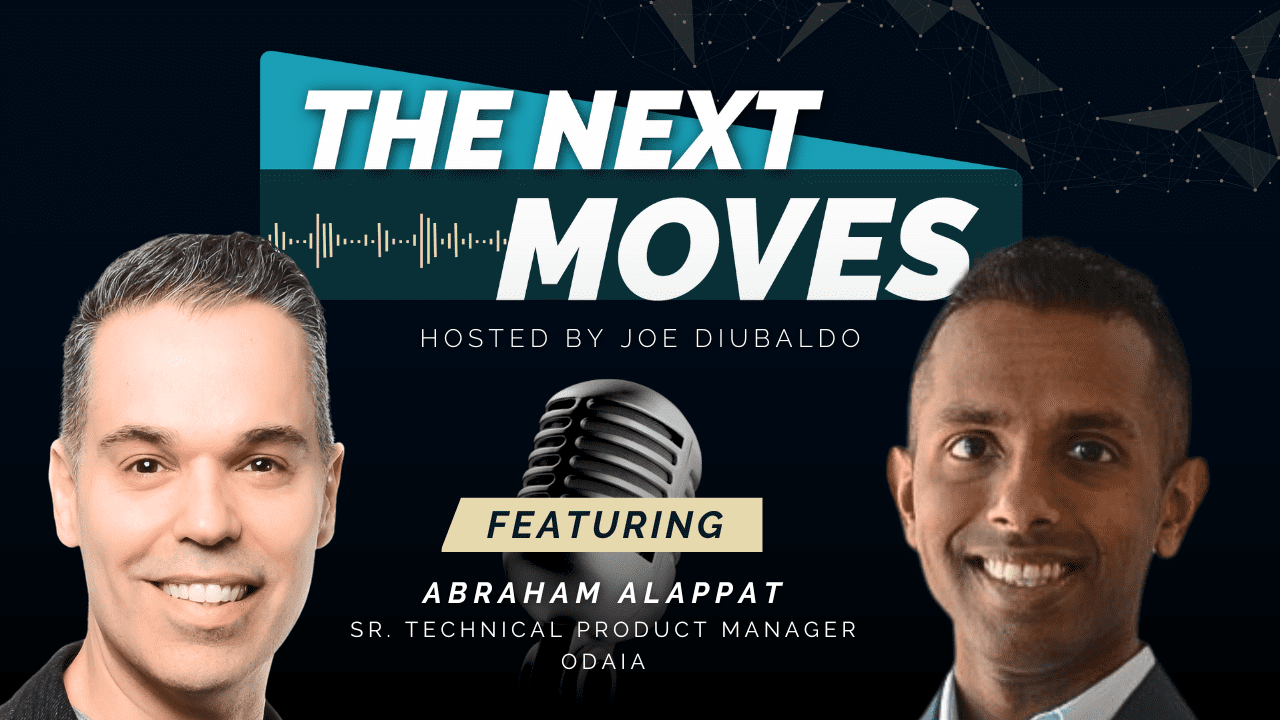
00:22 Joe: Welcome to the Next Moves. My name is Joe Diubaldo and for the past 25 years I’ve been helping people build careers and build amazing companies. The truth I’ve learned is that we all get stuck at different times and I want to help you get unstuck, plan your next move, and the move after that. I think the best way to do that is to look at the choices that some of our guests had in front of them and the moves that they made. Welcome Abe. I appreciate you making time for this. I know that you’re pretty busy with a full-time job and trying to drive forward the future of generative AI and AI in general.
00:59 Abe: Thanks man, no worries, glad to be here.
01:03 Joe: So I want to start the conversation by giving a quick background on you — maybe you could walk us through what you do now and what you’ve done before. Because I think, even from what you graduated with to what you’re doing now, it’s been an interesting journey.
01:18 Abe: Sounds great. So I’ll start off right now and scroll backwards a little bit — a reverse chronology. I’m a senior product manager at a company called Odaia. I manage their machine learning platform — helping them build out things like their training and inference pipelines, as well as looking at things like feature stores and of course the entire generative AI strategy as well. Prior to joining Odaia, I was at a venture capital firm called Georgian where I kind of ran their quant investment engine — using machine learning to find out the best startups to invest in, helped direct a couple hundred million dollars worth of deal flow. Of course if you scroll back, I had an entire career in investment banking and in equities research — completely different, outside of tech. And prior to that of course university, where I did engineering and economics as a double major for my undergrad. Somewhere along the lines I also did an MBA at U of T. I always find a way for more education — that’s just me.
02:22 Joe: That’s true actually. You know, the whole philosophy around this show is helping people get unstuck and make the next move. And I think there are two ways we can look at your background — you’ve spent a lot of time helping companies think about their next move, and you’ve also made some interesting moves in your own career. If I were to look at what you’ve done most recently, I think I would be negligent if I didn’t ask you about the nature of your job with Georgian, because everyone’s always thought “hey, I’d love to be part of a VC, I’d love to be part of the tech community.” You had a pretty specific role in there that a lot of people don’t get access to. So why don’t you tell us what the typical roles are and then talk about what you ended up doing within the organization with your team.
03:08 Abe: Sounds great. So the typical roles in a VC are kind of divided between your investment team — which is mostly focused on sourcing startups, doing due diligence on them, and then closing the deals. And of course managing the portfolio of existing investments. Eventually they’re also somewhat responsible most of the time for exiting — so finding a buyer for those portfolio companies maybe seven to ten years after the initial investment. In some firms that latter bit goes to a corporate development office or a team that specialized in exits. Outside of investments, there’s usually a portfolio improvement or operations team. They tend to work with the startups to engage in better methodologies in terms of sales, marketing, internal ops, and so on. They coach the startups on how to scale up in an efficient manner.
What made Georgian unique was they also had a research team and an ML research team, as well as a product and engineering team. What Georgian was trying to do is isolate their value-add — not just doing the typical VC thing of “here’s how you scale efficiently, here are some introductions to some banks or large institutions that can scale up your top line.” Their advantage was more around “hey, we can enhance your machine learning platforms, we can help you do ML research to improve the quality of your ML models” — because they mostly invested in AI startups. My specific role — which is slightly different from all of those and relatively new, I kind of started that entire thing at Georgian — was to take the product and research expertise we had there and build an internal quant investment system. What this really means is: how can we take those 50,000 to 100,000 startups in the world, probably about 10,000 within our investment range, and really collapse that down to a few hundred that could really generate value — thinking about 6x or even the decacorns that are coming out. Over the course of research we identified a lot of signals that could indicate future success — a lot of the typical ones people look at today like LinkedIn employee growth and things like that, but also the non-obvious ones, which I can’t really talk about on air.
05:30 Joe: Don’t know why not, tell us please. We want to know.
05:35 Abe: The interesting thing about it though is that we were essentially looking at how effective the system was — we more than tripled the ability or the probability of finding a really good startup as a result of the machine learning prioritization we built in-house. When I was there it started off as — and this is the typical zero-to-one product journey — it started as just an idea in the back of my head and an Excel file. That’s literally how it started. How it ended, around the time that I left, was basically a 15-person team managing it. We had a data platform, we had a machine learning system, we had an entire UX/UI that we were testing in-house. I’m not sure where that ended up — it’s been a little while now since I’ve been at Georgian. But you’ve seen — we were an early starter in that space, probably about a couple of years ahead of a lot of the other folks. There are VCs like SignalFire that almost exclusively source through their AI and ML systems. Index Ventures — Andreessen Horowitz now also has hired one of the major partners out of SignalFire and they’re actually running their own quant team and data team on the inside. There’s a whole host of others that are now using generative AI — not at the sourcing level but one level below at the due diligence level. How do I absorb the information from the startup, how do I ask intelligent questions of the data? And automate that really heavy component as well, because sourcing is tough — it’s a probability game. Due diligence is an effort and productivity game. That’s where generative AI really shines as well.
07:23 Joe: So I want to drill into something that you said to me before — and I like the frame because I think frames allow us to think through things. You said that you look at everything as a funnel, and a funnel is a funnel is a funnel. Can you just break that out for me — what it means, what it means for the audience listening to this, and why this was relevant as you’re looking at AI?
07:49 Abe: Sounds good. I’ll go back to the origination of this — when we built the internal quant investment system, we were talking about optimizing the investment funnel. How do we source initial startups, get down to like the first level of due diligence, then dive deeper — and how to use AI to prioritize which things to look at and even surface up the right kinds of information along the way. What we realized was that a lot of the workflows in our portfolios of startups — whether you’re talking marketing, sales, operations, anything — it ends up being a series of items or tasks. Whether it’s leads to be processed, tickets to be processed in your customer service, whatever it is, the funnel process is largely the same. There’s a series of things that are stacked at different stages of the process, there are flows between them, we need to prioritize things between those items. AI in general — traditional AI — is very good at the prioritization elements. Generative AI is extremely good at the processing of these items. Like — do I need to do data entry to move things from funnel stage one to funnel stage two? Well, generative AI systems today can help out with that in a massive way. Do I need to make decisions and fill in how good is this thing according to a framework I built up? Well, RAG systems in generative AI can do that as well.
09:12 Joe: What’s RAG for the audience?
09:14 Abe: Yeah. So it’s retrieval augmented generation. This is a methodology for inputting not just a question to the AI but also the relevant context — so it has to pull the answer from these relevant pieces of data. You might throw it a PDF — that’s a vastly simplified example — usually chunks of a PDF that are relevant to the question, and it’ll come back with an answer saying “based on the context you’ve given me, this is the answer you’re looking for.” And if you think about any cognitive effort that a human has, it’s really largely along those lines — I have a question, what’s the context, what are the rules, how do I get to the answer, and we logic our way in. With generative AI it at least imitates logic to a certain extent. That simplified logic — generative AI systems haven’t learned how to reason in the way that we think about reasoning. Yet.
10:09 Joe: So if you look at the funnel, and we look at a funnel as a funnel as a funnel, and I want to think about the opportunities inside of a specific industry — and we can look at something as simple as, I mean there’s going to be recruiters that watch this — we think about the sea of candidates and the sea of data out there for any specific role, and the ability to process that information and reduce it in some ways so that better judgment can be made. When you’re looking at the technologies that you deploy, everyone thinks well, matching just seems very straightforward. Is there something more comprehensive that we’re missing to get a better outcome for candidates and clients?
10:57 Abe: Yeah. So if you’re just using AI to prioritize existing information, that game has been played for quite some time now and there’s very little juice left in that game. You had to be pretty good at things like causal inference and understanding which particular features in a person’s resume would result in a good candidate popping up in the interview. Where the interesting things lie are along two fronts. Number one — think about the HR funnel. From your perspective, I presume — forgive me if I get this wrong — the idea is a set of candidates that you’ve identified either through a database you have or through LinkedIn or other social sites that have their full set of resumes, or even Indeed. You might have some feeds into those things. Then you identify the top candidates that you want to reach out to. So that’s a workflow — as we mentioned before, generative AI could help automate some of that, because you probably need to reach out to hundreds if not thousands of candidates to really identify the best ones. Then you have to have that initial meeting. Once you have that initial meeting there’s another workflow — what are the right questions to ask, how do I make sure this candidate is right for the series of jobs that I have on the other side? Because you’re a two-sided platform — you have employers on the other side. You have to ask the intelligent questions. And a lot of the times, at least when I’m doing interviews at the product manager level in larger orgs, the HR department isn’t a specialist in, let’s say, AI and ML — so they ask very generic questions. That’s fine, but maybe there’s an opportunity with generative AI giving you the right context. The way that an engineer has domain expertise, you can create an AI agent — or a RAG agent, as they call it, a retrieval augmented generation agent — that has the context and can act as an expert hiring manager, like an engineer in machine learning or a product director in machine learning, and can come up with a couple of really good questions. Listen in on the conversation, and you can really start narrowing the funnel really early to the right candidates. Then everything downstream suddenly becomes easier. Because in funnel dynamics, if you shrink the funnel right at the top on that first interview to the right set of candidates and you have a high degree of fidelity on what’s good and what’s bad at that point, all the effort downstream can be saved. And that’s a massive win for any org, your org, or an HR department on the other side for like a Fortune 500 company — that’ll probably save thousands of hours a year if that optimization could even be 10-15%. And the pace at which these things are moving — there are a lot of startups in this space as well, everybody’s seen the opportunity. Funnel is a funnel is a funnel, productivity is the element that generative AI can do, and everybody’s throwing AI agents and RAG at it. The hard part is identifying where you can differentiate and building that moat of data and context for the agents. That’s where I think people like yourself who’ve been in the industry for a long time and are even specialized in a specific industry or vertical can build up that set of context that suddenly the agent or the RAG agent can pull on and ask the right questions — or at least inform the interviewer of the questions to ask, given everything we’ve heard so far and the candidate’s background and resume.
14:39 Joe: Thanks for framing that up. I know I pushed you out to your comfort zone there and had you talking about something theoretical, but you walked us through it well. Let’s pull back for a second to where you’ve seen the most traction recently. And when I’m saying traction — depending on who you’re talking to, AI is the dawn of the apocalypse and is about to supplant us as a species in the next seven minutes, or it’s a distance off and there are significant barriers and obstacles to reaching something that has a high degree of utility at a reasonable cost. I’m curious — your general opinion on this and also where are you seeing these leaps that are in some ways almost surprising, where it’s like “wow, I didn’t see that happening that quickly.”
15:33 Abe: It’s funny because when ChatGPT first came out and there was all that hype and I tried it out for the first time — I was on that first camp. “We’re all going to die in about five years.” Good to hear. Then I started using it for work — I tried to use it for project decisions and I kind of realized “oh my God, this thing makes so many mistakes, it’s insane.” I realized, much like Yann LeCun — who’s one of the Turing Award winners, he talks about this to an extent — so much like he realized earlier on and I kind of realized after listening to him — you have these things which are basically stochastic parrots. They’re not reasoning on their own. They can’t reason in the way that we think about in terms of long-range, multi-hop, multiple-step problems. Basically, every time it’s trying to think about a sentence, each word that it’s thinking ahead there’s a probability it’s wrong and it’ll send it down the wrong path. So the longer the answer, the more logic you’re involving, the more likely it’s going to get wrong at the end of the day. This is not something fixable with the current type of AI that we have today. To an extent we can mitigate it. And this is where things are going by leaps and bounds — we’re almost exhausted with text data. All the language models in the world are pretty much using the entire internet at this point as training data. Of course they clean it up to avoid duplication or bad language, or ingrain some racist philosophy within its mindset — there are a lot of safety improvements happening there.
But what’s really interesting is they’re going beyond text. They’re going into things like video, visuals, audio. And the reason why that’s important is we have to place AI in the same progression that you might place a baby when they’re first born. They learn about the world and have a representation of the world that isn’t just text — it’s visual, three-dimensional space, time, audio, things like that. A lot of the logic that we pull in our heads and verbalize through language is actually reasoning over multimodal data. One thing that blew my mind recently is I saw Figure AI — I don’t know if you’re familiar with that startup. The way that the robot was able to understand the person, interpret the language, and then reason over a three-dimensional problem — the person was asking for a piece of food, there’s an actual apple on the table because the computer vision algorithm tells it that’s an apple and that’s food, okay. Then the language part reasons over that multimodal data and hands the apple to the person when they requested “a piece of food” without directly representing the apple — and also has a great conversation in the background as well. That was mind-blowing. Absolutely mind-blowing. Now can you imagine what that can do in a space like fintech, capital markets, things like that — where you have abstract thinking or pricing over the value of assets in different industries? If you think about construction or supply chains, you need to start visualizing distances, space, weight — things like that. AI today on a text basis might be able to reason a tiny bit based on the embedded knowledge in the training data and previous reports about those industries. But a multimodal AI that’s truly understanding distance, space, time in a really good way — even though it’ll probably still be wrong based on the current structure of AI — might be much less wrong than we’d expect. And that’s where you’re going to start seeing things like equities researchers and investors having little bits of their job, at higher levels of reasoning, getting automated over time. And this doesn’t only apply to fintech — it could apply to almost every industry we can think of. That’s kind of where I see things going. It’s a gradual shift over the next 15 to 20 years. If someone comes up with a way to get past the structural problem with AI, then all bets are off. My initial idea might come back.
20:27 Joe: So what you’re seeing is you’re seeing these glimmers and these bursts of unexpected innovation — with something like Figure, and I agree, I saw that and I was like “wow.” And then my brain immediately goes to “how?” And when you’re talking about multimodal systems and capturing real world data and then mapping the context appropriately — it’s shocking when you see those things. So the question is — are those behaviors inside of a controlled environment or are they actually able to be replicated with a degree of spontaneity? Am I going to go in and get the same thing if I do the same thing with that robot, or is it a controlled experience?
21:14 Abe: There is a degree of control in those demonstrations. But what we often forget is that the rate of change — compare that very first version of ChatGPT to what’s available today through their O1 model or things like that — it’s much better today. These things are geometric in growth. So yeah, it might be viewed as a trailer for the movie that’s coming in a year or two. And the way that I would put it is — you’re going to find use cases that are simple, the way that generative AI text-based use cases I discover today are relatively simple for the system to understand, process, and put out high quality results. And where you’ve got to think about it, the product way to think about it, is — what is the threshold for error? What is your fault tolerance? If the fault tolerance is really low — let’s say one or two percent hallucinations and it’s deadly if it ever goes above that in any circumstance, and users can ask any type of question — so basically it has to have a one to two percent hallucination rate across the board. Even the best models, even O1, doesn’t do that. It’s not humanly possible. So in those use cases — like a doctor asking a question about a patient’s health to the model, or asking what they should do — you probably shouldn’t rely on it because it’s not going to be there.
But if it’s something that’s fault-tolerant — let’s say I’m creating a beautiful set of logos for my company, or I’m building some nice background materials for a video that I’m creating — and there’s an openness to “hey, the machine isn’t quite exactly right, I can iterate and it’s okay if it is” — there’s a huge fault tolerance there. The natural workflow is back and forth, back and forth. And instead of going back and forth between human beings, which is a slow process — oh, let me go back and rework this design, God knows how long that takes — with the AI it might be 30 seconds. You just have to say “I like that but I want something else.” So in the computer vision and design space I see a lot of concern. My wife works in design and she’s worried that this thing is absorbing all the low-level ideation out of that particular industry. And I think that’ll happen across the board. I think the key for people in that space — and I can anticipate your next question — the key for people in that space is to learn how to use the AI in a better way, to become much more productive and much more creative. And in the end, these things are pumping out statistical averages of the training data. If you create something net new, it won’t be able to replicate that. And that’s the key — the creation part, which once done can then be replicated, but before it can’t.
24:12 Joe: I’ve got to take you back to the conversation with Georgian. The reason why is that felt like a win — you’re saying “we really found a way to identify opportunity.” And this in itself feels like something that would attract a ton of attention. So if you’re looking at different capital partners, VCs, private equity, companies with their own Corp Dev — and you look at the opportunity presented by this — I might know the answer to this and I don’t want to assume — but why is this not a strategy for everyone, and what is the material size it would take, and what are the tools it would take to do something like this?
24:55 Abe: That’s a good question. I’m going to lean on some of the experience that I had there directly, as well as some of the conversations I’ve had with other VCs trying to understand the opportunity. At one point we thought — could we take this internal thing and give it to other VCs and then do some kind of signal sharing, and everybody’s happy and singing Kumbaya? We were exploring that opportunity. One of the challenges with these systems — the prediction might be right, but how do you operationalize it in a workflow that the people like and feel attuned to? And that breaks down into two things. Can you physically alter the workflow? Do I have the UX/UI, the experience profile? Are you working on a CRM like Salesforce, or in VC’s case Affinity, which is like the typical CRM for VCs these days? Can we inject these predictions into the workflows that are native to that app, or can we alter those?
The second issue is trust and belief. For a lot of AI — and this is generative AI to its core as well — how do humans build trust? It’s over time, seeing good quality elements come out. So if you have something that requires a big shift, you have to find a way to give them exposure to the predictions and see immediate results. That’s particularly difficult in VC because the results are going to come six or seven years later when the ROI actually appears. You can do things like backtesting and everything else. But in private equity and venture capital and private capital markets especially, there is going to have to be an openness at the leadership level and a cultural level saying “yes, this is a risk but we’ve got to try it because we have to find some level of alpha somewhere.” Sure the data indicates it, but they’ve got to have that emotional attachment to it. So when you think about how the founders of Georgian went into it — it was because they were tech founders themselves previously. They knew the value of AI and data so they took a big bet on this stuff. And to their credit, that’s a big risk for a big VC to throw so many headcounts at these kinds of things.
27:17 Joe: That was incredibly insightful. If you look at what you’re doing now, can you frame up what you’re doing now and why the move?
27:25 Abe: Yeah. So at the end of my time at Georgian I had this thirst to build more scalable systems that are more outward facing and going to multiple enterprise clients. I think at some point in my future I would like to found a B2B enterprise company — maybe once I get another decade or so of experience. The idea was to go into a place that already had some large enterprise clients. Odaia, my current firm, sells machine learning systems to enhance the sales pipelines for big pharma — talking about targeting and segmentation, things like that. Very much in line with what I did, just for a different use case. The advantage here is that because the team is a lot bigger across the board — the front-end staff, the data management, the data platform side — the ML team could be a lot more focused on the really advanced machine learning algorithms and the real build. And that’s what kind of attracted me here. I wanted to get that startup experience — maybe a unique way of building up that hugely scalable B2B enterprise-serving machine learning system.
28:44 Joe: And you’re a product manager there?
28:46 Abe: Yes. I’m a senior product manager. I’m currently managing most — I would say about 80% — of their machine learning products. And there are several.
28:55 Joe: That was awesome. I really appreciate you taking the time to sit with us and go through that. That was a very wide-ranging conversation in a very short period of time. I know we were limited today so I want to make sure that we have time to do a part two — are you okay with that?
29:08 Abe: Sounds great. Looking forward to it.
29:11 Joe: Well thanks for this and we’ll catch up soon.
29:13 Abe: Thank you.