
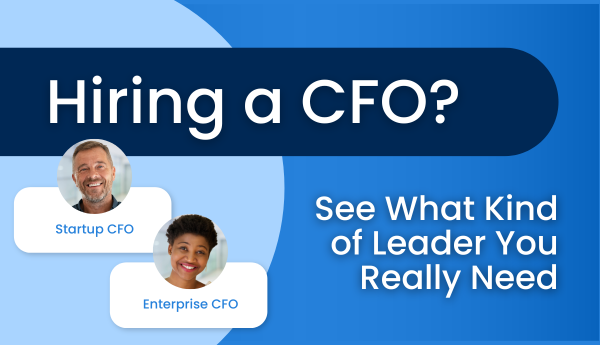
The CFO is the most consequential hire a growing company makes, and the one most often gotten wrong. Rarely because the candidate was weak. Almost always because the company never decided what it needed before it started looking.
A CFO is not one role. The finance leader who builds your first real forecasting model is a different person from the one who walks a board through covenant reporting after a private equity acquisition. Hire the second when you needed the first and you’ve bought complexity you can’t yet use. Hire the first when you needed the second and you’ve capped your ceiling at the exact moment the stakes rose.
So before you write the job description, answer two questions. Is it time? And if it is, what kind of CFO does this stage of the business actually require?
The trigger is rarely revenue alone. It’s the moment financial complexity starts outrunning the people managing it. A few signals that the moment has arrived:
If none of these is true yet, you may not need a CFO. You may need a stronger controller or a fractional finance leader to bridge the gap. Hiring ahead of the need is expensive in both salary and mismatch.
These roles get conflated, and the confusion is costly. A controller owns accuracy: the close, compliance, reporting, keeping the books right. They look backward and make sure the record is clean. A CFO owns direction: forecasting, capital, investor and board relationships, the financial strategy that steers the company forward.
Many companies searching for a CFO actually need a controller who can eventually grow into one, or a fractional CFO layered over a strong controller. Naming which problem you’re solving changes who you should be looking for.
Once you’ve decided it’s time, the real work begins: matching the type of finance leader to where the business is. Broadly, CFOs fall along a spectrum.
The builder: For early-stage growth, active fundraising, or the transition out of founder-led finance, you need someone who thrives in ambiguity and can stand up financial systems from the ground up. This CFO is comfortable without a playbook because they’re writing it. They build the model, the process, and the reporting cadence that don’t exist yet.
The strategic operator: For established businesses, especially public, PE-backed, or pre-IPO companies, the CFO has to manage complexity, compliance, and performance at scale while steering long-term planning and capital allocation. This is a leader who operates in boardrooms and audit committees as fluently as in spreadsheets.
Most companies sit somewhere between the two, and the right hire is the one whose center of gravity matches your next twenty-four months, not your last twelve.
The archetypes get concrete fast when you look at what the business is actually about to face.
A Series A company preparing to raise a Series B needs a CFO who can build an institutional-grade model, tell a credible growth story to investors, and hold up under diligence. That’s builder territory with an operator’s polish.
A company that has just been acquired by a private equity firm needs someone who understands covenant reporting, value-creation metrics, and how to sit across from investors focused on return. Different skill, different temperament.
A company approaching an IPO or facing heightened board scrutiny needs a CFO who can prepare MD&A documentation, field analyst questions, and manage audit processes without disrupting the day-to-day. That’s the strategic operator at full stretch.
Same title. Three different hires. The company that recognizes which one it needs runs a faster, cleaner search and gets a leader who fits on day one instead of growing into a role that was never theirs.
The cost of a wrong CFO isn’t just the search you’ll run again. It’s the strategy that stalls while the seat is empty or misfilled.
At Clarity, we’ve placed CFOs at early-stage startups, high-growth scale-ups, and complex enterprises with multinational operations. We don’t lead with résumés. We start by understanding the challenge you’re facing, your leadership culture, and your growth trajectory, then match you with the finance leader built for that specific moment. Our executive search process runs a structured, evidence-based assessment and typically delivers within eight weeks.
If you’re not sure whether you need a builder, a strategic operator, or something in between, that’s the conversation to have before the search starts. Let’s talk.
When should a startup hire its first CFO? Usually when a fundraise, a board, or financial complexity starts demanding forward-looking strategy the current team can’t provide. Before that point, a strong controller or fractional CFO is often the better fit.
What’s the difference between a controller and a CFO? A controller owns accuracy: the close, compliance, and reporting. A CFO owns direction: forecasting, capital allocation, and financial strategy. Many companies need one before the other.
Should we hire a fractional or full-time CFO? Fractional works when you need senior financial strategy but not a full-time seat, common in early-stage or transitional periods. Full-time makes sense once the complexity is constant. Read more on hiring an interim CFO.
How long does a CFO search take? A rigorous executive search typically runs about eight weeks, from defining the ideal profile through assessment and offer.
Clarity is here to help. With a deep network of finance leaders and a structured, evidence-based recruitment process, we’ll help you find the right CFO for right now and for what’s next.


Here is your link to the 2026 AI Listening Tour Findings:
2026 AI Listening Tour (PDF) ↗Are you hiring? Get in touch with us to talk about better hiring.
Get in touch →
Here is your link to the 2026 Salary Guide:
2026 Salary Guide (PDF) ↗Are you hiring? Get in touch with us to talk about better hiring.
Get in touch →
Here is your link to How Finance Fuels Growth:
How Finance Fuels Growth (PDF) ↗Are you hiring? Get in touch with us to talk about better hiring.
Get in touch →
Here is your link to the Finance Team Org Charts:
Finance Team Org Charts (PDF) ↗Are you hiring? Get in touch with us to talk about better hiring.
Get in touch →