
Spotify

Apple Podcasts

Amazon Music
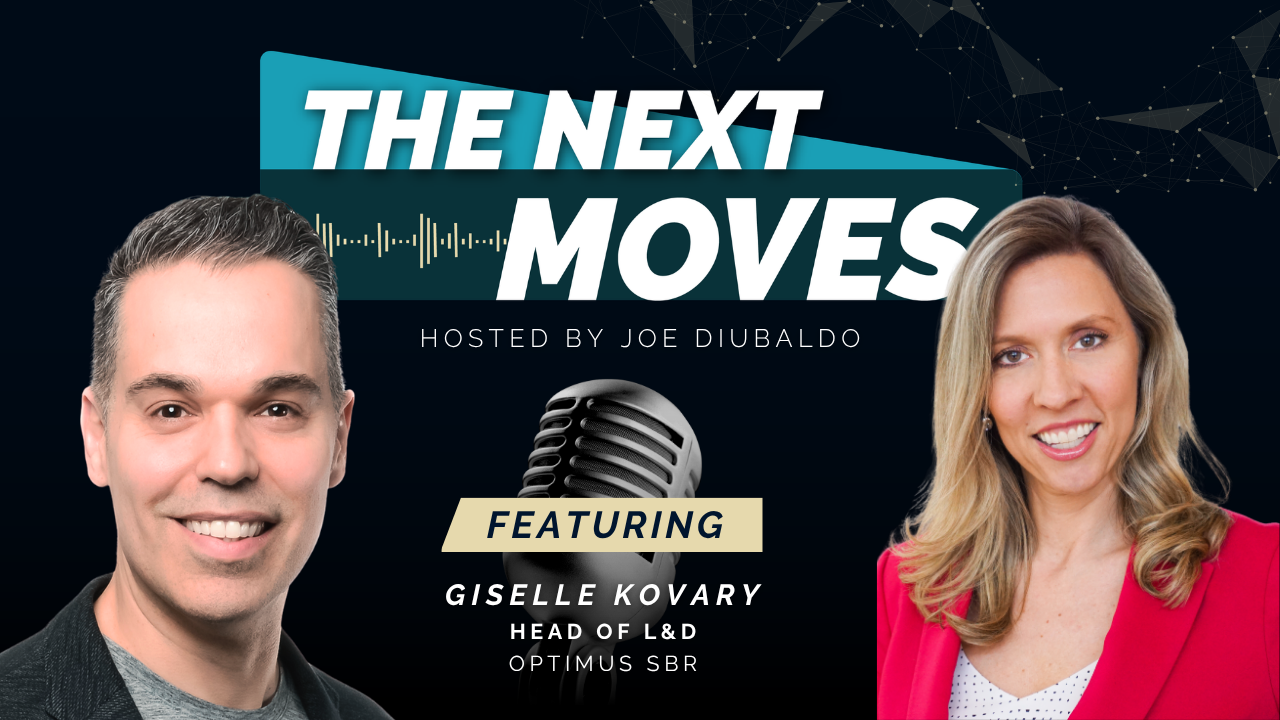
Most founders and CEOs think about generational differences as a culture issue — something HR deals with, or a friction point that smooths itself out over time. Giselle Kovary would tell you that’s exactly the wrong frame.
Giselle is the Head of Learning and Development at Optimus SBR and the co-founder of NGen, a generational intelligence consultancy she built over 19 years before its acquisition in 2022. She’s spent more than two decades researching how different generations work, lead, communicate, and disengage — and she has the data to quantify what getting it wrong actually costs.
On this episode of The Next Moves, Joe sat down with Giselle to unpack the real mechanics of generational friction: where it shows up, what it’s costing your organization, and what leaders can do about it.
The generational conversation has been happening for decades. What’s changed is the stakes. With five generations in the workforce simultaneously, and return-to-office accelerating the tension, the cost of getting this wrong keeps going up.
Listen to the full episode featuring Giselle Kovary and explore more episodes with founders, CFOs, and senior operators on The Next Moves.
00:00 Giselle: There’s so many other factors that are going to drive friction. We’re talking about communication, but relationship with authority — how do you respond to authority? Work styles. In my research, I looked at how different generations work, leadership styles, people’s loyalty to the organization, how long are they planning to stay. All those have costs associated with them. I would say in the work that I do with senior executive teams and boards, the cost they can really measure is an engagement cost. From a people perspective — what is your engagement score and what does that look like? What we know from the research is that organizations with highly engaged employees have higher annual revenue growth anywhere between 2 and 5% above industry average, and cost of goods sold again 2 to 5% below industry average. So you can make more and spend less with highly engaged employees.
00:56 Joe: Hey everyone, welcome to the Next Moves. Today we’re joined by Giselle Kovary, who’s the head of learning and development at Optimus SBR. Giselle built her career at the intersection of leadership, learning, and what she calls generational intelligence. This includes co-founding N-Gen People Performance, which was acquired by Optimus SBR in 2022. We’re going to unpack how to actually lead five generations at work, what it’s like to sell your company and become an entrepreneur, and where the future of work and learning is headed. This episode is built for founders, CEOs, and execs who are managing growth, integration, or generational tension inside scaling organizations. Welcome Giselle.
01:37 Giselle: Thanks for having me Joe.
01:37 Joe: I think it’s important for the audience to understand some core concepts. When you say generational intelligence, what is it? What is it not?
01:51 Giselle: When we think about generational intelligence, it’s really about how can you maximize the skill sets of the different generations that you engage with in order to drive the greatest performance and productivity from your teams. We are interacting with different generations in every facet of our life — in our homes, families, communities, organizations. In every place we tend to have some kind of engagement or potential friction point. The intelligence is: what do we do with the information we can learn about each generation so that we can modify our behavior, engage people, communicate better. And what is it not? It’s not about labeling people. It’s not about stereotyping them. It’s not about saying just because I’m a Gen Xer — and I’ll out myself up front, I’m a Gen Xer — that people could naturally say I’m difficult to manage or that I have rapid career expectations or I want 12 weeks of vacation, which is all true by the way. But we can’t just label people and stereotype them simply based on the year they’re born. Generational intelligence means we need to understand what are the core values and expectations that each generation possesses, but then what is my individual identity, where do I most align to? In my research and the work I’ve done for over 25 years on generational differences, in the books I’ve written and the thousands of people I’ve trained globally, I say it’s less about the year you’re born and more about the identity you align to. That’s why we see 20-year-olds who think and act like traditionalists, and baby boomers who think and function like Gen Zeds.
03:38 Joe: So at a broad level, what we can speak about is some generational identities and mindsets. Walk us through the generational identities, how they can be different, how they’ve typically been labeled or stereotyped.
04:07 Giselle: Probably because you’re a Gen Xer, that’s why we got along so well. I’m born in the Gen X cohort too. When I started doing this work way back in 2003, I was like “oh my goodness, I’m a classic Gen Xer.” Some people have that sentiment when they hear the key characteristics of each generation — and then other people say “oh no, I might be born in that generation but please don’t call me that, I don’t identify at all.”
So let’s start with what I call the most experienced. We don’t say older — nobody likes to be called older. The most experienced are traditionalists. They’re 80-plus. The argument often is “do we still need to talk about this generation?” And my answer is yes. Why? Because this generation’s values, expectations, and behaviors have shaped our organizational cultures. They sit on boards. They are still our clients in many cases, or decision makers in our society. They sit on a whole bunch of wealth and are still really critical to understand because our organizations still often align to their core values. Think about very traditionalist industries like government, banking, insurance, and oil and gas. This is a generation whose goal was to build a legacy. They’ve been financial savers and they tend to be very risk-averse, demonstrating traditional values of loyalty, dedication, honor, and sacrifice.
The baby boomers — we’ve all heard about them. In the US and Canada we define it slightly differently, but baby boomers are 61 up to 79 now. A lot of boomers don’t want to hear that. We’ve got people in our society retired or just about to retire or considering retirement, though many boomers are choosing to work longer either for financial reasons or simply because they want to stay engaged and add value. 9.6 million baby boomers in Canada. They still tend to be the movers and shakers in organizations — often the most senior people, the decision makers. Lots of founders fall within that category. This is a generation whose goal was to put their stamp on things, to really differentiate themselves from the other 9.6 million people they were competing with. They have a strong affinity to their work. They often identify their self-image with their work — I am what I do. And they’re quite politically savvy, knowing how to engage people and connect with stakeholders.
Then we’ve got Gen Xers — that’s us. Every generation thinks theirs is the best, but since we’re both Gen Xers, we can say it today: it is the best. We’re 44 to 60 now. 2026 will be the first time a Gen Xer turns 60 — a little hard to swallow. We’re a much smaller generation than the 9.6 million baby boomers, sandwiched between the boomers and their children the millennials. We came of age in a time that demographers referred to as the anti-child decades — the 70s and 80s. High rates of divorce, single parent households. We were the latchkey kids. We came home after school, took care of ourselves, highly independent. Our goal has been to maintain independence in all areas of life. We now see Gen Xers in key decision roles within organizations, and the highest amount of entrepreneurialism within Canada was within the Gen X cohort — because we knew we couldn’t count on anybody to take care of us, especially the government.
Then we’ve got millennials. Also entrepreneurial, but often in a slightly different way. Millennials faced a lot of difficult criticism as a cohort — a lot of millennial bashing happened for a long time. They’re between 30 and 44, so that older part of the millennials often say “please don’t call me a millennial, I don’t identify that way.” But fundamentally this is a generation whose goal is to find work and create a life that has meaning for them. Tech-savvy, of course — they came into a work world where they could adopt technology. And they are really a generation that brought in work-life integration.
And then we’ve got our youngest generation in the workplace today: Gen Zed or Gen Z, depending on whether you’re American or Canadian. The youngest are 13, but they’re up to 29 years old — so from the 15 to 16-year-olds who’ve moved into part-time work, right up to new grads coming into organizations today. This is a fascinating generation. I conducted Canada’s first national survey on Gen Zeds and what I find so interesting is that they’re being raised predominantly by Gen Xers and they’re showing a lot of different traits from the millennials. Early data has been consistent post-COVID — a generation looking at how do I stay within an organization for longer, but I still need to be learning and growing. How do I make sure that I contribute, but I understand there are rules and processes to do that. I’m creative and innovative, so I want to engage that part of my brain. This is a generation whose goal is to commit, evolve, and be engaged — but they want that on their terms, not necessarily on the way the leader wants to engage them.
10:14 Joe: It does. I think that’s a very clear breakdown. As someone who’s helping companies build teams and helping people select their next career move, I’m intensely interested in where do these differences create the most friction? If I’m a leader, what’s the moment when I usually realize I’ve misunderstood the people? What are the symptoms — what’s breaking, what friction points am I seeing that’s slowing me down?
10:51 Giselle: There are several, and some are specific to the size of the organization and some to the type of structure or industry. But across the board, hands down, generational communication is probably the biggest friction point. And we know communication in general is a challenge. I did my graduate degree in communication studies and I say in every workshop — communications is that skill you’ll practice your entire life and you’ll never get it right, but the day you think you’ve been amazing, you’ll go home and your family will remind you that you suck. There are so many nuances to the way each generation communicates — not just the medium. People say “well, young people are on TikTok or Instagram and I’m not on there.” Yes, that may be true, but the nuance in how people communicate — how are they interpreting a message? Is it clear to everyone what that means? Is it okay to use certain kinds of jokes? Our use of emoji, tone.
If you are Gen X or older, it was very likely that in the work world you had a leader that wasn’t going to be particularly nice all the time. Their tone was harsh. Maybe you got yelled at. Maybe they made strong comments about your work — “that sucks” or “this isn’t the way it needs to be.” We were used to that, and younger generations have not been exposed to that kind of communication style before. So it can seem really abrupt.
Communication style also breaks down as it relates to connection. Are we staying connected? Are we giving a thumbs up when we get a message? Is it happening in real time or not? Younger generations tend to want communication to land and then decide when they want to respond — that’s why a text or Teams message or WhatsApp works well. Older generations want a response right away. If we can, we’ll walk into their office, and if we’re not in the same workspace, maybe we call them. And people are like — calling? Why are you calling? I didn’t even know my phone rang.
13:32 Giselle: There are other things as well. When we think about collaboration — are we making assumptions and judgments about people before we’ve really validated that? That’s natural. From the beginning of time, every generation has looked at the younger one and said “we’re better than them, we work harder, we had better music, we’re smarter.” So we have to make sure that when we look at collaboration, we’re giving teams the tools to collaborate effectively. Are we listening for what people’s skill sets are? Are we giving people the opportunity to share their learning regardless of whether they’ve been with the organization for 10 years or 10 days? And are we making sure that when we think about career development and growth, we are not making assumptions that because somebody is older or younger, they only want to learn or grow in a particular way.
14:37 Joe: I’m going to try to constrain it a little bit. A simple question — if we can standardize one communication norm across the company, whether that’s the channel, the speed, the tone, the decision-making — what would it be and why? What impact would it have?
14:54 Giselle: From a medium perspective, we need more than one, but I would say we want to have some kind of platform — we use Teams, right — where we can have quick conversations, touch base if we’re not going to be in person, and then some kind of repository where information is going to reside. I think where people are feeling overwhelmed — especially when working in multigenerational teams — is the volume of messages coming at them. You’re sending me a message on Teams, but there’s also been an email, and then there’s an attachment, and then we’ve got to go to SharePoint, and then we have to upload it in a folder but it’s sitting on somebody’s desktop. All of that creates friction. So sitting down and saying “what is our communication protocol? How are we going to communicate with each other? What are we going to do when it’s urgent?” We had one client that decided they would all pick their favorite drink and text that to the other person if it was urgent. She would just get “gin and tonic” and she knew she had to reach out immediately. Having a platform for real-time quick chat is really important, but then not stacking on top of that an email and an attachment and this is here and this is there. We need to go to a single source first.
16:53 Joe: And then within that, are you creating a set of standardized behaviors for people? I’m thinking about if you have this multigenerational workforce using a channel, no one’s going to be entirely happy with it but we can get people mostly happy with it — do you have to create a standardized way of thinking about this and train people on how to communicate with one another, or am I going too far?
17:24 Giselle: I would say you’re going too far, and I’m not sure standardizing communication is the right way to go. Basic communication theory says it’s just a sender and a receiver. If it’s standardized too much, people can’t be themselves. They can’t communicate authentically. It’s not fluid. It feels too restrictive. And that’s why people stop using those mediums and channels and just find something else. But what we do need to do is give people some tools to say — if you get a quick message from a senior director or the owner of the business that says “I want to see you immediately when you walk in in the morning,” how might that be perceived? A baby boomer is going to be like “okay great, I’ll be there at 5:59 before you get there at 6.” A Gen Xer is going to be like “sure, I’ve got a couple things to do and I’m dropping off my kids, I’ll be there at 9, is that cool? Do you want to call me in the car if it’s really urgent?” The millennial might be like “well it’s not my day to come into the office, did you actually think I was supposed to come in or do you want to do this over Teams?” And the Gen Zed might be like “are you super mad at me? What did I do wrong?” So we have to equip people with an understanding of how their message might land. If you can understand that with tone, messaging, and body language when you’re in person — and then layer on the generational nuance — you are miles ahead in avoiding misinterpretations.
19:32 Joe: I’m smiling because this has happened to me. “Hey, can I talk for a second? It’s important.” I’ve learned to provide a further explanation — I need some help with this, would you mind sparing a few minutes, here’s why I’m reaching out to you. You want to buy them, you don’t want them going to buy a bunch of gift cards.
19:56 Giselle: By the way, that has happened here.
20:01 Joe: Really? So if we’re speaking to CFOs, senior finance operators, founders — they’re trying to understand the real cost of getting this wrong. Friction is slowing you down. What are you seeing as the major cost to organizations when they’re not doing this right?
20:42 Giselle: Great question, because there are so many other factors that are going to drive friction. We’ve been talking about communication, but relationship with authority, work styles, leadership styles, people’s loyalty to the organization, how long they’re planning to stay — all those have costs associated with them. The cost that senior executive teams and boards can really measure is an engagement cost. What is your engagement score? What we know from the research is that organizations with highly engaged employees have higher annual revenue growth anywhere between 2 and 5% above industry average, and cost of goods sold again 2 to 5% below industry average. So you can make more and spend less with highly engaged employees. I work in the space of how do you drive better engagement — and you do that by understanding the values and expectations of the different generations you have so you can drive the greatest performance from them.
When we think about engagement, we can define it by saying how do we know our employees are engaged? They’re going to do three things. First, rationally and mentally, they’re going to give you what we call discretionary effort — going above and beyond more often than not. That’s the salesperson who pushes extra hard to close a deal at end of month. That’s the person in finance who makes sure all the numbers are accurate before quarter end. That’s the person in HR who ensures the contract was perfect so the person could start on the project that day and we didn’t lose utilization by one day. People that are engaged go above and beyond. In professional services, that’s utilization — how hard people are working and how much they’re putting in towards serving clients and moving the firm forward.
The second is their heart is in it — emotional engagement. Do people like where they work? Are they proud of what they do? Do they speak positively about the organization? Do they encourage their friends and family to use the product or service or even work there? In your business and my business, that’s really important. You can have the mental piece — somebody stays late and works hard — but if their heart’s not in it and they don’t care, that comes through.
And then the third element is your people are engaged when they accept accountability. They’ll go in for the high five when it’s a great win, but they’ll also put their hand up and say “I messed up, this is what I did, this is how I’m going to avoid it in the future.” That accountability is the piece most overlooked, because when you empower people to be accountable, you give them ownership to identify problems, own those, and stop them before they become too costly.
24:01 Joe: You keep putting me on my back foot as I think through this about my own organization. You’re also providing value creation metrics that will compound over time — that 3 to 5% annually if done well. Two more questions. As I’m building my organization and I look at a Gen Z individual — create a manager playbook for their early career success. What is the ideal first 30-day playbook? We want to help them ramp quickly and avoid churn. Give me a succinct short message.
24:52 Giselle: Number one — once you bring them on board and you’ve agreed they’re going to be part of the team, make them part of the team right away. Do not wait to engage them. Ensure they are welcomed the way you would welcome any team member, any senior person that joins your organization, even if they’re right out of school. There’s a value created when we say “we’re really excited to have you here, we’re looking for you to contribute” — and getting them involved in work right away.
Number two — ask them: what do you want to learn and what can you teach us? Taking a reverse mentoring mindset. We’re going to give you lots of coaching, feedback, direction, and training on what success looks like here, but we also want to hear from your experiences. Younger generations are scary smart and they’ve been exposed to a lot more. While they may have delayed going into the work world, their exposure to incredible experiences has often happened much younger, or they’ve been involved in groups and experiences we wouldn’t expect.
And the third is ensuring we set them up for success by chunking their work in a way that’s manageable so they can get some really strong wins. The old adage of throwing them into the deep end and letting them sink or swim — that’s not the model. It’s: let’s set you up for success, let’s give you something, let’s see how you do, and we’re going to give you coaching and feedback and build upon that. This is a generation that was used to rubrics at school and a lot of clarity around expectations. Be very clear upfront and set them up for success — build that engagement and momentum early.
26:45 Joe: That sounds like a great playbook for almost any cohort, honestly. Now the opposite side — how do you prevent generational intelligence from becoming an excuse for how someone’s performing? How do you use this and turn it into performance and accountability? How do you avoid the trap of “well, they’re just like this because they’re this cohort”?
27:27 Giselle: I don’t believe that performance levels vary by generation. Every generation has the ability to be high performing and low performing. How do we avoid the trap of assuming or accusing a certain generation? We have to have clarity around expectations — and most organizations struggle with that. The job description is not a replacement for role expectations. Role expectations are not a replacement for career development path. Career development path is not a replacement for performance management process. We need these systems and structures from a people management perspective that set all employees up for success — but especially for bringing in younger talent. They have to understand what the expectations are, and then are they meeting that expectation or not? If they are, fabulous — what’s the growth path? If they’re not, what’s the coaching and the feedback? We have to avoid making assumptions, avoid assuming people’s career path is going to follow the one that we did, and ensure that we’re listening to the employee and that the employee is given an opportunity to hear from the senior people around them what the vision and direction of the organization is so that there can be alignment.
29:24 Joe: That springboards into something else. There’s an idea I’ve heard floated which is that homogeneity in employees at early stage companies decreases friction — mental models are shared, you can move faster, accomplish more. But as they scale, the idea is that becomes a trap for blind spots. You won’t have the experience or the frames to recognize risks coming at the company.
29:58 Giselle: You want that diversity of thought, and generational diversity of thought can be one of them — it’s only one, but absolutely. We see that a lot in tech firms that were rapidly attracting younger people because they’re saying “come in and tell us what you think, you don’t have blinders on.” I remember years ago they did a great profile in the US — I think it was the NSA — and they had brought in young grads or summer interns and just said “tell us what’s wrong here” — major security breaches, risks to security around the world. Nine times out of ten, the grads were able to figure it out because they didn’t come from the same mental models that everyone else had.
30:59 Joe: I want to push us into one last discussion, which is we typically start with the origin but I want to end with it. You’ve given so much valuable information about how these ideas were formed and why you’re interested in them. What problem did you see early when you started NGen — like before this became mainstream — that made you think “I’ve got to chase this”?
31:24 Giselle: The truth is the problem was our problem. I had a business partner for 12 of the 19 years that we had N-Gen. The problem was we don’t really like what we’re doing or how we’re working or how the organization is aligning to our expectations. We were young back then and we were seeing that across the board with our friends. At the time, we didn’t think baby boomer leaders and organizations understood what Gen Xers wanted — and we saw that across our friend group regardless of whether they were in banking, law, medicine, or consulting. We just said they have to fix this, because otherwise there’s going to be a problem. And why we thought there was going to be a problem — all the data is out there from Stats Canada and in the US on demographic shift. You’ve got fewer Gen Xers than baby boomers and you’re going to need people to work, stay, and be engaged. So that’s where it came from. We had a lunch one day and said “we should probably quit our jobs and do this.” We worked evenings and weekends for probably eight or nine months before we actually quit our jobs. We had no clients and no real product, but we thought we had an idea. We published our first white paper and went from there. It was maybe a little less about the market need and more about we thought the market ought to need this — and then we went on a campaign of trying to educate people on this for a long time.
32:56 Joe: That’s a hard path.
33:02 Giselle: We say we wouldn’t do it again. Would I go back knowing what I know now to start that way? No. But when you’re young and you think you’ve got something cool to say. We went into executive teams and boards and I walked in as a very young female and said “hey, you have a problem.” And they said “we don’t think we have any problems.” I said “okay, I think you do — let’s talk about it.” And here we are 20-plus years later and it’s still a problem. And the reason I’m passionate about it is one, it’s not going away. We actually thought it might — we thought it might just fall off in a couple of years, people figure it out and it’s gone. In fact, COVID accelerated it. The generational differences and expectations — the return to office is accelerating it again. And the second reason is there’s always something new to learn, something exciting to understand. It’s now mainstream — you cannot look at something online today and not find something about the generations. But when we started, no one was talking about it. So it’s fun to know we took a first mover advantage, at least from a product perspective in Canada, and expanded into the US — and that we’re part of this conversation. I still always want to be part of it.
34:27 Joe: I try to tell people when they ask me why start a company — if you have an idea and one person paying for it, you’re a consultant. But once you get two, three, four, you actually have a company. How fast did that first paying customer come, and when did this go from consultant to company?
34:50 Giselle: The first client came longer than we thought it would, but when I look back it probably wasn’t that bad — it was a couple of months. It just felt really long. I remember very distinctly — we got interviewed by the Globe and Mail and were on the cover of the career section. This would have been back in 2004. We started the business technically in October 2003, released our first white paper in December. So around January we got interviewed by the Globe and Mail and they were asking us about our clients, and we’re like “oh yes, of course, all the clients we have” — it was just people we were talking to. And that launched it. People started calling from across the country saying “we want to talk to you.” It went pretty quickly from two or three clients to probably half a dozen. And most of our business over all the years — including after my business partner left and I bought her out — was predominantly referral-based. People would see us speak or see me talk and then start calling. So I’d say definitely within that first year we were within company status.
36:13 Joe: Who would buy within the companies? I would guess initially you’re getting invited in by the chief people officer, the CHRO, or the COO. Has there been an evolution in these buyers?
36:34 Giselle: Not so much an evolution but an expanded interest. At first it was heavily around HR and learning — “we need to do a learning solution, we want to bring you in to educate our workforce or our leaders or executive team.” Then over the last 10 years for sure, it’s now business leaders — the CHRO, CFO, CEO, any of the business leads, doesn’t matter whether we’re working in a bank, government, healthcare, or private sector. Somewhere in the business, someone has said “we have a need.” And the work we do is not just generational — the work we do within learning and development at Optimus is very broad: learning strategy, design, delivery. Fundamentally the business has said we have a need to improve performance and we believe we need a solution, and then often HR or talent or learning is tasked with finding that partner. Having those conversations broadly with any executive level leader, they engage their people to make it happen. That’s how we get a lot of our client work.
37:52 Joe: Let’s forecast into the future — 5 to 10 years. What are the problems you’re obsessed with? Things you think you can solve, research, and contribute to the body of knowledge about.
37:58 Giselle: I still go back to my two core pillars — generations and my work in communication — and finding the intersection there. I just saw an article in the Washington Post about how Gen Zeds, because they’re not using their verbal communication skills, are finding there’s an impact on their neurological abilities to problem solve. I find that fascinating. There’s so much to connect. I hope to go back to that area and dive deeper at some point. I will always want to be in the space of helping people evolve, learn, and grow — finding ways they can level up whatever that looks like. Setting organizations up for higher levels of performance in their teams, because one, it’s good for the business, and two, it makes people feel good. If you feel like you can grow and learn in an organization, you want to stay there and you want to do everything you can to help that company grow. I love that win-win and I don’t think those two things are going to change in whatever format that takes.
39:15 Joe: To close us out — if people want to talk to you, where do they find you?
39:21 Giselle: You can find me on LinkedIn — Giselle Kovary, K-O-V-A-R-Y. I think I might be the only one with that name, so that’s good. That’s probably the best way to connect with me. Just drop me a message and say you heard me on this podcast. You can also go to the Optimus SBR website — there’s a section about learning and development and you can reach out there. I’m always happy and available to chat, share, or swap stories.
40:05 Joe: Giselle, this was fantastic. The way you ended that — about the things you get excited about. Starting services companies is a difficult journey, but you’re often identifying a problem and the problem you first identified has so many heads to it, it can evolve and push you in different tangents. Some of those are really exciting. I want to see what you’re doing in the future and thank you for doing this.
40:28 Giselle: Thank you so much for having me. I love talking about this topic — I think you can tell. I hope this has been valuable for all of your listeners as well. And congrats to you — it’s been really fun to watch your journey and the incredible things that you’ve been doing.
40:39 Joe: Thank you.
Here is your link to the 2026 AI Listening Tour Findings:
2026 AI Listening Tour (PDF) ↗Are you hiring? Get in touch with us to talk about better hiring.
Get in touch →
Here is your link to the 2026 Salary Guide:
2026 Salary Guide (PDF) ↗Are you hiring? Get in touch with us to talk about better hiring.
Get in touch →
Here is your link to How Finance Fuels Growth:
How Finance Fuels Growth (PDF) ↗Are you hiring? Get in touch with us to talk about better hiring.
Get in touch →
Here is your link to the Finance Team Org Charts:
Finance Team Org Charts (PDF) ↗Are you hiring? Get in touch with us to talk about better hiring.
Get in touch →