
Two companies can have the same revenue, the same profit and the same industry, and still sell for very different prices. One finds a buyer quickly. The other can’t find one at all. The difference usually has little to do with how much money the business makes.
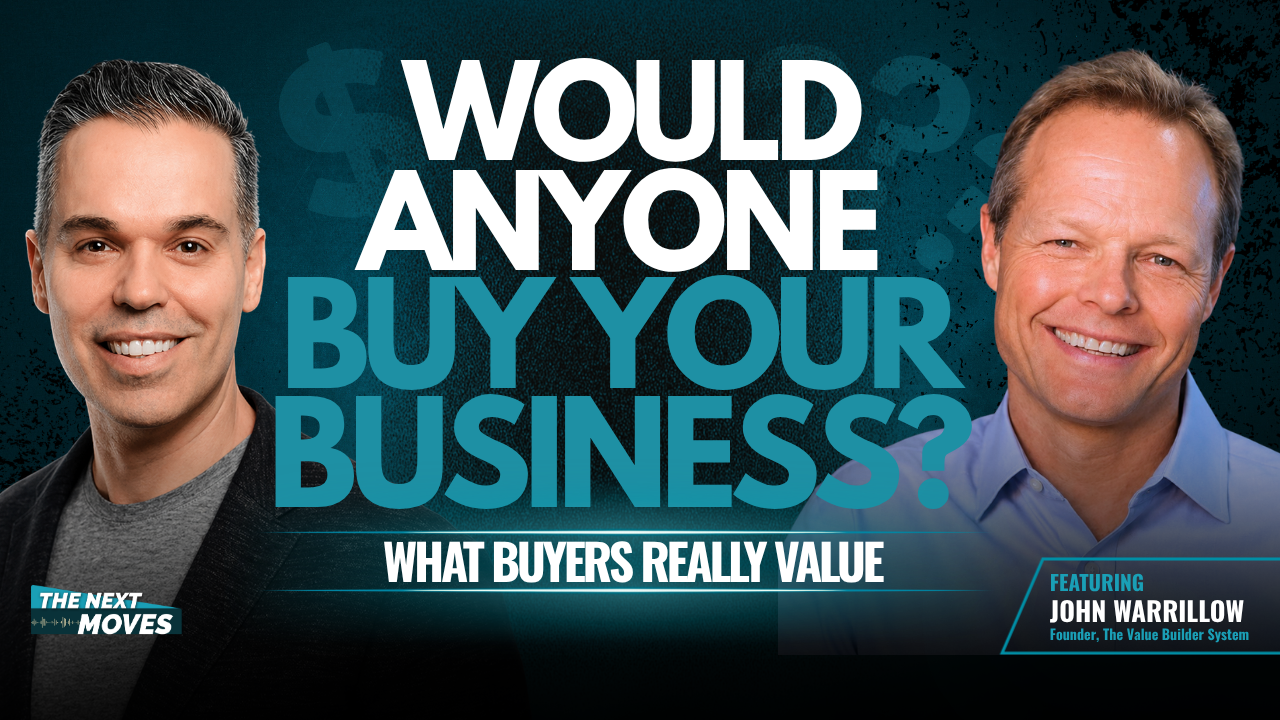
In this episode of The Next Moves, Joe Diubaldo, Founder and CEO of Clarity Recruitment, talks with John Warrillow, author of Built to Sell, The Automatic Customer and The Art of Selling Your Business. They cover owner dependency, why focus beats cross-selling, how recurring revenue and cash flow shape a deal, the difference between strategic and financial buyers, and how AI is changing the way buyers look at every company.

Spotify

Apple Podcasts

Amazon Music
Buyers now ask a new question of every business they look at: will it survive AI? When this episode was recorded in June 2026, Warrillow said AI scrutiny had changed deals dramatically over the previous four or five months, and not just in software. For founders, CFOs and leadership teams, the things that have always driven value, like owner independence, focus and predictable revenue, now sit alongside a harder question about whether the business model will hold up.
A business is valuable to a buyer when the buyer can see how it will perform under their ownership, not yours. Warrillow learned this firsthand. About twenty years ago, he ran a market intelligence business with five to six million dollars in revenue and roughly $1.5 million in profit. When he asked an M&A adviser what it was worth, the adviser asked who did the research and who did the selling. The answer to both was Warrillow. The adviser told him that, as it stood, the business couldn’t be sold.
Warrillow spent about two years rebuilding it. He created recurring revenue and put other people in charge of sales and research. The company was later acquired by a publicly traded company. His takeaway: “For a business to be valuable to an acquirer, they have to know how it’s going to perform under their ownership.”
Owner dependency also shows up in the deal terms, not just the price. A buyer may push more of the value into an earnout, ask the owner to roll equity into the new company or, in smaller deals, ask for vendor financing. Finance is a common trouble spot: if the owner still approves everything, buyers will price that in.
The fastest way to grow revenue is often the fastest way to destroy value, according to Warrillow. Most companies grow by cross-selling new products or services to existing customers. But strategic buyers, who usually pay the highest prices, don’t need a company to diversify for them. They want the one thing it does best, and they discount the rest.
His example is a company that handles payroll for families who employ nannies. At about $300,000 in revenue, she ran out of easy customers and faced a choice: add other household services or double down. She stayed with nanny payroll. Twenty-five years later, the business had about $9 million in revenue. She approached Care.com, which had seven million subscribers, and showed what her service could be worth if even one or two percent of them signed up. She sold the company for $54 million, six times revenue. As Warrillow put it, “That’s only possible when you become the best in the world at doing one thing.”
That’s the difference between the two kinds of buyers. A financial buyer, such as a private equity group, is buying a future stream of profit. A strategic buyer asks what the business is worth in its hands, which is usually more.
In professional services, buyers pay for what a firm owns, not who it employs.
Most professional services firms never sell, Warrillow says, because there’s little to buy beyond the people. Every project is custom, and once a mid-level employee knows how to do the work, nothing stops them from going out on their own. The firms that become valuable pick one thing and build intellectual property around it, like a benchmarking database a competitor can’t easily recreate.
Warrillow made that change in his own business. Instead of writing a custom proposal for every bank that had a problem, the company moved to syndicated research: one study, sold to everyone in its database. That gave the business structure and something to defend.
AI raises the stakes. “I think service businesses are going to get crushed,” Warrillow said. The tools that make a firm more efficient are just as available to its competitors, to new graduates and to its clients. He believes the winners will lean into what AI can’t easily copy, like round tables and live events, and he’s skeptical of firms handing their marketing to AI. Joe shared that Clarity is building AI into its own recruiting work, with the aim of improving quality, not just speed: placing leaders who help founders make decisions and who stay past their first year.
“The more that we lean in our humanity, the more I think we can survive.” — John Warrillow
Build the business as if you might sell it, even if you never plan to. Start by finding where the business depends on its owner, especially in sales and finance. For CFOs, Warrillow says cash flow is the place to begin. A buyer writes two checks: one to the owner and one for working capital. The more cash the business generates, the smaller that second check, and the more is left for the first.
The full conversation with John Warrillow is on YouTube and wherever you listen to The Next Moves. If you’re building the leadership team that will make your company more valuable, talk to the Clarity team about your search.
What makes a business valuable to a buyer?
A business is valuable when a buyer can predict how it will perform under their ownership. Buyers pay more for companies that don’t depend on the owner, focus on doing one thing well and have predictable, recurring revenue. Profit alone isn’t enough if it would leave with the founder.
Owner dependency is when a business relies on its founder to sell, deliver the work or run key functions like finance. It lowers the price a buyer will pay and usually leads to tougher deal terms, such as earnouts, equity rollovers or vendor financing. According to John Warrillow, it’s most pronounced in smaller companies.
Recurring revenue makes future cash flow easier to predict, so buyers apply a lower discount rate when they value the business, which means a higher valuation. That’s why subscription software companies, and wealth managers paid a percentage of the assets they manage, tend to earn stronger multiples than project-based businesses.
A financial buyer, such as a private equity group, values a business on the profit it’s expected to produce. A strategic buyer values it on what it’s worth in their hands, such as the customers or revenue it could bring them. Strategic buyers usually pay more, and the negotiation typically lands somewhere between the two values.
(00:00)
AI is having an incredible impact on virtually every industry. And there’s just a lot more scrutiny around deals to say, how durable is this business in the in the in the face of AI? It’s not just software, right? It’s like it looks literally at every business is saying, does this survive the AI revolution? Right? Like that do the does this business in its current form survive? Like literally every industry buyers are saying, you know, can Claude do this? We talked about, you know.
legal firms. we talked about accounting firms. Do they still exist five years from now? I don’t think in the current form. Not not with Claude. so, you know, buyers know that. They’re among the most sophisticated business people in the world and they are placing heavy, heavy scrutiny on does this business survive the AI revolution?
Joe (00:55)
There’s a question that I’ve been sitting with for a long time and it goes like this Why are two companies that look almost identical on paper, same revenue, same profit, same industry, worth very different amounts when they go to sell and someone goes to buy them. One sells quickly and the other one can’t find a buyer. And these differences don’t necessarily have to do with how much money the organization makes. There’s one person that I feel can answer this for me, and he’s someone who I look to when I first started this organization.
His name’s John Warlow. He wrote the book Built to Sell. You’ve seen him all over YouTube. He’s been on Bloomberg, and he’s advising people on how to build value inside of organizations, really in that sweet spot of probably sub fifty million dollars. We’re gonna ask him that question and many more. John, welcome. It’s a pleasure.
John (01:45)
Good to be here, Jim.
Joe (01:47)
So I’m gonna just start where I always start in my own head. Why can a business be genuinely profitable?
and still not be worth what a what an owner or a founder wants and worth nothing to a buyer. What’s the gap between making money and being valuable?
John (02:06)
Yeah, it usually comes down to can I make money as the buyer running your company? I know you can make money as the as the owner currently. I learned this the hard way, Joe. Back twenty years ago, I used to run a market intelligence business and I I built it up to I don’t know, five or six million in revenue, probably a million five in profit. I thought I was sitting on a gold mine. And I went to see a guy named Perimi, Toronto based, now runs private equity group, but at the time was an MA professional.
And I said, Perry, like, what do you think it’s worth? And I was kind of rubbing my hands together thinking this thing’s gonna go for a minute. And he said, Well, before we answer that question, let me ask you a couple of that. I said, shoot. And he said, Okay, like, well, you’re in the market research business. So who does the research? And I said, you know, I’m involved in some of that. And he said, Okay. Well, who does the selling? And I’m like, it’s you know, my name’s on the door. I’ve got to do some of the selling. And he says, Okay, well, there’s nothing here. I like I can’t sell your company, it’s worthless. And
And I walked into that meeting kind of chest pumped out, feeling pretty, you know, proud of myself. And I left feeling like an inch tall. Right. Then I’d built this business that was what I thought was a really valuable asset with lots of profit and lots of, you know, blue chip clients. And what Perry was telling me was it was virtually worthless to a buyer because it was so dependent on me. And that that kicked off for us a kind of a two year odyssey where I remade the business. I
create a recurring revenue. I put someone in charge of sales, in charge of research. It was ultimately acquired by a publicly traded company, New York Stock Exchange listed company called Gartner Group. but it for me, I think galvanized this this idea that you, you know, raised in your question, which was that, you know, for a business to be valuable to an acquirer, they have to know how it’s going to perform under their ownership.
Joe (03:58)
So a transformation of only two years is impressive. And you’re talking about what I would say I’ve seen often, which is really key man risk or that the business has to be able to run without the owner and make money. If you take that idea and scale it out to larger organizations, ones that have hit 30, 40, 50 million in revenue, and maybe this isn’t a fair question, how does that risk show up at larger private companies that have managed to scale?
What does it what does it cost in value or or is does bigger solve some of these problems for the acquirer?
John (04:35)
Yeah, it’s not a space I really play in, Joe, to be honest. I you know, our world is where the the lion’s share of businesses is, which is the kind of one to ten, one to twenty million in annual revenue. That’s where owner dependency shows up the most. Most larger companies, like once a business reaches ten million in value, fifteen million in value, twenty million value, the business owner will typically wake up one day and say, my gosh, like that’s enough money for me to live comfortably for the rest of my life. And they’ll
They’ll sell a chunk of it. They’ll sell it to private equity. They’ll bring in a family office. They’ll they’ll sell a bunch of the equity to to de-risk. so the majority of the owner risk problem happens sub 20 million in annual in enterprise value. That’s that’s where that that that really shows up. And you know, I’d be guessing to look at at larger businesses. Obviously, if you go all the way up to the very high end, you’ll get the the the current IPO.
of SpaceX, I mean, that’s heavily dependent on Elon Musk’s storytelling. So it never goes away, right? The that the problem of owner dependency still will show up in even the largest companies, but it’s most pronounced in the smaller companies.
Joe (05:43)
You bring up an interesting point with SpaceX IPOing today. If you were to apply your model to this and say key man risk, what do you think of the valuation that’s out there now?
John (05:53)
Yeah, I mean it’s through the roof, right? Like the the key man risk associated with that is through the roof. The the Musk’s ability to tell stories and and ability to kind of string together a narrative is is how that’s getting a such a high valuation, right? Like you can’t as I mean, again, I haven’t looked at the the documents in in great detail, but you can’t really justify that kind of valuation on the current business. You’ve got to place a huge bet on the future of the business, which is what all investors do. They’re making effectively a calculated bet on the future, but
in the case of us, you know, SpaceX, a lot of that bet is can Musk kind of recreate the magic that he’s, you know, created so many times before? you know, there’s there’s a case to be made that he’ll he’ll figure out a way, which is what a lot of investors will, you know, will be betting on.
Joe (06:42)
So you’ve you’ve measured value across a set of drivers and you’re you’ve interviewed so many people that have built and sold businesses. And I’m I’m wondering if within your your set of drivers, if there’s a common starting point that has to be tackled first. And or is it a s or is it a series of points? Like is it typically this is number one, or is it like there’s a cluster of three that you always see as
Something people have to start with.
John (07:14)
Yeah, the the first is really getting really good at doing one thing. And and here’s the problem. Most businesses grow by cross-selling. They’ve read the books and seen the stories about how it’s like eight times cheaper and easier to cross-sell your existing customer or new service, right? Everybody’s seen that work. And as a result, they say, okay, we’re we’re selling this suite of customers, this product A, but boy, we could really grow if we sold them product B, product C, and product D. The challenge with doing that is that.
Buyers, and particularly strategic buyers who pay the highest price for your business, don’t need you to diversify for them, right? They want the one thing you’re best at the world at delivering. I I’m reminded of a podcast I did with this woman named Stephanie Breedlub. She did an amazing job. She built a payroll company that pays payroll for nannies. So if you’ve got a nanny and you want to pay them legitimately, you’d hire her company to do that. And she reached about 300 grand in revenue. It was like her and an assistant.
And she ran out of people to sell to, like all of her friends and friends of friends she already sold to. And she reached that point on the road that every business has reached, every business reaches, which is what do we do? Do we do we double down as it’s getting harder to find more people to buy what we want to sell? Or do we cross-sell our existing customers another service? So in the case of parents who have a nanny, it’s like, well, we could do meal delivery services and lawn care and like snow removal and you know, all this stuff, right? But she had the discipline to say no.
We got into business to be the best payroll provider for people who have a nanny to pay. That’s what we’re going to double down on. And it took her 25 years to build that business to nine million dollars in revenue. So this is not SpaceX. This is not Tesla. This is a very slow, steady growth business, but discipline, doing one thing, payroll for nannies, all she did. And she reached a point where 25 years on, she decided that she would sell the business.
And she looked around the landscape and said, Who would want to buy a payroll company that just does payroll for nannies? And she realized at the time that care.com was like the Angie’s list of care providers. You plug in your zip code or your postal code, it’ll give you like the five-star rated babysitters in your local market. Right. At the time, they had seven million subscribers. So Stephanie just went to the seven to the company and said, look, if 1% of your seven million subscribers
Buy my payroll service, that’s 70,000 customers. That’s like seven times the size of my business today. If two percent of your seven million subscribers buy now, we’re talking about et cetera. She sold that nine million dollar business revenue, nine million dollar revenue for fifty-four million dollars.
Joe (09:52)
Yeah.
John (09:53)
That is a six times multiple on revenue. Like six X on Ebida is a good outcome, right? She sold it on a multiple of revenue. That’s only possible when you become the best at the world doing one thing. And it’s the biggest mistake I see most founders make is they chase a revenue target. They’re like, we’re at a million, we got to get to two. We got we’re at five, we got to hit 10. And they they do that by the fastest possible route, which is to cross sell. And it’s
Both the fastest route, but the also the fastest way to destroy value. Because again, acquires look at that business. It’s like you and I, when we look at a a cable subscription, right? You you you you you have Rogers Cable, whatever, you look at your thing, you it’s like 500 channels, two of which you watch, right? They want 200 bucks a month or whatever it is for two channels. you know, we discount that. We discount the other four hundred and ninety-eight channels. The same thing strategic acquires do. They say, Yeah, no, we don’t need you to diversify, right? You gutted all these product lines, all these solutions that
are irrelevant to us. We’re going shut them down. We’ll discount them. We want that little jewel in the crowd. If you just focused all your resources on the jewel, you would build a much, much more valuable company. And so that’s the biggest mistake I think people make in in this journey is starting to cross-sell the chase of revenue target.
Joe (11:09)
For those people that are listening that caught it, John lived this within this interview by saying, Look, SpaceX and the size of it and a large company, they’re not my domain. I specialize in this area. I know what I do. I’m an expert in this, not that space. I’ll offer an opinion, but we should discount it. Awesome. I I live and breathe really helping organizations that need to build the enablement function, you know, primarily finance and accounting leaders, but
we look at it and we’re really when organizations are gonna grow, they’re looking at their HR stack, their finance stack, their op stack and and we put people into that. But if I’m really narrowing my focus to my CFOs that I deal with, what’s within their control when they’re brought into these companies to help unlock value? Which of these drivers do you think they should focus on? I mean, there’s obviously EBITDA and multiple, like what what should we be
helping them think about because what you’re talking about is strategy, a strategic choice, which is deciding what you do and what you don’t do. What can these individuals affect when they join an organization?
John (12:16)
In short, cash flow. So when an acquirer buys a business, they write two checks. People fixate on the first check, right? That’s the check to the owner that they, you know, they get to run off into the sunset. The second check, though, is for working capital. And when you hand over the keys to your business, you basically got to hand it over with some cash in the bank to pay the immediate receipts. And and most business owners really forget about the second check.
And yet they’re both drawn on the same account, the acquires account. And so the more your company generates excess cash, the lower the check they need to write for working capital. By contrast, if your company is just a cash suck, you’re in the habit of buying a lot of inventory, buying a long machinery, you’re constantly running down your cash flow, they’re gonna have to write a bigger check for working capital, which basically means they’re gonna shrink the size of the check they write you to sell, you know, to buy your business.
And so that’s one of the things that I would I would really get, you know, a CFO to zero in on quickly is like, how do we improve cash coming in quickly so that not only do we have the money to grow the business, but when we go sell the business, the the acquirer is not gonna have to write a huge check for working capital. That’s one of the kind of immediate places. but you know, look, I I think CFOs can really add a lot of strategic value, like in the in a world of AI, in a world of cloud, et cetera.
You know, everybody’s getting disintermediated, right? Like every professional is is becoming scrutinized as to what is the value you’re adding. Because like now just doing the books doesn’t cut it, right? Like maybe it never did, but it certainly doesn’t cut it today. Now you’ve got to start to say, Yeah, of course I can do the books, but I can actually add a lot of strategic value. So for them, I’d be focused on all eight. I’d be saying, Yeah, like you’re an owner. I don’t expect you to know all this stuff, but but these eight drivers.
are what’s gonna move the needle for your business. And so I’d I’d, you know, cash flow is an easy one because that’s obviously the domain of the finance expert, but I’d go beyond that if I could.
Joe (14:18)
So there’s an education effort around all of these initially when they join probably to bring people to a baseline of understanding and then start measuring them and putting them in front of people.
John (14:28)
Yeah, for sure. For sure. And I mean, again, your world is so important to them, Joe, because the the probably the biggest discount that a business owner is going to get, it’s not only a discount, but it’s also a structuring problem. And that is it that is owner dependency, right? And one of the areas that owners often get dependent on is is the finance function, right? Like they they they they kind of run the books, they sign the checks proverbial. They kind of they do all the kind of bookkeeping.
And if they’re doing that still, or if they’ve got a very junior bookkeeper doing it where they’re approving everything, that’s gonna be an owner dependency issue. And owner dependency issues show up in two places, neither of which are good for owners. The the first is a discount on valuation, the headline valuation. That’s that’s an obvious one. The less obvious one, but in in many cases even more pernicious, is the fact that if if you have an owner dependency problem, the structure’s gonna look terrible, which means that they’re gonna they’re gonna
put a lot of the value in an earnout, or they’re gonna make you roll a bunch of equity so that you’ve got lots of skin in the game. You might have to finance the, you know, the seller to s if it’s a smaller business, you might have to provide, you know, vendor financing. That structuring stuff tends to get much worse, the deal terms. I you know, I think it was was it Buffett who said, I’ll buy any business if I could pay a dollar for a thousand years in the future. Or I think it’s also Buffett who who has this kind of claim.
It says like you set your price, I’ll set the terms. The idea that the terms are where a lot of the value gets clawed back. And if you’re owner dependent, that’s where you’re gonna get messed up with with the terms.
Joe (16:06)
So when you wrote the automatic customer, the idea of predictability, recurring revenue, cash into the future, is that what we’re looking at when we’re de risking an organization and understanding that it drives such a premium when it has that type of business and that type of revenue?
John (16:26)
Yeah, that’s exactly right. It’s it’s why SaaS companies, software companies, generally jive a better multiple than transaction companies. Now, obviously with the SaaS pocalypse that’s going on right now, some of that that’s that’s that’s being cast into question. Meaning, are these revenues as durable as we thought they were with Claude? Do is is Claude going to basically destroy or or or discount a lot of the SaaS, you know, value that we thought. But the same
you know, principle remains that recurring revenue, especially sticky, durable recurring revenue, de-risks the business for the acquirer. And that’s going to be just incredibly valuable to the, you know, the value of the company. You know, finance wants will and you know, speaking to the preaching to the acquire here, finance wants will do a DCF calculation, right? So they’ll do, you know, how much profit is this company making? how much, you know, did we expect it to make in the future? And then discounting that, you know, profit stream back to today’s dollars.
The more reliable and predictable the revenue stream is, the more confidence they have in the future numbers, meaning the lower the discount rate. And obviously with the lower discount rate, the higher valuation. That’s the math behind why you know recurring revenue businesses are trading at higher multiples. It’s just you apply a lower discount rate because you can see the revenue in the future. that’s the the essential. But we see it again. SaaS is one example. wealth management companies, you know, that that use an assets under management.
model where they’re, you know, they’re getting one percent of the assets they manage in perpetuity. And the average lifetime value of a of an a a wealth management client is like twelve years. And so they can get really predictable about the future, which is why those businesses get really good multiples these days. so that’s all about kind of recurring revenue is is one of the the kind of main drivers of value for sure.
Joe (18:14)
So when you look at mid market companies right now, professional services businesses, they may not be subscription businesses and they think they never can be. So how do you build that kind of predictability into a company that’s dealing with projects or services and historically one off deals? Is there a massive pivot needed or is it just a reimagining and reframing of how they do the work?
John (18:38)
Usually a massive pivot in professional services. bec and and it’s really hard to do because most of the professional services providers are ego driven. They’re so insecure as people that they need the the the the gratification, they need the acknowledgement from the client. thank you, Mr. Client. You’re happy with our work. Thank you so much. You’re gonna hire us. And they’re so desperately insecure that it means that they they they can’t they have to provide a solution.
They can’t stand on their own two feet and say, this is what we do. We’re not going to do it for anybody else. Instead, they kind of grovel for the work. And that makes them just every project is different. Lawyers are terrible for this. Every project is different. There’s nothing unique, nothing scalable, nothing structured. And so they get discounted. And most of them never sell, like most professional services firms never sell. It’s just really a management transition from the next tier of middle, middle managers up to become partners.
And and the reason for that is because there’s no IP, there’s no structure. It’s like the middle, you know, manager says, Well, like I know how to do the work, like I know how to do the le legal work or the graphic design or the whatever, you know, professional services they’re providing. And they say, when they get to a level of competence, they say, I don’t actually need to work in the context of this firm. I’ll go put up my shingles somewhere else. Right. I mean, well, yeah, you know, recruiting is the same thing. Like once you build a book a book, you know, you gotta become you gotta be made a partner or you leave. Why? Because there’s no cost of entry.
Right. There’s no barrier to entry. You just put up your own shingle and you’re you’re a your partner all immediately. And so most professional services companies are not valuable because the the there is no value in it other than the people that that run it, which is why they’re they’re deeply discounted. The best professional services companies do the opposite. They say, We’re gonna do one thing, we’re gonna build IP, it’s going to be a moat, right? So that the companies that do branding where they built like branding benchmarking reports and they’re like
We have the quintessential database on you know a certain market segment. That’s IP you can’t just manufacture it. That gives them a moat, and that means that, you know, to work for that company, you’re not just a hired gun. You’ve actually got to work for the company. There’s there’s inherent IP. In our case, you know, I’ve lived this world, you know, f 20 years ago, I had this market research business and we were the groveling, insecure little professional services company that would do anything for a buck, right? You know, Bank of America had a problem, we would go in and provide a solution.
Royal Bank had problem, we would go in and provide a customized proposal for them. And we kind of pulled up and said, This is crazy. There’s nothing, there’s no tail to what we’re doing. What we’re going to do is switch the model to be syndicated market research. So we would do one piece of research and then we would sell that research to everybody in our database. That gave us structure and it it gave us IP and ultimately it gave us a moat that made us more valuable than if we were just a professional services organization.
Joe (21:29)
I want to take you back to you walk out of the office, you’re heartbroken, and the transition from this is awful, I’ve built something that doesn’t have value to okay, I have a plan and I’m executing it. My question is, how long did that take you? The second thing is, did the plan survive the collision?
with the market or did you have to iterate it? Like what did you tackle first? What assumptions did you make? And and did you manage to execute really quickly on a plan over two years? Or did you find there were fits and starts to it?
John (22:05)
Yeah, it goes back a long time, Joe, like 20 years ago, but it but so I you know it’s a bit f fuzzy and the timing is little bit bit different, but there was a fork in the road where we had one giant misfire. And the misfire was that I had a general manager, president of the company, who was incentivized by Ebita. And and I was keen to kind of move the company in the subscription model world and really make a just a fundamental change to the way we did business.
But those short-term changes, those those the structural changes led to short-term reductions in our EBITDA. And I never changed the variable compensation model of the president. So she continued to be you know motivated and incentivized by EBITDA was I wanted to make these structural changes, these big, big kind of major structural changes that would in the short term diminish EBITDA. And I never changed for variable comp.
And that created friction. Ultimately, she left. And that created a kind of a there were two sort of groups in the company at the time. It’s a small company, like 25 employees or something like that. But there were there were two factions, right? Some loyal to her, some loyal to me. And it created just a kind of huge rift in the company. And as I’ve reflected on it over the years, I think the mistake was mine. I just failed to rethink the variable comp and the kind of incentive structure.
Of the president to align with what my goals were, which were to not only build a profitable business business, but in the longer run build a more valuable business. she didn’t have shares in the company. So she didn’t have the long-term sort of equity that that I did. But that was a kind of sort of a big learning for me. And I’ve always like kind of remembered that idea of like, you know, resistance to change is often very personal. Like it’s very like, how’s this going to impact me today? My bonus this week, this month.
I made that mistake. Again, this is twenty years ago now. The players have all moved on and had successful careers, but you know, the the lesson sticks with me.
Joe (24:05)
That reminds me of a line that one of my coaches said to me, I’ve been lucky enough to have some very bright coaches who have been operators inside of businesses. We have a common friend in one. His comment was basically, you know why incentives are fantastic? And I’m like, Why? He’s like, Because they work. And wherever you point people at with that incentive, you’re likely to get more of it. And where you don’t, you’ll get less of it. If I think about this now, you you make a point of separating strategic
from financial buyers, from private equity. And I want you to just for people that are listening to this, you know, language is valuable because you can frame things effectively on what your path looks like. So let’s break these two things out right now and talk to me about the current state of each of these buyers. What’s happening right now with them?
John (24:54)
Yeah, sure. So there’s two types of buyers. You know, i i if you wanted to s kind of generalize deeply, there’s financial buyers and there’s strategic buyers. So financial buyers are in the same way we’re buying an asset, we buy a house, a commercial real estate property, a stock, a bond, whatever. We’re basically just buying a future stream of cash. That’s all we’re doing. We’re saying, you know, this thing that I’m buying is expected to make profits in the future.
And the bigger the stream of profits and the more reliable that stream of profits are, the more I’m willing to pay today for that asset. So that’s a financial buyer. And and there are financial buyers of businesses. Oftentimes they’re strategic, they’re private equity groups that are buying an asset. They they could be a family office, they could even be an individual investor who is buying an asset that they think will throw off profit in the future. The strategic buyer is a different animal altogether. They are
Looking at what your business is worth in their hands. to go back to the Stephanie Breedlove example in care.com, care is not valuing Breedlove on a multiple of EBITDA. They’re instead saying, if 1% of our 7 million subscribers buy that service, that’s 70,000 customers. What’s 70,000 customers worth to us? And they’re going to model 2% and 4%, 5%. And they’re going to basically come to some
sense of what the strategic value is in their hands. And so typically the strategic value is bigger than the financial value. And the negotiation is has it, you know, happens in between those two numbers, right? so as an owner of a business, as a shareholder, you probably want to be paid for the strategic value. The the buyer is going to turn around and say, that’s our value.
Right. That we we wanna that, you know, that’s what we have to gain from this, and we’re gonna keep 100% of that. And that’s where the negotiation happens typically with the strategic. It’s like the between the financial value and the and the strategic value. what’s going on in a marketplace right now? So I mean, you know, private equity companies are still trying to deploy capital. they’re getting kind of beat up right now because a lot of the investments they made five or seven years ago aren’t liquid. AI is having an incredible impact on virtually every industry.
And there’s just a lot more scrutiny around deals to say, how durable is this business in the in the in the face of AI? it’s not just software, right? It’s like it looks literally at every business as saying, does this survive the AI revolution? Right. Like that that do the does this business in its current form survive? And I’ve never seen in it until for me, it’s even in the last like like last year.
We’re recording this in June of twenty twenty six. So at the end of twenty twenty five, obviously kind of we we were well aware of AI. but it really wasn’t showing up in a in as a dramatic way as as it is now. It it was kind of a novelty. people were using it, but there was like in the last four months, five months, the it’s totally changed. like like literally every industry buyers are saying,
Can Claude do this? We talked about you know legal firms. we talked about accounting firms. Like, do they still exist five years from now? I don’t think in the current form. you know, not not with Claude. so you know, buyers know that. They’re not, you know, they’re they’re among the most sophisticated business people in the world and they are placing heavy, heavy scrutiny on does this business survive the AI revolution?
Joe (28:36)
That leads me to an idea, which is something you’ve already said, which is does this business survive into the future and in what form? I guess the signal you’d be looking for as a buyer is proof of the organization’s ability to evolve and leverage the tools to reinvent themselves against the face of what’s probably going to be margin compression. Like look at recruitment and you look at it as a service industry, and we are actively deploying this in our workflows.
To be the company that has the ability to do aggressive pivots into spaces that other people can’t. The reason why is I’m drinking the Kool-Aid. I’ve invested heavily in it and I feel like I have to. This may take longer. Like the world has momentum and inertia, and it may take longer than expected. If you were to forecast on the horizon, are you thinking that services businesses are going to be dramatically impacted in the next 12, 24, 36 months? What are you hearing from people?
and from founders that are actively operating their business right now.
John (29:41)
Yeah, I I th I think service businesses are gonna get crushed. Absolutely crushed. So I would be looking for ways to bring the human element to them. What I see a lot and and I gave a we we Value Builder has like a thousand advisors that use the tool and so we we we have a an event that we put put on every year for our advisors. And I gave a speech this year at the at the at the event talking about AI and and and there’s
What what I think is is happened is there’s this sort of this kind of bio rhythm or kind of wave that that that advisors go through, professional service providers go through. The first wave is all optimism, right? They’re like, my God, like this can write my proposals for me, this can do my analysis for me, this could like there’s just all like like all day long. It’s like this is incredible. This is the most amazing tool ever. And then it hits them. They think, wait a minute.
My competitors have access to the same platform, they can do it. And every young kid right out of university has the same platform, they can do it. And all the barriers to entry that I thought I had in my years of experience, my brand, blah blah blah, are all starting to fade away. Not only do my competitors and the young people just entering the same industry have access to the same tools, now my customers have access to the same tools, right? So now they can disintermediate me altogether.
And then they hit a trough of absolute despair where they think, what’s the future? Right. Like there is no future of an accounting firm, a law firm, whatever. You pick the professional services you want. I think there is a future, but it requires a completely different way to think about your business, which is it’s the human elements that are hard for AI to replicate. And so I think the winning firms are going to go back to a world where.
From a business development standpoint, they’re taking people to lunch. They’re buying the box at the game. They’re showing up physically in face-to-face you know meetings that AI can’t deliver. And what I see a lot of professional first services firms doing is exactly the opposite. They’re they’re trying to leverage AI.
They’re trying to out AI the AI. They’re trying to build their website using AI. They’re trying to create tools using AI. God forbid, I see another LinkedIn post from somebody who’s posted some garbage that they’ve produced through Claude. It has become LinkedIn is just now flooded with garbage that Claude like AI slot that go that that you can tell has been generated by by AI. And I think it in a funny way undermines their reputation. Because if you’re going to put
your marketing in the hands of Claude. you know, you’re, you’re, you’re, you’re, you’re, you’re dehumanizing your company. And if professional services have anything, they’ve got humans. And the more that we lean in our humanity, the more I think we can survive. But trying to to to leverage these tools, especially for your marketing, I think is just a massive mistake. And I think it’ll show up. I think the winners are the ones who are like,
Hey, let’s get together for lunch. Let’s do a round table. Let’s do a physical live event. Let’s do a workshop. Let’s go to the game and I’ll rent out. I mean, it sounds like 1984, but I think that’s the play that it, you know, if I ran I don’t run a professional services company, but if I did, I’d be all in physical.
Joe (33:14)
Are you seeing signs of success with this from anyone? Is anyone thinking like this as you’re
John (33:18)
for sure. Yeah. Yeah. We’ve got tons of advisors on Value Builder that have that have made the migration. you know, I think COVID put us all in a weird virtual world like here we are recording, you know, this virtually. you know, we’re all of a sudden, it’s more efficient to do Zoom and it’s I again it all let’s all work remotely. It’s all it but at the end of the day, I I think, especially in Canada, you know, I see a di most of our customers are in the United States and and they have been, you know, obviously back in the office since.
basically April of twenty twenty, you know, it w what’s a month of the pandemic was over. They like, let’s go back to the office. In Canada, we’ve gotten so bad at s y at this sort of weird, like, we’ve got to work from home, so much remote. Like the banks have been trying to claw back people to work. Now it’s like, well, you can come back four days a week, but you still get one day at home. Like it’s like this is how slow it has been to to kind of rip the band aid off of from from COVID has been
a problem. How did I get onto this diatribe? But effectively the you know the the the the the the human element, the physical, I think is going to be the only way professional services companies survive.
Joe (34:29)
Interesting.
John (34:30)
Do
you think they’re gonna face margin compression? Massive margin compression?
Joe (34:35)
Your your comment like this is exactly you game theory things out and you’re like, Well, this is fantastic. We this makes us more efficient. What’s the likely response from our competitors? They start deploying and using it. So, okay, how do we respond to that? Well, there is value in looking at it from what’s the promise that you provide? And the goal isn’t just that I’m putting in in my business that I don’t put someone in and it’s I I don’t want to drop like
Cliches, but putting someone in to fill the seat versus someone who’s going to add value to the company by helping founders make decisions and also survives the first year. So looking at your defects and how do you improve your quality score, not just your efficiency score. Marketing is an interesting one because people are blowing up LinkedIn. And I’m with you. If I see one more thing that says, here’s the thing that you didn’t know as the opener,
John (35:30)
Right, right. You with the the stylized like graphic that you could tell has been done by Claude or Gemini or whatever. I think we’re just Yeah, it’s an interesting it’s an interesting one for sure. I think what’s gonna be interesting to watch is is the new recruits of graduates coming out in the next like the class of twenty twenty-seven and class of twenty twenty-eight, because all of them are gonna be
Full digital natives, right? So AI natives. Like they’re they’re not going to be learning about AI. They’re going to have like basically grown up with it. And I think they will actually command a premium in the marketplace where these sort of older, you know, established businesses, millennial-run businesses, Gen X-run businesses, are struggling mightily with the adoption. They’re just kind of clinging to their old business models.
I think the people that are like twenty-eight, twenty-nine, thirty, thirty-one, thirty-two are gonna get crushed because they’re they’re w they’re the bottom end of the of the of the of the labor pool. They’re still on their first job or their first second second job, maybe. and and and they’re not AI native. And so I I think I think we’re gonna see a resurgence of hiring at the very low end of like the the literally the university graduate for people who are super AI native. Like they grew up with it.
but I think people who are twenty seven, twenty-eight, you know, on the first rung of the ladder, career wise, they might get crushed.
Joe (37:00)
And the reason why the group that came out two years ago is going to be at a disadvantage is because they haven’t been using it the way that the new university cohort is. And they are, like you said, living in two worlds. They haven’t found their hedgehog, they’re not leveraging it in the right way. The hiring of the person who’s second year right now in university, when they come out
They’re going to drive a lot of value. And the advice that I give people now, it doesn’t matter if your organization, if you’re working and you’re that cohort that’s 27, 28, 29, it doesn’t matter if the organization isn’t developing you in your ability to leverage AI. You should be using it in every way that you can and building the competencies that you can then bring in because that’s your portability. Someone will pull you into your next role. You can, you can arrive.
Or or regress back in that earlier cohort that we’re talking, or the later cohort I should say, that comes out in the next two years and be just as valuable, if not more than, ’cause you have context of a business and you can then say, Hey, I know what it looks like to exist in the old world, but I’m also programmed in a way to operate in the new world.
John (38:11)
Did interview with a guy recently who is acquiring non-AI businesses, like businesses that have not made the AI shift yet, right? And and so he’s as you might imagine, paying really low multiples for the business. But he’s said 20-something guy who’s look picking off these great businesses where the Gen X or the boomer owner just like they look at it, they just they can’t get their head around it, right? So they’re
So he’s going in and paying, you know, two or three times EBITDA for these businesses and just injecting AI into all the workflows and the processes. And that’s his thesis, which I think is going to be more common. You know, like for a lot of boomers, I don’t know if you identify with this at all. You’re younger than I am, but I think I think the it’s hard to have perspective on this because you know, every generation thinks they’ve had a tough you know go.
But for late millennials, excuse me, late millennials, Gen Xers and early boomers, they have gone through some major, major disruptive events. So you think back the tech wreck of 2001, if you go back further, 9-11, then you had the GFC, then you had the pandemic. All businesses through light have problems, but I think you could make a pretty good case that businesses that have sort of survived the last, say, 15 years have gone through a whole lot.
Disruption. And now they’re looking at AI and going, I’m out. Like I don’t have it in me. I like I just don’t have it in me. I I like I I dealt with all the COVID shit and now I dealt with all of the GFC. I just don’t have it in me. So I think there is a large cohort of older businesses owners, call it late millennial late Gen X and early boomers, who are just saying, tapping out.
And they’re gonna get whatever they can get for their business, a lower valuation. And there are gonna be a lot of businesses that are acquired at very low multiples because of that. There are gonna be really interesting opportunities for there’s this whole, I don’t know if you’ve been following this Joe, there’s this whole entrepreneurship through acquisition. yeah.
Joe (40:19)
Yeah,
so stealth monitoring was the most successful search fund play in Canada.
John (40:28)
Yeah, for your listeners who don’t know, entrepreneurship through acquisition, it’s this major trend. It was, I think, popularized first by two guys at Harvard who wrote a book on it. I had them on the pod a long time ago, and they’re they’re kind of pioneers in this teaching MBA students how to buy a business. Instead of going to work at McKinsey or you know, Proctor and Gamble, they teach students how to buy a business using a lot of debt and a lot of leverage. And and some of them
go to search funds to to fund these businesses. Some of them kind of fund them, you know, out of their own pocket. But it’s a huge trend. So now Harvard has a program, Stanford has a program, Cornell has a program, all the big sort of blue chip, you know, MBA programs in the US have these programs. And it’s become a very accepted way for MBA students, to to build a career that all these people that used to go to work in investment banking consulting, a lot of them are starting to choose to work in
in entrepreneurships or acquisitions. So it’s a big trend. And I think a lot of those folks will be looking at these boomer run businesses that haven’t adopted AI saying, yes, please, all day long, I’ll pay you whatever, three times profit for this business and make it worth seven times five years later. Like that’s that’s a model we’re gonna see.
Joe (41:41)
I started this conversation thinking it was about how to sell companies, but I’m leaving convinced it’s how to run one. And when I look at what you’ve developed over time, how often are people reading what you’ve written before they start the business and baking it in from the start? Are you seeing that as part of people’s journeys? Are you getting that feedback loop? Because for me, when I started Clarity,
My coach had given me your book when I was working at an organization and I just thought this seems so reasonable and thoughtful in the way that it’s done. So are people reading this ahead of time or are they typically picking it up when they’re in the middle of the same apocalypse that you’re talking about when you think I don’t have anything of value? Like what’s their starting point?
John (42:33)
That’s well, that’s interesting, generous that you’d acknowledge the book. yeah, you know, I the honest answer is I don’t know. I I to be honest, I don’t know because Built to Cell is you know, it’s published I I don’t know who buys it because you don’t f you know, the the the the publisher doesn’t give you a list of here’s all your customers today. Like they you don’t know. So I I get some signal from people that that listen to the podcast. I get a sense that for a lot of them
They are building to sell rather than wanting to sell now. I I sometimes I’ll do speeches and I’ll canvas the audience. And one my favorite questions to start a you know a presentation is just can I get a show of hands? How many of you want to sell your company? And of course, in a public room, virtually no one puts their hand up, right? And then I’ll say, okay, just a separate, let me just tr change the kind of question here. How many of you like would like to know you could sell your business when you’re ready? And like virtually every hand goes in the air, right? Because
I think everybody wants to know that they’re building an asset, that it’s got value. it doesn’t mean you want to sell it. Like you you get your statement for your RSP in the once a month. You like you look at it, like it’s nice to see it going up. Doesn’t mean you want to retire. It’s just it’s just nice to see that you’re building value. And in the same way, I think, you know, you know, a lot of people have the same view about their company. Like they don’t necessarily want to sell it, but they definitely want it to be an asset that one day they could.
Joe (43:55)
I also think that if you look at the principles, whether it’s growth potential, customer stickiness, recurring revenue, monopoly control, these are things that any business owner would aspire to and would want. So at the design stage, what I’d recommend for people is they take a look at this and have a read and think, Am I creating something if at some point in the future I want to sell maps to these principles within the framework? I think that it’s a it’s an excellent idea.
John, this has been fantastic. It’s probably for me almost fifteen years and twenty years in the making, almost. Fifteen years. Fifteen years in the making. So I appreciate the time. Thank you for doing it.
John (44:37)
Yeah, my pleasure. It’s been fun.
Joe (44:39)
I hope this conversation with John Warlow gave you a new way to look at the business you’re building. And I know it affected my thinking when I started. Remember the next moves is wherever you listen. you can get the full episodes on YouTube. Please like, please subscribe. You can send me comments, you can comment. It helps us. I’d love to hear from you. Thank you.
Here is your link to the 2026 AI Listening Tour Findings:
2026 AI Listening Tour (PDF) ↗Are you hiring? Get in touch with us to talk about better hiring.
Get in touch →
Here is your link to the 2026 Salary Guide:
2026 Salary Guide (PDF) ↗Are you hiring? Get in touch with us to talk about better hiring.
Get in touch →
Here is your link to How Finance Fuels Growth:
How Finance Fuels Growth (PDF) ↗Are you hiring? Get in touch with us to talk about better hiring.
Get in touch →
Here is your link to the Finance Team Org Charts:
Finance Team Org Charts (PDF) ↗Are you hiring? Get in touch with us to talk about better hiring.
Get in touch →