Most organizations assume the thing slowing their AI down is technology, tooling, or a team that needs training. That assumption is where the budget goes, and it’s the wrong place to look.
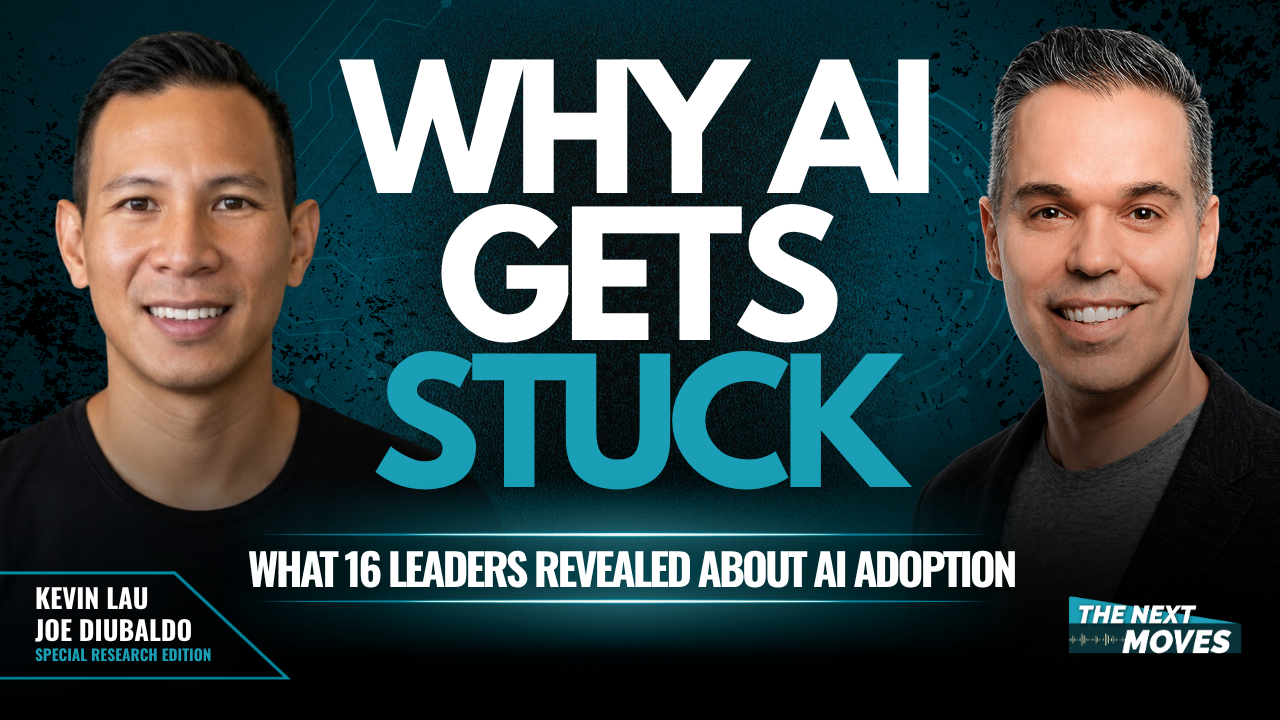
Between April and June 2026, Joe Diubaldo and Kevin Lau sat down with senior leaders at 16 organizations — off the record, from a 50-person software company to one with more than 100,000 employees — and asked where the bottleneck actually lives. The answers were about people, process, and structure. In this episode of The Next Moves, Joe takes the guest chair and Kevin walks him through what the research found, including the places Joe was wrong going in.

Spotify

Apple Podcasts

Amazon Music
Most organizations assume the thing slowing their AI down is technology, tooling, or a team that needs training. That assumption is where the budget goes, and it’s the wrong place to look.
Between April and June 2026, Joe Diubaldo and Kevin Lau sat down with senior leaders at 16 organizations — off the record, from a 50-person software company to one with more than 100,000 employees — and asked where the bottleneck actually lives. The answers were about people, process, and structure. In this episode of The Next Moves, Joe takes the guest chair and Kevin walks him through what the research found, including the places Joe was wrong going in.
Finance is where this pressure lands first. Every finance leader on the tour named FP&A as the hotspot, and the fastest-moving teams were already running forecasts they’d never had the capacity to build. But the problem this creates isn’t a finance problem — it’s a hiring problem, and it’s showing up the same way in HR, IT, and operations. Leaders are writing job descriptions for someone who knows the function cold and can build with AI inside it, then discovering the market can’t produce that person as a single hire. What the tour surfaced is that the shape of the ask is wrong, not the ambition behind it.
Every leader was given four layers — process, data and tools, skills, will — and asked to stack-rank them for their own organization. Data and tools came out on top, named by seven of the sixteen. Will and skills came second. Process was named by three. Skills on its own never topped a single list.
Joe’s read on why that’s surprising: skills is where the money goes. Training budgets, tool rollouts, lunch and learns. When leaders take stock of a team, they default to a skills inventory, and the assumption underneath it is that people can’t learn the tools. They can. “Knowing how to use a tool and knowing what to do with it are two different things,” Joe said. “We’ve been funding the wrong one.”
The other correction came mid-conversation, more than once: several leaders realized their data problem was a process problem in disguise, because the faulty data was the output of a process nobody had redesigned.
The two most advanced organizations on the tour were a roughly 50-person company and one with more than 100,000 employees. The stuck ones sat in between — and they weren’t short of money or willingness. What they lacked was a working unit. The teams where AI capability actually lands are small functional teams, two to nine people, and that unit is the same size and shape at any scale of organization.
The second assumption that broke was efficiency. Joe went back through his notes across all sixteen conversations and couldn’t find a single headline result that was old work done faster. Every one was work the organization hadn’t been doing at all. A residential real estate operator put an AI agent at the front of its leasing process — identity check, guided tour, smart lock, application, approval — and opened up the hours between 6pm and 9am, when people drive past a sign and call. The leasing agents trained the system, and that changed their own jobs. It was a people story with technology underneath it.
In more than ten of the sixteen conversations, leaders described the same hire almost word for word: someone who knows a function deeply — finance, HR, ops — is genuinely fluent in AI, and sits inside the team. They were equally clear about what they didn’t want. No more strategy decks.
That request contains four separate capabilities: business strategy, technical depth, functional expertise, and the psychology of organizational change. Read any real person against those four and you’ll find depth in one or two and gaps in the rest. It isn’t a hiring market failure. It’s arithmetic.
What works is a cluster in sequence. A functional expert lands in the highest-pain function and designs what’s possible. A forward-deployed engineer productionizes it, so it stops living in a folder on someone’s laptop. An enablement lead makes it stick and carries the playbook to the next function. Where the diagnostic says the process itself is broken, an AI process engineer redesigns the workflow around what agents can now do — rather than automating the status quo, which is how one organization ended up decommissioning a multi-million-dollar bot fleet it had installed on top of processes nobody had touched.
Most leaders want this as transitional capability with a handoff date, not permanent headcount. One CFO put it plainly: six to twelve months to automate the month-end workflows, then that person moves on and the muscle is trained.
Don’t start with a hire. Start by ranking the four layers honestly, because that answer determines everything downstream — and be willing to find out your data problem is a process problem. Then take an inventory of who is already doing this work informally: the analyst with a forecasting prototype on their laptop is the seed of a role, and the person your team already watches for results is half an enablement lead. Most organizations have more of the cast than they think. When you do hire, screen for traits before the résumé — curiosity, persistence, and enough frustration with a broken process to go fix it — because AI now writes a growing share of résumés, and the document is a weaker signal than it used to be.
Listen to the full conversation with Joe Diubaldo and Kevin Lau on The Next Moves, then read the complete research: We Asked 16 Senior Leaders Where AI Is Stuck. Part one is the sixteen conversations. Part two sets what we heard against what the consultancies and the frontier labs have published this year.
If you’re working out which of these capabilities your team actually needs — and in what order — talk to the Clarity team about the search. If you’re a finance, HR, IT, or operations professional building AI fluency into your own function, we want to know you before the role opens.
Rarely because of the technology. Across 16 leader conversations, data and tools was the most common primary blocker, followed by will, then process. Skills never topped the ranking on its own — the more common gap was people not seeing what AI could do for their specific job.
No. The two most advanced organizations in the research were a 50-person company and a 100,000-plus-person organization. The stuck ones were in the middle, and what separated them was structure: whether they had a defined working unit — a small functional team of two to nine people — driving the work.
Usually three, in sequence: a functional AI expert who designs the workflow inside their own function, a forward-deployed engineer who builds and productionizes it, and an enablement lead who makes the change stick. Where the process itself is broken, an AI process engineer redesigns it before anything gets automated.
Most leaders on the tour wanted transitional capability with a defined handoff date rather than permanent headcount — someone who solves a specific problem, trains the team, and leaves the muscle behind. That may shift as the roles mature, but it’s what the market is asking for now.
Episode Transcript
Joe (00:00.096)
Nobody that we spoke with was stuck on the technology. They were stuck on people. They were stuck on process and not being able to think about what these tools can do inside of their own job. How could it transform my job? And where people were frustrated and intensely curious, we had the best examples of positive outcomes. So you’re not just throwing money at a problem. You’re not just buying licenses. You’re looking for these moments inside of organizations where you have intense curiosity.
with intense frustration and then creating a culture for them to succeed.
Joe (00:41.646)
So between April and June this year, we sat down with 16 leaders and asked them one question. When you think about why AI isn’t moving faster in your organization, where is it actually stuck? So I went in expecting to hear about the tech, but almost nobody talked about technology. But heard instead over and over was a description of the person these teams were looking for. And they were all looking for someone to join their team who knows a function deeply, like think HR, Think Finance.
And is also genuinely fluent in AI. More than 10 of the 16 describe that person without being asked to describe someone. And the part I keep coming back to, that person as described actually doesn’t exist, not as one hire. So today I’m in the other chair of the Next Moves, and Kevin Lau, who ran this research with me, he’s going to be my partner. And he’s going to walk through how I think about AI implementation and clarity’s teams within our organization.
And he’s gonna take me through what we found, speaking to a diverse group of leaders, including the places where I was wrong going into this. Great, Kevin, you get to point out where I’m wrong all the time. So Kevin, over to you.
Kevin (01:51.726)
Thanks, Joe. really looking forward to this conversation amongst a number of conversations we’ve already had about this. So let me start with a bit of context about how this was built because I think it’ll give the audience a bit of an understanding of where we’re coming from. So Clarity started its journey on its own transformation a while ago. And as part of that journey, we wanted to talk with other organizations to see where they were. So we spoke with sixteen organizations over about ten weeks between April and June of this year.
we did every single one of those conversations off the record because we wanted to really understand from them where they were really feeling about how their AI transformation journey was going. and that’s really the reason I think that these people were so candid with us when we were talking about them and I think more forthcoming in terms of where they were than we we thought they would be. we were also quite deliberate when designing this study. you know, there’s ways in which you could have done a study with
broad survey data and and tons of questions, but we wanted this to be more primary, research focused. and so we were deliberate about going to a number of different companies from small to large. the smallest company we sat with has about fifty people. The largest had more than a hundred thousand. So we got a good sample of public companies, private companies, venture back companies, and found our own businesses because really it’s going to be different for every single one that you talk to. Finance kept pulling to the center.
as we half expected that to, but we also spent time with operations leaders, HR leaders, and technology leaders as well to round it all out. So let’s get right into it. Joe, of the 16 conversations that we had, which one are you still thinking about?
Joe (03:36.184)
So I have to literally pick one.
Kevin (03:38.318)
You got one.
Joe (03:42.328)
Well, there’s actually two, but I’ll I’ll pick one because I probably remember it the most in detail. So it was the CFO of you know a residential real estate company and they put AI at the front of their leasing process. They didn’t put it at the back office. So when you think about it, all these
Residential units need to be leased and you drive by, you see a sign, and you would call a number. So you can actually call that number. And from your first phone call to the signed lease, you don’t talk to a person. In fact, what picks up the phone is an AI agent. And you can ask for a person if you need to speak to them, but people aren’t. They’re actually going through this entire process. That means your identity check, that means a guided tour, a smart lock, your application, your approval, your credit check, like all of it is done.
start to finish. And what I found fascinating about that is it wasn’t actually just that they had this working and it and it did the work of what their normal team would do. It actually opened up a whole set of hours where people were actually looking. They drive by in the evening and, you know, if the leasing desk was closed, they’d be calling in, but they’d get someone answering and it was actually the agent, the AI agent. And suddenly, you know, from the hours of six until
nine the next morning, people were able to get the information they needed and what felt was like a very dynamic human interaction. And that’s fascinating, like number one, but that’s not the part that I keep coming back to. The part I keep coming back to is what the person said about their own people. The people you need to implement the technology are the same people who are probably going to be affected by it. So the leasing agents train the system and then that changed the nature of their jobs. So when you think of that, that reframes
The whole thing, the entire experience that we were expecting or the entire
Joe (05:40.162)
The entire AI initiative. This wasn’t a technology story. It’s actually a people story backed by technology because you were relying on the people. So that’s the one that sticks with me because it just felt so out of left field from what I expected. Mm-hmm.
Kevin (05:54.732)
And what did you assume going into these conversations, something that you th had stuck in your head that turned out to be wrong altogether?
Joe (06:02.392)
I mean, like everyone probably thinks the bottleneck is the tech, right? So no one talked about technology. There were really three things. The first thing is I assume the bottleneck was tech. That wasn’t what people were talking about. I assume the size, like you look at these companies and you’re like, okay, size, resources, that’ll predict progress. you would think like a big company’s gonna move slow, a small company could move fast. And I think the two
fastest moving, most advanced organizations. Yeah, they were like fifty fifty person companies, but we had one with more than a hundred thousand sitting in there. And that just didn’t tie into the, you know, size equals speed. The stuck ones were in between and they actually they didn’t have a money issue. they they didn’t have a willingness issue. It was actually structure. Like they didn’t have the right structure. They didn’t have a working unit defined for AI transformations.
Which turns out is like the small functional team. Like you have these teams of like small team, I guess two people, you know, up to nine people, and that team is the same size and shape at any scale of organization. So you look across all these companies, what was common was these small teams of two to nine people that would drive these transformations. I also thought that the prize was efficiency. So like are we gonna actually be able to do what we do faster, faster, faster? but you line up the results that we had and I just
Checked my notes on this across all 16 of them. None of them was the old work done faster. Every one of them was work that they weren’t doing. Right. That they hadn’t done before, and they are now doing with AI. So those are things that you have these assumptions going in, and suddenly they’re getting knocked down. And you’re like, okay, the nature of the problems being faced and the solutions they’re going to craft are different. So we have to adjust our perspective. Right.
Kevin (07:59.438)
That ties right back into your example with the residential leasing operator where they were doing work before from let’s say nine AM to six PM, but now they were also doing work from six PM to nine AM. and that is a mixture of both the humans and the AI working together in concert to provide the seamless customer experience. So it’s completely new work that wasn’t being done before.
Joe (08:22.562)
And it’s it’s one of these moments where when people, if you look at it and it’s at the front of house, it’s talking with your customers, those customers want something. Right? They want something from you that you’re unable to provide at that moment in time if if it’s just you needing to pick up a phone or you needing to return an email because we’re not on 247 or we’re not supposed to be. And then right? Yeah. And then you have this whole service level that goes out to people and they love it. So I thought that was a really neat.
Neat outcome especially for the leasing one. Yeah. So
Kevin (08:55.576)
So we asked every leader the same thing. You alluded to this a little bit. We gave them four places where the bottleneck could be sitting in their organizations and asked them to stack rank them for their own organization. So I’m gonna just make sure that I give the framework for everybody so they understand it. The first area which we asked them to talk through was process, meaning are you stuck at the process? Nobody’s redesigned how the work should actually get done. the second area was around the data and the tools. And so in this case,
We’re looking to see whether people can find the data that they need or get access to the tools that they need in order for the AI to access it. The third was the skills of the people. Did they have the knowledge and the capability and the ability to use the tools that were given to them? And then the last was around the will of the leadership. and for this one, it was really around does the leadership have a mental model of where they think AI can actually take your organization? when we added it all up.
Data and tools was out on top. It came up for seven of the sixteen. will and skills ended up being kind of second. and there were but five of them there, and process was named by three. There was one organization actually that actually had claimed that they had solved all four, which was amazing to hear. but the thing that really stood out to me is that skills on its own never really came out as the number one thing, which is a little bit surprising. So if a leader considers
that it is the skills that their team has. why is that surprising that it came last every single time?
Joe (10:37.016)
I guess they think about it because that’s where the money goes, right? Like training budgets, tool rollouts, lunch and learns, like the stuff that you do. Because and you’re also you’re you’re trying to take stock of okay, what capabilities do I have internally, what competencies? And we automatically default to skills. And if you think about that, you’re making the assumption that people can’t use the tools. And
They can’t learn to use the tools. The problem is no one can use these as efficiently as we want to because we are all learning. Right? The reality is the people can learn the tools. We just inventory and say, well, they they don’t have them, so that must be the gap. knowing a tool, and I had a note on this in my in things I wrote before this just helped me think through it. Knowing how to use a tool and knowing what to do with it, understanding a skill.
And then deciding to leverage it, they’re two different things, right? We’ve been funding the wrong one. So I don’t think that this the gap is the skill. I just think we revert to that because when we assess people, we think what are the skills that they have? Not are they able to learn to use these tools and apply them? One of our clients said, look, the biggest proponent of AI is my AP manager. And this was a publicly traded company. And I thought this was hilarious because
She said, this is a person that’s near retirement. Right. And what she found was something that she was working on that had given her intense frustration in the AP process. She solved it from like a week to an hour because it was that idea of like, you have a problem, yeah, try it. And it was sponsored by the CFO and it took shape. And and they’re now the biggest proponent of AI within the organization where you wouldn’t expect it. Because if you were to tie characteristics, we’re like, well, you know.
People who are retiring may not be interested. I hope that doesn’t get me in trouble saying that, but people use heuristics and try to categorize people. This person is the biggest sponsor of it in the organization now.
Kevin (12:39.916)
Were there specific traits then or heuristics like that that you saw across these conversations of people that tended to be more interested in accessing AI or leveraging it to to improve their their day to day work?
Joe (12:56.074)
W when we were doing these interviews I I was asking with you a the same questions of all these people. But what I found is probably by the second interview, there were traits.
And number one is curiosity. Right? Like, is this person curious? Do they have an app type for learning? Are they reading stuff? Like what are they trying to master in their own life? And intense curiosity about stuff, but why does that work that way and does it have to? But the second one was a condition that would exist. And you you and I both know that I think it was a great line, which is like overwhelming frustration. Yeah.
Like if something sucks and you’re really angry at it and you’re frustrated with it and you’re a curious person who’s willing to be a little resourceful, this is heaven for you, this tool. Because when curiosity a curious person is embedded in an intensely frustrating process, they start finding workarounds and ways to modify it modify it and way to improve it. that’s what I found was like the two key characteristics. What about you? Yeah.
Kevin (14:06.008)
I think it’s funny well, you know, I like to use the word forcing functions. So everybody needs a forcing function. But the forcing function can either be a leader mandating that you have to do something, which doesn’t work as well as somebody that was acutely f you know, frustrated at something that wasn’t working the way that they wanted. And the those that were able to figure out a way to get the tools to do what they needed to got that loop of learning that they needed in order to say, Okay, how am I gonna get better next time? Okay, I can think about
doing it a little bit better the the the time after that.
Joe (14:38.19)
So I find this stuff like I find things to be addictive when you get that feedback loop. Yeah. Right. And I think that individuals who are experiencing frustration and they get even a s a slight signal in the noise that they’re starting to solve something, they just double down on it. And this is different because mandates like they apply pressure. Right. They don’t they don’t stimulate imagination. So you saying you must do this, you know, and I’ve been guilty of that. I mean maybe once in my life, I don’t know. Twice.
like when you when you have frustration and curiosity and a person working independently, you get stuff like we had and this is unique in one of the conversations where someone felt that they were operating in a different geography. They had it was English as the second language. and they decide to look at the way they’re interacting as a business partner.
with people because they weren’t able to get what they needed coming back from. And they they felt that it was a limiting factor. And the documentation they produced, they were struggling with to make it like regionalized and localized and relevant. And they just leveraged AI and they started creating these workflows that enabled them to produce things that people said, this is fantastic. So that feedback loop hit them and then they doubled down and they thought, what else can I do with it? Right. So success will breed success. And then what happens is that person will tell people and then
There’s the FOMO that kicks in, which is like, What do what is that person doing that they’re so happy about and how do I get some of that? And they start chasing it. In some ways, there’s a virality to it, right? And it’ll spread outside of just the one individual.
Kevin (16:20.97)
So let’s come back to the point that you started with because I think, you know, on in addition to the traits of the people that are successful with it, who is it that the leaders are actually looking for? In more than 10 of the 16 conversations, we heard some flavor of what people wanted, the same hire that they were looking for. So can you describe who this hire is and what we heard over and over from these leaders?
Joe (16:46.542)
Yeah, I think in like more than ten of them it was verbatim. It was like word for word. And they want someone who knows their function deeply. Like they know a functional area, finance, HR, ops, right? Like please understand this. And then come in and be genuinely like genuinely fluent in AI and sit in my team. And this isn’t like a central group that’s just sitting out there where you have this consolidated group of people. Like these are individuals that
understand a function, know and it’s not just the language of the functions. Like, what is the goal? What goals do we have? What would be valuable? And then they can come in and they can execute. And if they know that function and they’re fluent in AI, then they can start delivering on some of these use cases faster, I think is the perspective. then they actually said one thing they don’t want, which is like please God, no more strategy. Right. I don’t want a strategist. I they’ve they’ve hired people with
Like impressive thinkers that come in and they they say, Well, these are all the things and we must consider them and then let’s map forward. And they couldn’t execute, you know, or they spent money on a big firm. And, you know, they hire, I’m not gonna name them, but they’ll hire one of the big strategy firms or the big integration firms, and they produce decks and nothing else. And they said, I am done with advisory, I’m done with talk and strategy. I need execution.
And we needed to get going. So this bar now is moved more towards the execution side, embedded in the person that knows the function and understands AI.
Kevin (18:20.396)
You’ve been placing people for the better part of your career and you’ve told Yeah. And you’ve told me that this hire that people are looking for doesn’t exist. Why is that?
Joe (18:24.952)
Or my life.
Joe (18:31.832)
So I want to be fair to strategy for a moment, because what and I wanna be fair to the people we interviewed. They’re talking as though strategy doesn’t matter, but the person needs to understand business context, business strategy. They they basically are saying to us they want four people wearing one job title, right? It’s four different capabilities. They business strategy, technical depth, a domain expertise or functional expertise, and
They want to know the psychology of organizational change so that the stuff sticks, right? Like we’re gonna do all this stuff. Is it just gonna die when you leave, or can we actually create momentum and create some change? So if you take any real human and read them against those four, you’ll find depth in one or two, and then you get gaps in the rest, whether it’s the three or the two that are left over. So it’s not a hiring market failure. It’s just where we are with all of this stuff.
So we have a market and the market has now priced this. While running these interviews, the largest technology companies on earth are committing to billions embedding engineers inside customers, they’re calling them forward deployed engineers, and they pay for that builder profile who is broken away from just the straight engineering stuff, right? Like I’m only an engineer. Like I’m a builder who works alongside people. So there’s so much money channeled into this by
Open AI, bianthropic, right? And they’re hiring these people and trying to build them up so they can add value within these functions pretty quickly.
There’s a scarcity of them. This stuff is all new. And when a CFO in the mid market says they can’t find this person, like I get it. And the most sophisticated people that I talk to understand they gotta stop hunting for one person. Right? Like
Kevin (20:22.2)
Who is it that they should be hiring instead then? If it’s not that one person.
Joe (20:27.224)
Cluster. Right? Like it’s
Like if we think about what’s needed, you’re you’re hiring a set of skills at different intervals in a sequence, and you need a functional expert to come in and they’re fluent and you feel that they’ll be able to gain credibility internally, and whatever your highest paying function is that isn’t working well, you can start there, and they will prototype and design what’s possible. Right. So then
The builder, who’s the more technical resource, the forward deployed engineer, comes in and productionizes it. Like they turn it from, hey, this is living on my desktop in a folder, because a lot of the stuff, and I hope I’m not moving too fast with people, but a lot of this stuff may just live on someone’s laptop. And you got to get it off the desktop and into a system so the team can experience it. The stuff that should just probably run on your desktop, though, but there’s other stuff that is going to be need to be production productionized for everyone. And
Then there’s the enablement person. When I say enablement, I want to talk about a couple of things. You enable change in the organization and you make it stick. Right? They carry that playbook and they can help it go to that next individual, that next function. There’s one more, and we didn’t name this, the market named it for us. It’s like one of these interviews named it for us. And we found you and I found this interesting, right? The AI process engineer. And this is where the diagnostic says that the process is broken.
Right. You need someone who will reinvent the workflow around what the technology can do and what agents can do now rather than automating what the status quo is, because we also had a client who automated the status quo and ended up ripping out a seven million dollar project and decommissioning the last bots that they had. So you need someone who redesigns the workflow around what agents can do because what wasn’t possible before is now possible. And maybe the leasing example is another one.
Joe (22:26.2)
I hope that’s helpful, but effectively you’re looking at a cluster of people in sequence to solve different problems at moments in time.
Kevin (22:34.818)
And when we were talking to organizations, most of them said they didn’t want this as a permanent hire. What did they want instead?
Joe (22:42.092)
I don’t know if that’s correct, by the way. That’s what they said. I don’t know if in the end that’s going to end up being right. I think it’ll end up being a mix, but I think for now, they need a defined stretch of capability. They need someone who has a specific skill set. They need a handoff date. one CFO said, I don’t think this is a full time role. What I need is, you know, temporary consulting to help me automate month end workflows. You know, six to twelve months while we get it right.
That person moves on and I’ve trained that muscle and it’s embedded in my team. The change is now stuck. And another one who’s hiring a head of finance with a direct focus on FPNA, I don’t need a direct thinker in AI as a permanent head of FPNA. I just need someone to get us started. And that answer man matters more than it sounds like
Because it changes what you’re shopping for. You’re not looking for a job description. You need a capability for a defined moment to solve a specific problem. And maybe that’s the best way to do this because it’s gonna let you try something and get a win and give you the feedback loop. Right. So yeah, we’re I I’m undecided on at what point this becomes a full time hire or a net new hire. but initially it’s probably going to definitely be, it’s probably definitely maybe kinda gonna. Yeah.
Be a consultant or a contractor.
Kevin (24:07.404)
Yeah. Well, I think it’s gonna depend on the organization as well, right? Depends on I think when you’re talking with some of these organizations, they’re looking at who do they have on staff, who do they already have on the team, who do they need to supplement them with to get them over a certain hump, or who may be a full time hire in the future that they don’t have and think is going to be a full time person in the future. So I think it it’s probably a bit of a it’s a classic cons consulting answer of it depends. Yeah. so let’s say a CFO reads this report,
Joe (24:30.718)
Mm.
Kevin (24:36.682)
on a Monday morning and decides to do something about it. what is the first move that they should make?
Joe (24:44.302)
I think you don’t hire anyone. You don’t hire someone now. You know, there’s two things. Number one, you rank the four layers. And to your point, you need to be honest about this. Like, is it a process issue? Is it a data and tools issue? Is it skills? Is it wills? Like, where are we stuck? Like talking about where you’re stuck will help you consider what your next step is. it determines every determines everything that you’re going to do downstream. And we were in these
Conversations and several leaders discovered mid-conversation that their data problem was actually a process problem, wearing a disguise as a data problem because the output of the process is the data that’s faulty and they really have a process problem. So I think you don’t hire a number two, understand who your kingpins are that are already playing with the stuff. Take an inventory of the people in the organization that are doing this stuff informally, that are curious, that are trying to solve problems.
So that analyst that you have that you see who’s built a forecasting prototype and it’s on their laptop, that could be the seat of the role that you need. And the champion your team already listens to. Like imagine they’re looking at someone getting results. That person is someone that the team will listen to. And that’s half an enablement lead. So the organizations have more of the cast than they think they have. They’re in
different jobs than how you would normally categorize them. They’re doing the work. And you may already have some of this here. you’re probably gonna be missing a couple of ingredients though. And going through this exercise will let you know where those gaps are.
Kevin (26:27.0)
Where else do you think that leaders are getting some of this wrong?
Joe (26:31.074)
I think they’re not being honest with themselves. Like if it they haven’t formed their own mental model of what AI can do, if they’re not sitting there and in some ways trying to forecast the future of what it could look like, the first move you have to make is education and educate yourself. It’s not a hire. So if a hire is made before you’ve actually informed yourself,
I think they’re likely to fail. Misalignment of expectations and not understanding what great execution will look like and what success would look like.
Kevin (27:11.64)
So I’m gonna turn this around for you for a minute and think about your own organization because we’re about to publish a report that tells people where they’re stuck with their AI transformation journeys. How about at Clarity? where is AI stuck here with us at Clarity?
Joe (27:27.766)
Well, the leader doesn’t know what he’s doing. I think. where’s it stuck? I I think we’re executing. I’m gonna be honest, I think we’re executing well. I think that what I see within the organization is there are users of the tools that we’ve introduced and there are builders. And I think that you can misclassify someone who is a user and an in someone who enjoys the tool and try to move them into
a builder mindset, but that’s something that catalyzes within an individual. So we have to be careful about that. The other thing we’re finding as well is we are building some very, very interesting tools that live on laptops that now have to be turned into production tools. Right. So those are things that you and I both know we’re tackling aggressively because there’s now benefit to the whole organization. And then probably the best thing that I’ve uncovered in the past week, you and I were talking about this was the show and tell.
was missing. And not show until like, look what I created. It’s more like, hey, I had a problem I was trying to define. Here’s what I did. And here’s how it went. And this was the number of iterations I went through. And it ended up taking me about an hour and a half, but I got some really good feedback happening at this point. But up to that point I was stuck. And then people see themselves in that moment that they are actually it’s okay to be stuck. Yeah.
And I I ha I think I’ve managed not to fall into the trap of trying to get a unicorn. Yeah. Right. So I think that’s one thing I’ve avoided. Observationally, what do you think?
Kevin (29:05.11)
Yeah, I think it’s been interesting to see the journey of different people and I think everyone progresses at their own pace. In some cases, some people are very comfortable working with the AI to get themselves unstuck. In some cases, some people need a person that they they trust to be able to take them through something and say, How do you get me unstuck from where I am? but each person has an individual journey with where they’re gonna be able to move in with AI. I do think that there’s something that a long while ago that that
already saw within Clarity that you need to get that data and tools foundation early on, but that that was just the tip of the iceberg. Right. So that was something that we we had seen quite a while ago. And and now it’s about me doing that last transformational change around the people. so instead of having kind of one person do it all, if you can have two or three or five people that are able to then build that all compounds over time. And I think clarity is
Like to say well on its journey, but only time’s gonna tell in terms of how far we’re able to get.
Joe (30:09.26)
So if we go back to the report then, I think that we s we see the patterns, which is these we had single players trying things with intense curiosity and massive frustration and and built entire software platforms. And they’re these are not developers. These are actually like they built something, a vibe coded app running on their desktop. And I shouldn’t say a platform, ’cause it’s really an app running. And then they uncovered what was possible and then that quickly uncovered the constraints. Yeah.
Right. Yeah. And your data comment. I mean, without giving away everything we’re doing.
Every time we get an unlock on something now and the data is correct, we can move faster. What I’m finding is we’re also uncovering new opportunities to tackle if we get the data right for this part of the business, we’ll be able to understand this part and make better decisions. And we have disparate systems. Like recruiting is known for this, right? You have your ATS, which is tracking your applicants, you have your CRM, sometimes they’re the same system.
There’s no reporting engine because I think recruiters tend to get the worst technology support from different organizations. And it’s only more recently that these things have begun to evolve. So we’re building around this thing that we have to create these opportunities that we want to run after. yeah.
Kevin (31:36.91)
So what have you actually changed in the organization because of where you think that clarity is stuck?
Joe (31:49.762)
What have I changed? well, number one, I’ve introduced you know, back to training though, but the first thing is to create some interest and create some use cases and to bring people together and be like, what might we be able to do if we just like let’s just wave a magic wand. If you could fix something, what would it be? And it isn’t always just go faster. There’s some moments where it’s like things are intensely painful and take a lot of time and
Technology should unlock that, and those are incredible use cases, but there’s other ones that we’ve never considered. when you look at what we’re doing though, data and the tools, like without question. Like we have the will internally. And I think on skills we’re ahead of it. And I know why. It’s these sessions that we have. and it’s the people that we’ve hired. Like we actually hire people that are trying to figure out how to do recruitment better.
And when you say, here’s a way to think about doing it better, imagine if you could affect this thing here. And they’re like, wow, okay, I’m going to try that. And it’s showing them that the tools can actually support them. The other thing is the translation layer. It’s the exact thing that most companies in this research were missing. So process we’re designing instead of just speeding it up. The data spine that we have is where we’ve been closing this gap all year. And then we’ll be layering on more sophisticated, more sophisticated use cases after that.
So I think that’s where we are.
Kevin (33:15.702)
And what are you telling your team about what they should be doing differently on any given Monday morning?
Joe (33:26.126)
I don’t think it’s a
I don’t think it’s a single moment in time. I think that what we’re telling them is look at something and build. Right? Like we rebuilt our delivery workflow. Like how we’re actually doing. Like look at what you do, break it apart, and don’t try to accelerate what you had, invent something new. And in our business, the delivery matters. And I’ll be specific, which is how do you actually deliver
Better outcomes for clients and better outcomes for candidates, clearly defined is someone, the right person in the job stays in the organization. And that is that’s gonna eliminate your defective placement rate. How do you actually make sure the right person that takes a couple of things? Understand the organization and the state they’re in, and then match it against the person who’s gonna find this kind of work rewarding. And then bring that together very clearly. And the the numbers we have have moved materially.
Like our fill rates have gone off the charts. And at the same time, our throughput, the pace at which we can actually close our business, improved, and cut by a third. So these are not things that I would have been able to do without a team coming around the table and thinking critic critically about this. So I’ve empowered the leaders to do it and I tell them, like, think about it, try it. I go and I experiment with things. So he asks me what am I doing? I’m
Like yesterday I made a joke, Claude was down and I went crazy because I was trying to solve some problems. but I’m living it and I’m telling them to live it and then to show and tell with their teams and then get them to do it. And then you get this compounding effect across the organization. You said one person, two person, but there’s a whole distribution of what each of those people does when they share information. You know, like for those people are a little more advanced and they’re building skills inside of these AI tools.
Joe (35:22.626)
We’re all building skills, not our own individual skills, like technology skills that AI can leverage. And then we share those with each other. So I think what I’m trying to create is a culture where you look at something, deconstruct it, understand how to make it better, and then share your learning and then have someone iterate on it, or you own that iteration yourself and make it better. That I find is gonna move us faster and then tell us what is missing for you to do the next thing. So the feedback loop for you.
for our engineering team, for our head of operations to be able to say, okay, these are things that people are asking for that we can enable because they’re constrained at this moment.
Kevin (36:00.492)
had a number of conversations about these sorts of topics with you, but every single time we have one of these, I think I uncover something different. So appreciate you taking the time to talk through kind of your own journey, what you saw from other leaders. I’ll pass it back to you to close it out.
Joe (36:16.632)
So Kevin, I think I wanna before I close this out, I wanna be able to say something to the people in this organization, also, you know, our colleagues, our competitors, town acquisition professionals out there. One thing that we’re learning that I think would help all of us is when we’re screening, we screen for traits ahead of the resume. Like AI is writing a growing share of these resumes. So if you want to do the business of recruitment in a new paradigm, look for evidence.
That these people have done the work or that they have the traits demonstrated by some kind of output. Right. What we found was there is no unicorn, but there are individuals that have a series of these traits that are going to make each of our organizations better. When you’re dealing with the client, at a sales level, you’re trying to. I understand we’re all trying to get engagements and mandates to work on. I think that we would do ourselves
A real service by leading with a diagnostic and not a pitch. Seek to understand where the client is stuck, whether it’s AI or whether it’s finance, use these tools to better understand the organizational context and what it’s going through. And then use that as you go and you screen for traits, characteristics, behaviors in your candidate pool and speak to them, that candidate pool in a transparent way about why this is relevant for where they are and where they’re not relevant. Should tell them, say this feels like a bad role.
These tools allow you to do this at a level that we haven’t been able to do before. So I think that’s something I’d like to leave for talent acquisition professionals, whether you’re inside of an agency, whether you’re on the sales side, whether you’re on the recruiting side, or whether you’re working inside of an organization, I hope I hope that is at least something directional for how this can be better. And as far as our conversations, like nobody that we spoke with was stuck on the technology.
They were stuck on people. They were stuck on process. And not being able to think about what these tools can do inside of their own job. How could it transform my job? And where people were frustrated and intensely curious, we had the best examples of positive outcomes. So you’re not just throwing money at a problem. You’re not just buying licenses. You’re looking for these moments inside of organizations.
Joe (38:40.568)
Where you have intense curiosity with intense frustration, and then creating a culture for them to succeed. So for those of you listening, the report is available in full on our site. And the first half of the report is the 16 conversations. And the second half is really comparing what we heard against what the big consultancies and specifically the Frontier Labs have been publishing this year. There’s a question that we can ask ourselves, which is with these 16 companies,
Is this really a pattern or was it just a coincidence? We’ll put the link in the show notes. So I want to say one more thing because it it’s really the reason that this exists. After the first few conversations, it became obvious that every person we were sitting with was working through the same problem. And each of them would get something out of seeing what the others were working through. So we promised we’d come back to them with what we heard. We’re keeping this tour going and we’re going to continue these conversations on a regular basis. So if there’s something in here that landed with you or
If you think we’ve got it wrong, I want to hear about it. And if there’s a leader out there and you’re listening to this, or if there’s someone that you know who’s wrestling with these challenges that we’ve been talking about, we want to have them in the next round of conversations and the next part of our research. And that is honestly the most useful thing that you can do for us is refer us to someone who’s tackling this problem for their organization or trying to understand it. We can have a chat with them and incorporate
what they’re struggling with into this and then share it back. Kevin, thanks for everything. Thanks for doing the work on this. And everyone, thank you for listening.
Here is your link to the 2026 AI Listening Tour Findings:
2026 AI Listening Tour (PDF) ↗Are you hiring? Get in touch with us to talk about better hiring.
Get in touch →
Here is your link to the 2026 Salary Guide:
2026 Salary Guide (PDF) ↗Are you hiring? Get in touch with us to talk about better hiring.
Get in touch →
Here is your link to How Finance Fuels Growth:
How Finance Fuels Growth (PDF) ↗Are you hiring? Get in touch with us to talk about better hiring.
Get in touch →
Here is your link to the Finance Team Org Charts:
Finance Team Org Charts (PDF) ↗Are you hiring? Get in touch with us to talk about better hiring.
Get in touch →