
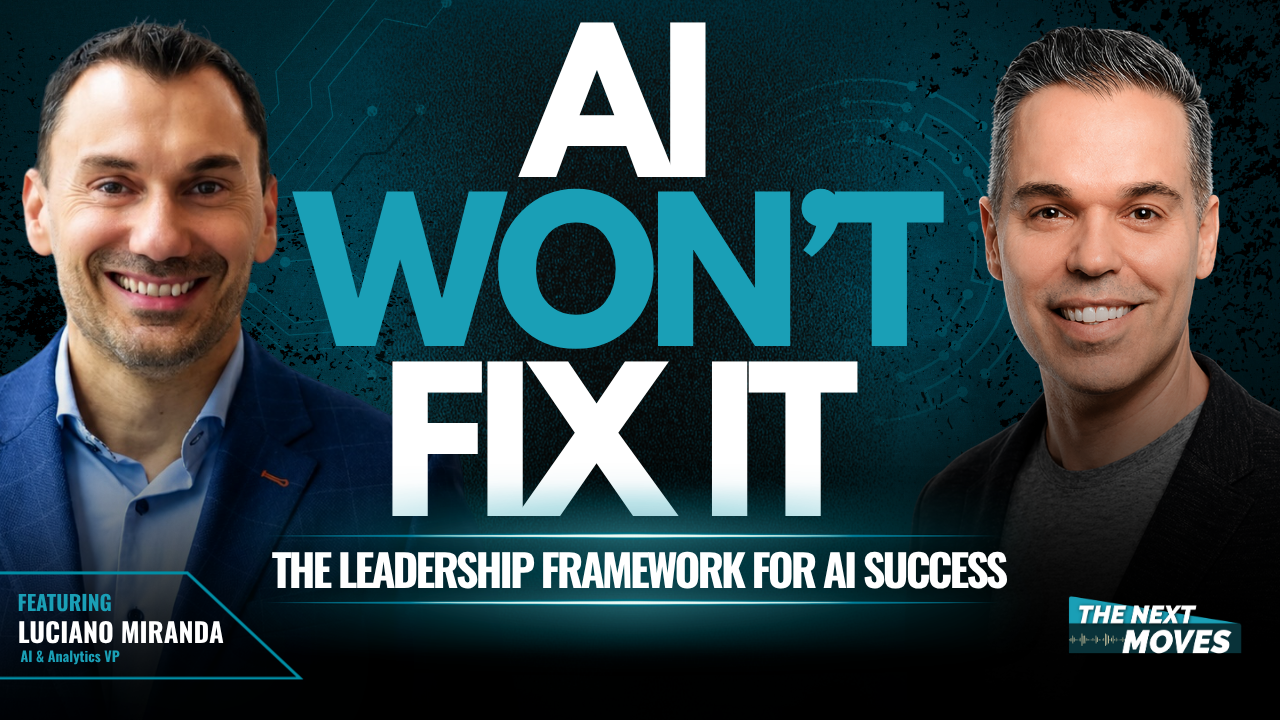
Every finance leader I talk to is hearing the same thing. Get AI into your team or get left behind. So they buy the tool, roll it out, and wait for something to change. Most of the time it doesn’t. The tool sits there, technically impressive and barely touched, and everyone starts asking what they did wrong.
I’ve watched this happen enough times to stop believing it’s a technology problem.
For Episode 24 of The Next Moves I went looking for someone who has built this well and at real scale. Luciano “Luch” Miranda leads analytics and AI at one of the largest medical device companies in the world. He started with five people and a $13 software licence. The team is 170 now, and it has delivered hundreds of millions of dollars in measurable value.
Here’s the part I didn’t expect. When all of this started, he wasn’t excited. He was afraid. What he did with that fear is the whole story.

Spotify

Apple Podcasts

Amazon Music
Luch runs everything through one order of operations. Mindset, then people, then structure, then AI. Most organizations run it backwards, starting with the tool and hoping the behaviour follows.
The sequence isn’t a tidy way to describe the work. It’s the strategy. Lead with the tool and you can still succeed, but your odds drop, because you lose the people who were supposed to use the thing you built. As he put it, it doesn’t matter what you build. What matters is what people do with what you build.
His team started from the business problem every time, never from the tool. Not “look what AI can do.” Instead: what is hard for the people we serve, and can we now solve it in a way we couldn’t before.
This is the line to sit with: AI amplifies what’s already there.
Curious team, amplified. Bad processes and bad master data, also amplified. The AI will work. It will just make the mess move faster.
Which is why mindset first saves money. If you start there, you stop before implementation and do the unglamorous work. Fix the master data. Map the process. Ask what the process was ever for, and whether the answer is still true. Luch’s version of the question is sharper than most: this process exists to solve a problem, so what happens if we solve that problem completely differently?
Resourceful and confident. Not arrogant. Confident because they’ve been in hot water enough times without a map and figured it out anyway, and that repetition builds a belief they’ll figure out the next one too.
They also don’t fall in love with their own solutions. They fall in love with solving the problem, which lets them tear up work they were proud of six months ago.
If you look at your team and don’t see that, Luch’s advice is to get curious about why. Sometimes it’s the people. Often it’s the environment. If failing has quietly become unacceptable, nobody will push a limit. You can say “fail fast” as often as you like; the team is watching what happens the first time something actually goes wrong.
The leadership version of the same trap is subtler. Luch told a story about taking a stalled vendor negotiation off one of his people and closing it himself. He called her back pleased. She was deflated, and told him she’d have rather been told to try again than watched him do it for her. You cannot instil curiosity while handing out answers.
CFOs keep asking where the value is. Luch splits it in two.
Little rocks: personal productivity tools. Copilot, ChatGPT, and the rest. These show up in the cost column immediately and almost never in the savings column. Someone tells you they now finish at five instead of six. That’s a real quality-of-life gain and there’s no honest way to put it in the P&L.
Big rocks: the use cases with a business number attached. Three-way invoice matching, faster submission, better cash cycles, improved collections. These you can measure.
His conclusion is the useful part. Stop trying to dollarize the little rocks. Fund them anyway, because they’re what produce the big rocks. Someone using a personal tool every day is the person who eventually walks in and says, I wonder if we could use this on the invoice problem. That idea doesn’t arrive without the daily habit underneath it.
Two things to hold leaders to on the big rocks: name the business problem, and put a value on it before you build. His team killed a use case that saved someone five hours a week. Real pain, wrong size. You don’t shoot a mosquito with a bazooka.
And one caution on the upside. Cost savings are finite. You can only cut so much. The revenue side has no ceiling, and almost nobody is looking there yet.
This is where the conversation landed for me, and it’s the part with the most direct consequence for anyone building a team right now.
I asked what compounds over three years. His answer was almost boringly simple: use it. Every day. Leaders especially, and it doesn’t have to be work. He planned dinner parties with wine pairings and told nobody how.
Using it daily improves the quality of your questions, and the quality of your questions is the whole game. One line to keep, because it’s the difference between the two outcomes: don’t outsource your thinking to AI. Use it to enhance your thinking.
AI won’t rescue a team that isn’t curious. It rewards the team that already is. Which means the most important decision in front of you isn’t which tool to buy. It’s who you hire, who you back, and how you lead once they’re in the room.
Listen to Episode 24 of The Next Moves with Luciano Miranda, wherever you get your podcasts.
Because the tool arrived before the conditions for using it. If people don’t see what AI does for their own work, don’t have permission to experiment, and weren’t part of naming the problem it solves, the licence sits idle. Adoption is a leadership and process outcome, not a software feature.
Mindset, then people, then structure, then AI. Set the expectation that curiosity is part of the job, make sure you have people who work that way, redesign the process around what’s now possible, and bring the tool in last. Most companies run this backwards and lose the users before they ever get to value.
Separate the small tools from the funded projects. Personal productivity tools like Copilot and ChatGPT show up as cost and rarely as measurable savings, so fund them as the foundation rather than trying to put a number on them. Reserve the measurement discipline for the larger use cases, where you name the business problem and attach a value before anyone builds anything.
No. It will run the broken process faster. Automation on top of a workflow nobody has redesigned produces the same errors at higher volume, which is why the data cleanup and process mapping have to happen before implementation, not after.
Curiosity, resourcefulness, and persistence, weighted above tool experience. Teaching a curious person a technical skill is far easier than teaching a technical specialist to be curious. Screen the behaviour rather than the résumé, since AI now writes a growing share of applications and interview answers.
Luciano (00:00.076)
I had one of my developers come up to me and said, You know, Luch, this is so unfair. I'm like, tell me more. Because I spent the last three years learning Python, right? And goes, I'm pretty good at it. And goes, now with AI, somebody can code almost at the same level that I can. The developers that were more proficient were much slower adopters of AI and much more critical of it. If you're a phenomenal developer and you don't use AI, you're gonna let

Someone like myself that maybe doesn't know how to code that well, but with AI, I'm gonna code very similar to your level. However, if you amplify yourself, right, with the knowledge that you have and you add AI to yourself, there is no chance I'm even gonna come close to you. Because just for the mere fact that you're gonna be able to ask it to do things and ask questions that I just will not know even to ask.

Right. So we just need to reframe the mind again, the mindset going back to it, on on and the relationship that we have with AI.

Joe (01:11.532)
Every finance leader I talk to is hearing the same thing. They're hearing, get AI in your organization or in your team, or you're gonna get left behind. So they end up buying this tool and they roll it out and then they wait for something miraculous or for something to change. And most of the time it it doesn't change. Not really. And the tools will sit there, technically impressive, they're underused, and people are saying, What am I doing wrong? Why is this not catching fire?

So I've watched this happen enough times to stop believing it's a technology problem. I went looking for someone who's built this well and at real scale. And I asked him, what are we getting wrong? What do we need to think about? How do we how do we even need to think? So Luciano, Luch, Miranda leads analytics and AI for one of the largest medical device companies in the world. And you're looking at someone who started with five people and a $13 software license, and his team is

170 strong, it delivered hundreds of millions of dollars in measurable value. And here's the part I didn't expect. When all this started, he didn't feel excited, he was afraid. And what someone does with that fear is really the whole story. So this conversation is really about what putting AI to work actually takes. Why the team you build matters more than the tools that you buy and what all of this means for anyone hiring right now.

So welcome, Luch.

Luciano (02:39.618)
Hi Joe, thank you so much for for having me and thanks for the intro.

Joe (02:43.98)
Well, it's true, I hope. And feel free to correct the record if I'm wrong.

Luciano (02:48.002)
No, it's true, it's true.

Joe (02:50.328)
So you told me something on our call and I like I find it interesting when people give me a way to think about things and you said that you suffer from phobo, fear of becoming obsolete. And when Chat GPT three point five came out, like all of us, you had a minor heart attack and a panic attack. So I want you to take me back to that moment, you know, where were you and what was going through your head?

Luciano (03:14.712)
You know, I think I was staying in this office. I it was not renovated. you know, fun fact, I got tired of putting fake backgrounds, so I just basically put some you know, renovated the background as I have a real background, right?

Joe (03:26.169)
It's lovely, by the way. It's lovely.

Luciano (03:28.152)
Thank you. Thank you. Yeah. I will tell my wife she'll be very, very happy because she's she was the the play the designer role. But yeah, I was actually sitting here and I remember it coming in and and and you know it's one of those real human feelings, right? Where you feel it in front of and it's this immediate fear that you get you're like, my god, everything I built up to now is not gonna be done by AI. Right. Now this is obviously going many years ago. and then I kind of took a breath.

And I basically told myself I've been here before because I mean, maybe not to this scale, but when we started our journey when you said that we were five people, we had a big dream, right? And and our dream was to create an basically an artificial we call that at the time supply chain assistant, operation assistant, right? But we were to to be honest with you, it it was a thought and we actually believed we could do it, but I'll be honest with you, we had no idea how we would do it because our tool at the time was Excel.

And I remember that we were getting quite good at Excel. As a matter of fact, one of my at the time, funnest and best question to ask someone when I was interviewing them was like, What's your level of Excel? And if anyone told me they were advanced, probably I wouldn't hire them because that means that their scope of who they were comparing themselves to was too low, right? Because you anybody that's very good in Excel knows how capable that could that that that

tool is right at the time. And then Power BI comes along, right? And then Tableau and these other tools. And we're like, now all this knowledge that we built, it's gone, right? Because now you can do so much better with these tools. So then we said, all right, you know, we had that s simultaneic moment and and and we started moving towards those tools, right? And and and reinvented ourselves to become I would say experts in in in in that space. And now AI comes in and is the next level, right?

if that if let's say the first one was you know a three out of ten, this one is an eight out of ten or nine out of ten in in in full scale, I would say. But you know, or you basically look back and you and you say to yourself, okay, there's only one way through this. And the one way through this is start using it as much as possible, irrespective of what I think, you know, do I think it's good, do I think it's bad, would it help humanity, right? I have a lot of principles, would it not?

Luciano (05:52.662)
And so on. I'm like, the only way that I'm gonna be able to actually take advantage of this and even protect myself and and deal with this phobo is to start using it. Right. So we started using it immediately, just learning, and asking some very silly questions and and being completely, you know, astonished by some of the answers at a time that if we it's funny, right? If we were to get those answers now we're like, this sucks, right? It's terrible.

It's hallucinates. I remember ever saying it's has hallucinates. I'm like, yeah, humans hallucinate too sometimes, right? So you have to just ask better questions. So that was kind of like the mindset. It w it was basically at the at this moment, having that fear and then saying, Okay, you know, I'm a big believer in giving people and myself opportunities and then letting folks make their own choices. So we're like, okay, as a leader, I'm like, how do I give people that opportunity? Because at that time we weren't five anymore, right? I think we were like

fifty or sixty if I recall correctly. Right. So we were in the 170 yet, but we were well on our way there. And as a leader, you you you want to give your people the all the opportunities. Right. So that that's kind of the the moment when when we started really thinking about how do we use this, right? And and how do we not just protect ourselves, but then we quickly realized that it was the quality of our questions that really mattered. Right. And

things that we thought we couldn't do, all of a sudden we're like, whoa, wait a minute, right? Now we can do these things. Like in the first transfer, right, Joe, went from Excel to to these other tools like Power BI, right? We, you know, we were gated by the fact that Excel at the time had launched the million rows. If anybody goes back, you know, if every yeah we're like, my God, we have a million rows. But we didn't because after two hundred thousand the thing would run out of memory unless you had, you know, the sixty four bit version, right? That very few of us had.

So now all of a sudden we were able to solve bigger problems. And AI was exactly, you know, as as I look back and reflect, it gave us the same thing. It's now we can solve bigger problems. And that to me is a number one, you know, aspect is the mindset on how you use this is extremely, extremely important.

Joe (08:05.248)
You just predicted the next question. I don't know how. But listening to you describe a sequence that you run now, I think it's going to be helpful for people as they process where they are and what what they're doing and how to approach it. And that sequence that you described, you run everything on. It's mindset, then people, yes, then structure. Yes. And then

AI. So most leaders do it exactly the opposite order. So like why is the sequence the strategy and not just a tidy way to describe it?

Luciano (08:41.87)
So I'm tell you a story and kinda how it's funny how everything comes together in your life, right? So it's a sports story. And I I've had the privilege to play, you know, maybe I'm I'm I I I'm reliving my glory days when I played in the professional soccer league, right?

Joe (08:55.598)
Agent one, begin.

Luciano (08:59.842)
But I tell you, having the privilege to play sports throughout my entire life, I was able to see a big a really big difference, right? Being in teams that were incredibly talented but lost. And then being in teams that weren't so talented but won. And the difference, you know, sometimes it wasn't coaching, you know, you you can blame your coach. you call the wrong play. It's not the coach, right? It's the mindset of the team. And and the coach has a big plot part of that is is, you know, what mindset do you build a around the team.

So I kinda tried to bring that into corporate as well. It's just stuck with me, right? And for us, you at the beginning of AI and and maybe I don't know what the stats are now, right? But at one point I think it was it was published that about 90% of all AI cases were failing, right? And what I've observed, right, it was that a lot of folks were leading with AI. Right? It was AI chasing a pro like chasing to see, hey, look what I can do with AI. Like

Hey, let do this with you, right? Like, well, let me do this with you. And and it's just that wrong mindset because you're doing AI for the sake of AI. And that's not the point of this. Right? So for us, we were very purposeful about this, right? To put it to team because AI is cool, right? And if you're working in a technology, you know, with technology people, we all get excited. We want to use it. We want to use the coolest, latest technology. And that's okay. But for us, we were very you know again deliberate about saying, look, folks.

Mindset first, then people, then structure, then AI. Because AI is an amplifier, right? So for us, curiosity was a principle, irrespective of AI or not. We always said, hey, you know, you gotta lead with curiosity, right? At the time was maybe we had analog tools, let's call it, and now we have obviously a much, much powerful tool. and for us, something that's been very successful. I think it's helped us go grow from that massiveness of

five to to to what we are today was that we always started with the business problem. Right? Not the tool. Now that doesn't mean that sometimes people said, yeah, I want to solve the business problem using this analytic. No. Sometimes they said no, but we were always trying to solve their business problem. Right. And our mindset was almost one of like, you know, I always wanted to be an entrepreneur in my life. And I later realized I I can't remember which book it was, I ended up being an entrepreneur, right? Where like you end up building teams within a massive corporation. And

Luciano (11:24.038)
we use that mindset, right? So we we think of ourselves as marketing. We think of ourselves as service. We think of ourselves as serving the people. We think of ourselves as if they win, we win. So that was a really big difference for our team, right? Was we started with the mindset and instead of pushing AI for the sake of AI, we basically looked for problems that were now more easily solved that we couldn't solve before or how could we make the life of the people we serve easier?

And we used AI for that, and that had a a very big impact, right? In in in how we progressed and and and and what we ended up doing. So one of us for us, for example, we call it the friction, right? So we do analytics. So what's friction and analytics? Well, friction analytics is that, you know, again, in the past you had a spreadsheet and you had to go through all this, filter, be look up and there was a ton of friction, but you could get to your information. Then we had dashboards. And we asked dashboards to do so much, right?

And now it's easier, right? But you still have to click a bunch of times to get to your information. The difference now is we can remove a lot of that friction, right? Where to the point that we're now, you know, kind of piloting, how we don't even have to have people click on the dashboard to find the issues. We just bring the issues to them. Right. Now somebody could be saying or listening to this saying, well, that's alert, it's been there forever. Yes, but

We've also over alerted and we didn't have the capabilities we have today to make them really, really smart, where it almost becomes that that assistant that is there serving you. So for us as well, was a very big part of this was how do we remove further friction from analytics? Well, AI obviously helps you do that, right? And then it grows from there. Then, you know, it's the white Toyota effect, right? So now all of a sudden you have the entire organization using AI.

You know, at the beginning we even said, we don't care. Use it to do recipes. Don't care. Just use it. Why? You know, the other of you heard the, you know, they always say it's like the white Toyota, right? Like all of a sudden, you know, let's say you buy in brand new to white Toyota, you start seeing them everywhere. Well, those white Toyotas were always there, right? The difference is that now your brain is looking for them. So the same psychology, if you would, we use we we kind of bet on that our folks will start using it.

Luciano (13:41.962)
And then they themselves will start seeing these white Toyotas, right? Or blue Teslas, whatever you want to call it, right? And then they would come to us to say, Hey, what if we can do this? And what if we can do that? Right. And what the team is doing today and they're coming out is beyond my my expectations, right? In in in in what I would have came up with, because my view of the world, you know, I have a a view of the world, but it's very, you know, obviously have tons of blind spots that other folks are now looking for those.

for those opportunities and you know because we have a new fold I'm like right I gotta learn this more right like my team is leaving me behind a little bit but but yeah so that mindset is it's is to me is is the number one key ingredient and you know what? It's free. You don't have to buy anything, right? It's literally working with curiosity. And when we hire, you know, we even have a saying within our team is let's say we're looking for a developer, right? And I'm gonna make it could be anything, right? It could be SQL, it could be Python, whatever.

It's very difficult sometimes to teach a developer, right? Let's say a Python developer or a or a SQL developer curiosity. But it's very it's very easy, especially today, to teach a curious person Python or SQL. Right? So we we even changed a little bit how we look for folks. We've always looked for resourcefulness first, right? And and a lot of IQ and EQ, right?

But you know, now we we even double down on that because it's so important and AI obviously opens up a whole new world of possibilities. sometimes it's even unfair, right? What you can do. but but that's kind of the mindset that we put in and and to me as I look at even use cases that are successful, you know, maybe I'm biased and I look for that, right? But but I see a mindset, right, that of someone trying to solve a problem.

and using the technology to solve the problem and then being very successful with it versus the other way around.

Joe (15:38.52)
So let's go the other way around for a second because I think this is valuable. So a leader ignores the framework and they start with the tool. What actually goes wrong? What does failure look like, say, six months in?

Luciano (15:52.11)
Yeah, I mean, first of all, there there is no black or white, right? Like you may do that and be successful, but I think it has more like your pro I think to me everything's about probabilistically, right? Your probability of being successful is much lower that way. Because what ends up going wrong is you end up using losing the people that are supposed to use your technology to solve the problem. Which is the biggest issue, right? So you're you may have built a tool, the tool may be amazing.

But if you didn't get the human aspect, which is people using the tool

What have you done? Right. It's like you have this fancy thing that nobody's using, right? So for for us again in my team, we always worked on this as well. We even said in analytics, you know, it doesn't matter what we build. What matters is what people do with what we build. And I think in in in AI is exactly the same thing, right? You can build an agent. Obviously, the agent can do a whole bunch of stuff, et cetera, right? But you still need people to understand it, to fund it, to use it, right? Et cetera, et cetera. So usually what goes wrong

I find that the tool just doesn't deliver on the value that is sold, right? There's a lot of hype obviously at first. That's I'm sure everybody that would listen to this will will know. so you're much more succe susceptible to that, right? and then you end up having these amazing tools. I mean, just do a quick check. Think in your own organization, how many tools you have where you're using maybe ten, twenty percent of its capabilities.

But then you get really excited, right? When a new tool comes, you're like, my God, that tool can do that. my god, let's buy that, right? But I'm like, folks, you you we're not even using a hundred percent of what we have today and we now want to buy the Rolls Royce of Rolls Royces, right? Are we really going to use it? Sometimes the answer is yes, don't get me wrong, right? but a lot of times it's more of like a foundational. And that's the piece that I think AI you know amplifies. So that's the other thing we say is is AI is a massive amplifier, right?

Luciano (17:52.568)
Curiosity and curiosity amplified, right? If you have a lot of bad processes, bad data, you know, AI will work, but it will amplify that. but again, but the end result is not the ROI, the the you know, the the returns that you potentially could get if you start with mindset first. Because if I have a mindset first, I may say, wait, hold on a second. Before I implement the AI, let me do the a lot of grunt work that is required, like fixing my master data, right?

looking at my processes, doing an A3 or a lean value stream, right? To see what it is. Rethinking the process because you're not thinking about fitting it into your own, you know, process. You're thinking about, okay, wait a minute. This process is there for what? What? To solve a problem. What is the problem? X. Great. How can I solve this problem completely different? That to be honest is something that keeps us up at night a little bit right now. It's like

Are we not thinking broad enough? Because we could solve problems differently, but we suffer from that too, right? You we we have our per our peripheral our our vision of what we we know of the world, but we're constantly asking us ourselves that and when we're starting to find that we're starting to solve problems differently.

Joe (19:02.766)
Well, the friction that you talk about in any experience when you're looking at a process, the interesting thing I found about AI is it collapses the process in terms of going A, B, C, D, and E. The ability to go, why is B and C actually suddenly necessary? Right? Can we go A, D and straight to the end? Because you're able to look at it and say, This existed because we needed someone to do something.

And intervene, but is that intervention necessary anymore? I feel like you've got a cheat sheet where you know the questions I'm gonna ask you because you lean into the next one, which is curiosity. I don't you just maybe well you you know your master thesis, you deliver on it. So you've written and published that curio, you know, AI doesn't create curiosity. It rewards it and it amplifies it. So let's go to a team that's curious before AI ever shows up.

Luciano (19:41.498)
Okay.

Joe (20:00.28)
What does that team look like if it has the natural curiosity that you're talking about? What does the team look like? How are they behaving?

Luciano (20:08.344)
Just extremely resourceful. Right. that that that's I think if there's a word that I would use, that that's what it is. And resourceful and confident. Now not confident from a sense of arrogance that they can solve anything, but confident because they know they've they've had situations where they had no idea how to solve something. But the you know, what is confidence? The confidence is fact that you got yourself into some hot water a bunch of times, right? You didn't really know where it would go, but you solved it.

And you do that enough and that builds confidence to believe in yourselves, right? So it's a it's a team that's also extremely confident that they will figure it out, right? A curious team is one usually that's a very high performing team. Why? Because they're curious. And what does it mean? It's continuous improvement, right? I mean, within our team, we always talk about it's like, okay, we're we're

Yeah, when we started as five, we're like, we want to be world class, right? What the heck does that mean? I don't know. We just wanna be world class, right? And then and then all of a sudden we started getting and then we got, you know, written up by Microsoft, by IBM, by Gardner, and we're like, Whoa, wait a minute, hold on. Some something good here. But then having the humility to say, especially with AI now, it's like we could be good today. We could be in the back of the bus, like in in weeks time, right? Like not even day not even months or before maybe we had a like the your advantages and

doesn't last that long. So that healthy tension and having the curiosity to continuously, you know, look for better ways to solve it. You also is a team that doesn't get enamored with their own processes or their own way of solving things. Which it which sometimes it happens, right? We get enamored with the solution that we came up with and it's happened to us, right? But curiosity allows you to just look past that. Get enamored with solving the problem. Right? And that k that drives a

It's like, okay, how else can I solve it better? and then the phobo kind of helps, right? Because you have that one of this it's healthy phobo, right? If you get an unhealthy phobo where you then you start losing sleep at night, it's happened to me, right? but health a little bit of healthy phobo is good because it keeps you pushing forward, right? But to me, curiosity, especially in the age of A, I think about it. You you I can learn pretty much anything. I had one of my developers come up to me and said, you know, Luch, this is so unfair. And I'm like, tell me more.

Luciano (22:26.094)
Because I spent the last three years learning Python, right? And goes, I'm pretty good at it. And goes, now with AI, somebody can code almost at the same level that I can. Right? And I'm like, man, he's right. Right? Think about it. And what we saw that, right? Like, I mean, we got through it, right? But like the developers that were more proficient were much slower adopters of AI and much more critical of it. Now, we went through the you just keep going because the inflection point will come. Now, what happens is this.

This is I I don't know if this is what broke it or not, but one of the conversation we had, we said, look, if you're a phenomenal developer and you don't use AI, you're gonna let someone like myself that maybe doesn't know how to code that well, but with AI, I'm gonna code very similar to your level. However, if you amplify yourself, right, with the knowledge that you have and you add AI to yourself, there is no chance I'm even gonna come close to you because

Just for this f mere fact that you're gonna be able to ask it to do things and ask questions that I just will not know even to ask. Right. So we just need to reframe the mind again, the mindset going back to it on on and the relationship that we have with AI, right? So that it becomes an amplifier of humanity. And and and I know that there's arguments that it could go both ways. I I just choose to think it as an amplifier of humanity, right? Versus

potentially a you know like something that could be very negative to humanity, which is also a possibility, right? it's just that but how do we how do we all work towards if we are all thinking about how to use this as an amplification of the goodness of our of what we do, then I think our probability of this being a very good thing for humanity is is is amplified, no pun intended.

Joe (24:17.922)
But if you have that curiosity, you can observe that individual and say, Okay, well let's get curious about some new things. What if you're in a team that you're looking at and you're like, I don't sense the curiosity. How do you catalyze it? How do you how do you initiate it before you spend a dollar on tools?

Luciano (24:38.904)
So I think the first question is get curious about why your team is not curious. Right? What do I mean by that? Sometimes teams are not curious because we've developed an environment where failing is not acceptable. Now we all heard, right? Fail forward, fail fast, you know, until somebody fails and then everything is like, whoa, wait minute. What do you mean this went wrong? Right. And I creating a

culture where you allow your team again, control the blast radius of obviously, right? Of what we said, but where you allow your team to develop and push the limits.

is the first environmental setup that you need to breathe curiosity. Because if you are, you know, and again it all depends what I'm saying, it depends on every situation, of course, right? But it but you know for illustration purposes, if you're someone that is like I am very regimented and if this anything goes wrong, I'm gonna hold people completely accountable, right? And so which sometimes is needed, don't get me wrong.

But you do it constantly, then people are gonna be afraid to be curious because like I just need to do it this way and then you know I don't feel any pain. but then you're not gonna be pushing the limits. And again, if the if the environment you're in, that makes sense because there are situations where sometimes you need to operate that way, great, right? But if you wanna create a curious environment, you gotta allow people to be curious, right? And that means that every time they're curious, they're not gonna develop, you know, the the best the next thing, but believe that

maybe out of ten things they try, two will be number one hits, right? Or one will be a number one hit which more than pays for everything. So I think looking at the leadership style, looking at the environment that we create, it's extremely important to to to you know to drive curiosity. Now, could you do that and at the same time get them a tool, right? So that where they can actually start experimenting and then I I think, you know, people a lot of time emulate leaders and then you show what you're doing.

Luciano (26:46.786)
Yeah, I think you could do that, right? Like you don't have to wait. So you can build them both kind of in parallel. but the first question is if you don't have a curious team, is be honest with yourself and say, Okay, why don't I have that curious team? It could be the people that you have, right? But it could also be some of the the environment that's been created either by the company or by you know, by by yourself sometimes.

Joe (27:09.11)
It's also that the end state of being too rigid, too overbearing, can create that learned helplessness, which is I am s subject to and I need to be guided by the rules and the process.

Luciano (27:26.242)
And you can see it in your team, right? If if they start saying start pointing fingers everywhere, you probably have a little bit of a victim mindset metal you know, happening in the team. So how do you change that again? The quality of the questions you ask. There's another book called Change Your Question, Change Your Life. Phenomenal, right? Like to to me, because the author talks about there is the learner path and the judger path, right? So what's the the judger path? Somebody cuts me off, right? I'm driving

And basically we'll say, what the hell is wrong with that person? Right? Like what a jerk, must be a you know, doesn't care about me, blah, blah, blah. That's judger. The other one could be, I could ask a different question and say, Huh, I wonder what's making that person behaving that way. Right? What is going on in that person's life that he's so in a h or she's so in a hurry? Now, we're not talking to the person, it's just all dialogue that happens in your mind. But think about the difference, right? The first one, I'm gonna get riled up.

Right. And that other person that cut me off is happy. They're they cut me off and now they're gone and I'm now angry, right? So I gave them double the power. But if I use the other approach, right, it it it's it's it just doesn't hurt me, right? Like I I kind of can protect myself from it. Now at work it's the same thing, right? If you ask and it leads to curious questions, because if I'm, you know, judgmental, then what is it? Isn't Ted Lasso say that right? Be curious, not judgmental. Love Ted Lasso too.

You know, but if I'm judgmental then I I lost the learning opportunity

Joe (28:58.338)
I remember a degree of frustration I was experiencing where I was trying to explain something to move the organization forward. And I was getting frustrated because I couldn't get the buy-in. And I was kind of, you know, you have those moments in your life where you're venting. And my wife just turned around and she looked at me and she said, And again, she's brilliant. She comes from a strategy advisory background before moving into industry. And she said, one thing you need to think about, Joe, is

If you're explaining things to people and they're not understanding, it's actually the way that you're explaining it. So change what you're doing and how it's being explained. Don't just keep so reframe it, push it through different lenses, bring external views in that kind of either challenge what you're saying, modify it, and then deliver it again. So it's the delivery. It ties to Jocko Will Inc. with extreme ownership, which is as a leader, it falls on you. And how do you

number one, model that level of ownership over these things so that your team can then feel comfortable owning what's happened and really diagnose it and understand it. The first thing he says when someone comes to him and says, look, we have a massive problem, he's like, Good. Good. And then the person starts explaining it in a very they'll look at him sideways. And his team, you know, special forces operator got to the point where they said, I'm gonna describe a problem. I know what you're gonna say. You're gonna say good. He's like, good. So the idea of

Breaking down the problem in terms of why does it exist? Problem statements are very powerful, deconstructing them and then a path forward on it. And again, the way that you actually frame a problem and describe it to people without having the exact ultimate solution locked in is also a very good way to catalyze curiosity because they can step into the moment and think alongside you as opposed to you delivering the message of here's where we are and here's what we're going to do.

Luciano (30:53.826)
And you know what, to be totally transparent, right? I I went from an individual contributor to leading and that was the hardest part. One of my people once, I remember this story where she we were negotiating with a vendor and she called me, she's like, Luch, we just you know, we won't be able to keep going. We can get them down to the price we want and so on. So I love negotiating, right? So I pick up the phone, talk to them, got them to the price we wanted. So I call her back, right? And I'm like, Hey, like this is amazing, right? Like I we just got it, we can keep working.

And I see her and she was completely like sad. Yeah, inflated, right? And she basically said, Well, Luch, I wish you would have told me you were just not happy and for me to try again, not to do it for me. Because you just disempower me. You know, and so on. So it's almost like, Well, if I want to create curiosity, I gotta let them be curious and not just solve it. 'Cause I love I'm a problem solver, right? So I love to solve problems.

Joe (31:27.182)
Deflated. Deflated.

Luciano (31:48.858)
and honestly that was the biggest one of the biggest gifts I got from one of my employees, right? And I thank her to, you know, I talk about this to other leadership groups, right? And and I thank her all the time, right, for actually first of all having the courage to tell me that and then just being honest and and you know, because I looked at I immediately saw from a different perspective and I'm like, my gosh, she's so right. I am a terrible leader, right? How could I instill curiosity if I'm giving people the answers all the time?

They're just gonna follow and you know, this is the last thing I want.

Joe (32:20.184)
That was a teachable moment where the idea of let's solve this together. Here's some new ideas. Exactly. Negotiations are always challenging when they're given to a team member, but the vendor hiding in the background thinks that they have leverage until you step in and probably say it's it's a go or no go. And they're like, Okay, well, I we have to capitulate. So teaching them how to create that urgency and that

That idea within the vendor of like, this is not, we're not playing, this is real. So I'm going to tie this in very quickly then, because you, you and I both know that CFOs are out there asking, where's the value in AI right now? Right. So you have the framework, which is big rocks and little rocks. And, you know, w like, why can't the CFO ever justify AI and the little rocks? I mean, tell me the way you think about it.

Luciano (33:04.237)
Yes.

Luciano (33:14.2)
Yeah, you know, when we talk about what are the little rocks and the big rocks, right? So so when we talk about personal productivity tools, we call those the little rocks, right? So like a Microsoft copilot, a Chat GPT, whatever it is. Those are very easy to see in the PNL in the cost column, right? Very difficult to see them.

in the savings or or you know revenue expansion or margin expansion whatever the you know call them. It's very difficult to show them the PNL and most CFOs, they're like, show me the PNL where this is. And I remember when they first you know, when this first came out, you know when you instinctively know this is the right thing to do, right? Like so I instinctively felt in my gut, I'm like, I need to give everybody my organization a copilot. It for us was copilot, right? So copilot license.

at the time and they were not cheap, right? Like in in the in in they were not, right? And if you have a lot of people it it multiplies pretty quickly. So we needed to self fund it a and and and and so on. And it's like, you know, and people are telling me it's like, you know, one person said, Luch, this is amazing. Thank you so much. Now instead of working 'til six o'clock, I'm working until five consistently. I mean that's a quality of life improvement. How the heck do I show that in a PNL? So that's why we came on the concept of the little rocks and the big rocks. Because what happened was

Joe (34:07.453)
They were not.

Luciano (34:34.989)
Remember we talked about the white odds? I came to the realization and and maybe this will change through time, right? Like I I I I think we will start s seeing in the PNL as as we use more of these little rocks that kind of accumulate with each other. But I'll share kind of like where we landed on, at least in my organization. We said, you know what, I'm gonna stop trying to dollarize the savings from the little rocks because they're extremely difficult and I'm probably not gonna but I know it's making my team more efficient.

Joe (34:37.09)
Yeah.

Luciano (35:04.79)
Right. And maybe I I can I can use less contractors, right, in time, but I can't see it yet, but I know it's coming, right? And then we this we saw the big rocks because someone saw this white Toyota or the blue Tesla, whatever you want to call it, right? And they said, Hey, I've been using this personal productivity and we have this problem. Now this is a few years back, right? Of three way invoice matching.

Now this is that common use case, right? But at the time it wasn't yet. And like I wonder if we could use AI, right? So they can say, I wonder if we could use AI to do this, this, this, and this, and therefore be able to submit invoices much faster, improve our cash cycles, right? And prove collections, etc. And we're like, heck yes, you can use this for that. Now we weren't thinking about that, but this person all of a sudden has this view of the world and has this business problem.

Right. And that's a one you know, this that is a big rock. Right. So this person using the little rock was able to use the big rock. Now, the big rock were able to show the benefit in the PNL, right? So I think that's one way to think about it, right? And then the other piece too for CFOs and something as as we mature more and more, is really, you know, we find that sometimes people are hesitant on putting value on things. And

really driving that to say, okay, what is the problem you're trying to solve with it, this AI model? And what is the value? Right? And making sure that they can actually state it because what we're finding, for example, we had one use case come our way where they're like, this is the most important thing. And so and as we broke it down, we're like, wait a minute, this is a pain in the butt for someone. It's gonna save them five hours a week, right? If we dollarize it

This is not worth it. Like it's not worth it to, you know, to shoot a a mosquito with a bazooka, right? We're not gonna do this. But then when something else like this through InverseMatches and and and many other, you know, other use cases come in, again, it'd be dependent to your business, and you can tie it to solving that business problem and making it more efficient and then holding people accountable to that and tracking it, right? Now don't beat them up.

Luciano (37:17.934)
too much if they miss because they're making a guess, right? Obviously, but hopefully within the range. I think in my opinion, that's how we see the value in AI. But a lot of times the value in AI is, you know, even putting AI forces you to solve your, you know, maybe a process problem that you had. So now you're like, well, was it AI that saw that that got us the value or was it the process problem?

And then finally is it's really, you know, and this is a really hard one, and I get it. It's it's very easy again to see in the P L cost savings. Right? But cost savings are finite. You can only cut so much, right? But how do you also flip the equation? Because the upside is, you know, if you can figure out how to use AI in in in your upside of the equation, there is no limit per se. Right.

So th those are things that I would say with you know with with with CFOs, right? I and how they at least what I've observed is hard sometimes to see the things that PNL believe, and that's up to you, right? That you will I would advise that you believe the fact that if you empower people with this, and it's not just about giving them the tool, right? It's giving them the tool, doing you know, training for them to use the tool.

showing them. So for us, for example, we started something called flight school. At the beginning, I would do a lot of the demos, right? So we called it flight school Fridays, right? I haven't done a demo in like I don't know how long, in over a year. Like the team took completely over. So what we did is we started saying, well, if we want people to use this, we need to show them that it's going to make their lives easier in their terms, not my terms, right? So that's what we did in flight school is we started taking problems that they had, right?

How do you make them more efficient? Because our goal right now was making the people more efficient and then showing them how they can make their work, you know, more and more efficient. And Flight School now has evolved to, you know, some amazing, amazing solutions that the team is is working on constantly.

Joe (39:25.218)
So we're gonna go with some rapid fire now. You're gonna explain terms. Ooh. Okay. Ready? Number one, taking the AI to school.

Luciano (39:33.624)
Ha ha take the AI school. Skills studio. We teach the AI about our business context.

Joe (39:39.406)
Okay. Now the next one is people decisions. This is a hard one. And maybe we can't go rapid fire on this. AI and what it does to a team in terms of people build capabilities, other people don't. you know, you've built this function from a very s ha like a handful of people into what it is now. how do you make decisions?

Luciano (39:47.31)
Ooh, people decisions.

Joe (40:09.694)
on people. On and how do you actually think of this holistically from look, you're trying to build a capability in the organization that is valuable and you need the right people. So how do you think about we need to bring in skills or we need to actually look at people maybe not being the right fit for us? And I know I'm putting you on the spot with this, but I'm looking for a mental model here because this is all new. And everyone is coming to us right now and saying, what

What do I do with this and how do I think about it?

Luciano (40:43.726)
Okay, so for this I I have to tell you a little bit about myself because everybody will have a different opinion on this, but I think you need to understand how my opinion was built. Okay. I'm an immigrant of Canada. We s like Drake said, we started from the bottom. Okay. What did Canada do for us? We came in in the n nineteen nineties, right? Canada gave us opportunity. Nobody gave us anything for free. Okay, but it gave us opportunity.

Right. At the time my family made had a very low salary, right? you know, my mom and dad, you know, my parents immigrated to Canada, my dad was fifty, my mom was forty-three, that means none of us spoke the language, right? So you're not doing the best jobs, right? But there was opportunity. And when it came time for me to go to university, Canada gave me a loan, right? Because we didn't have enough money obviously to to go to school and so on, which I then paid back in less than a year and best you know. So it allowed me, gave me that opportunity to develop myself. For me

The first step is give people opportunity. hold them accountable. Cause I also had a situation once, right? Like, and this is a little tougher. I believe I run a very human centric organization. We really care for people. But sometimes that also requires us to be very tough, right? Just because we talk about, you know, human well being and so on doesn't mean that you're weak, right? Or you're soft because you you'll get run over.

So f I had another situation once again as a as I was in a in a different company many, many, many, many years ago where I almost burnt out one of my best performers. I had a very small team because I didn't have the guts to get rid of a person that we had given multiple opportunities and had not taken advantage of it. And what was the what was the end result? Well the j work still needed to be done. So my top performers got or my top performer at that time got completely burnt out.

Because I didn't have the gut to do the you know, probably the worst part of any leader's job is is to take job action in the in that way when you have to get somebody off the team because it's somebody's life, obviously. And I didn't do that. And and I saw the the person I'm like, I will never do that again, right? No matter how hard it is. So what I from there on it became a principle of of of of how we tried to operate. Still the worst part of the job, still sucks, still horrible, right?

Joe (42:59.114)
Yeah.

Luciano (43:09.89)
However, the way I guess I sleep well at night is we give everybody opportunity, the same way that Canada gave me opportunity. So how do we give people opportunity to develop themselves? Now, if they choose not to do that, now that is a personal decision that that's you know that's on you. and now you're affecting the rest of the team and and potentially, you know, again, every situation is different, but you you have to you have to do you know some tough tough actions.

Joe (43:40.846)
We're gonna call we're we're gonna call these lucha's lessons.

Luciano (43:43.796)
Well, I don't really look at lessons, right? But they're just lessons of life, I think, as as I went through it because like I said, it it's the toughest thing, right? Can I look myself in the mirror and say, Did I give this person every single opportunity? Right? And then when we go higher, we look for that, right? Like now we we know, you know, I had an interview the other day and somebody pretty much read of Chat G PT and I'm You gotta be so I basically just topped him and said, Okay, stop. I d I don't want to know what Chat G P T thinks. I wanna know what you think. You know what the funny part was? Once he became himself

He was amazing. Right? But what we also have to make sure, you know, you asked that one of the questions about AI and the rapid fire, right? That got me thinking about something we also talk about. AI cannot replace your thinking. If you're outsourcing your thinking to AI, big trouble, right? But if you're using AI to enhance your thinking, holy, you know, the stuff that we can do now, it's it's it's exponentially more or better than what we could do before.

Joe (44:14.563)
Yeah.

Luciano (44:43.362)
But you know, that's something we have to be careful too, is you know, how do we use this? Because it is you know, we're lazy by nature. So so how do we use it to to enhance our thinking and not just simply think for us.

Joe (44:55.47)
So here's another one that I I found an interesting quote, which is if you want to play this game, you have to pick your eagles and you have to feed them. Yes. How do you decide who's an eagle?

Luciano (45:07.224)
They decide for themselves. Like I I I tell you, right, like you give the opportunity and I've seen this because we've grown the teams. We had, you know, when we did this many, many, many years ago, just with the when we moved from Excel to Power BI, let's say, right? We we all started at the exact same level. Exact same level, exact same opportunity, exact same training. There are people now that have significantly risen because they went all in and learned it.

And there are people that just are staying at the same level they were be they were before. Now I'm not here to say that one is better than the other because that's a personal choice, right? But when it comes to a high performing team, right, they basically the the e the eagles will tell you they're eagles, right? We have a couple of individuals in our team now and all in on AI now. And the stuff that they're producing is fascinating.

Right. And they're making themselves more valuable, which is then bringing in another problem for us, right? Which is like, right. Like now they're too valuable. What do we do? but but I think that's a you know, I always encourage them to say, make yourself as valuable as humanly possible. Right. and and then you then you're on the driver's seat, then you decide what to do.

Joe (46:23.352)
So you you run teams of teams and your red line is culture. So you mess with my culture and you're out.

Luciano (46:32.738)
Yeah, you mess with the culture, you're

Joe (46:35.246)
Let's talk about what happens when you have a problematic leader below you running teams.

Luciano (46:42.326)
Yes. So if you have a problematic leader, you you have to take action, my opinion. Right. again, that's just for me, right? Either everybody sure has different red lines. But the red line for me, if you make a mistake, whatever, we'll who doesn't make a mistake, right? now if you make the same mistake all the time, they're storing. But once you start because culture is so fragile, right? It's and it it only takes a little bit to start seeing, you know, kind of tribes forming even within your own team.

And I and and especially as you start growing into bigger and bigger and you know our team is also in in a multitude of different countries, maintaining that is r it's is really difficult. It's almost so if you have someone that is playing against that culture, then in my opinion, you either have to find a different role, maybe they're in the wrong role. That's hopefully the best thing, right? Or take action. because they can do a lot of damage to you and and very quickly.

Right to to to the to to your culture. Culture is fragile sometimes.

Joe (47:46.478)
So then let's talk about moves that compound over time. Not compound movements, but the moves that compound over time. And let's look at where you were three years ago. Mid mid panic attack, three AM cold sweats. What were the moves or the move that compounds? What's the most important one that compounds?

Luciano (47:57.859)
Yeah.

We're trying to die.

Luciano (48:10.348)
The move that compounds is using in this particular case is using the technology and you're gonna have opportunities when people fail, right? And trust me, 'cause you know you're sometimes your bosses will get mad at you, right, for for the failure, but you gotta resist that urge and ask, Okay, are we gonna do it better next time? Right? Now, 'cause if they keep making the same mistake all the time, different story, right? But like just

Number one, use the technology and leaders need to use the technology. Right? Why is it a no-brainer for me? Well, because I started using it. I planned, like I go, I I threw the best dinner parties like with wine pairings that were incredible. And everybody's like, How did you do this? Like, you know, at the time I didn't tell them, but it was like use chat GPT. It told me exactly what to do and what to buy, right? so using it, using it myself, I immediately knew the value.

And then it started using it for my email, started using it for different things, right? So it's just compounded. Where like at first it was, you know, I would tell people it's like, don't even use it for work if you if you're a lead adopter. Just use it for yourself. Solve a real problem for you. So using it, so using it every day, even if it's with the simple things, it automatically compounds because the quality of your questions will get better and better and your thinking will change, right? Because like, I can actually do that.

Joe (49:37.506)
So there's one thing I'm taking from this. It's that AI doesn't rescue a team that isn't already curious. It amplifies whatever behaviors are in there. So it rewards the team that is curious, which means the most important decision it that you're going to make when you're tackling this isn't about the tool to buy. It's who you hire, how you reward and how you pay and and and who is going to run with this.

And then how you lead once you're in the room. So that's a conversation we're gonna keep having all through the fall with different people. So I hope you stay with us for this. And and Luch, thanks for this one. I got a lot out of it, okay?

Luciano (50:20.268)
My pleasure, thank you.

Here is your link to the 2026 AI Listening Tour Findings:
2026 AI Listening Tour (PDF) ↗Are you hiring? Get in touch with us to talk about better hiring.
Get in touch →
Here is your link to the 2026 Salary Guide:
2026 Salary Guide (PDF) ↗Are you hiring? Get in touch with us to talk about better hiring.
Get in touch →
Here is your link to How Finance Fuels Growth:
How Finance Fuels Growth (PDF) ↗Are you hiring? Get in touch with us to talk about better hiring.
Get in touch →
Here is your link to the Finance Team Org Charts:
Finance Team Org Charts (PDF) ↗Are you hiring? Get in touch with us to talk about better hiring.
Get in touch →