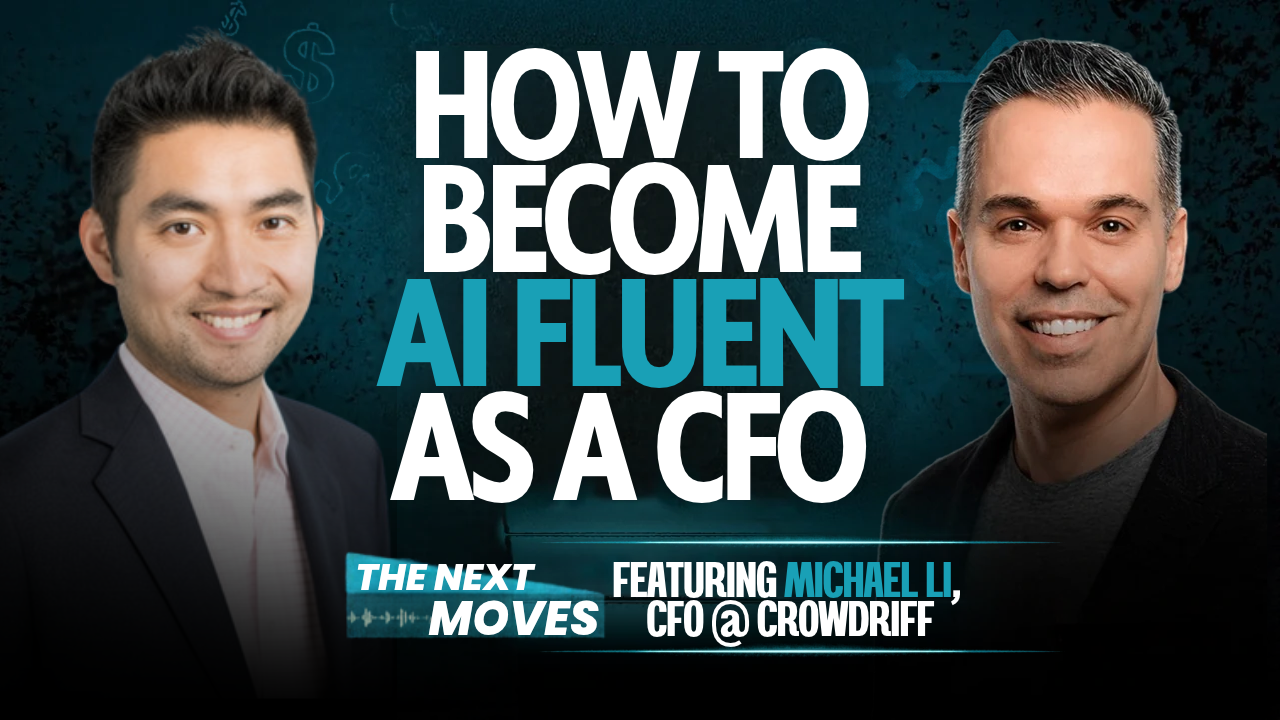
Most finance leaders assume becoming AI fluent is about writing better prompts. Michael Li, CFO of CrowdRiff, learned otherwise. When his team first started using AI, two people could ask it the same retention question and get three different answers. The AI wasn’t the problem.
In this episode of The Next Moves, Joe Diubaldo, CEO & President at Clarity Recruitment, talks with Michael Li, who he has known since Michael was a manager at Davis + Henderson. Michael has worked in finance, customer success and as chief of staff, from multi-billion dollar companies to a seven-person startup. They cover where his AI journey started, the mistake that slowed it down, and what he now looks for when someone says they’re AI fluent.




The question for finance leaders is no longer whether to use AI. It’s what finance is paid to do once AI handles the first pass. AI can now pull the data, build the first model and flag a variance. Joe points to EY, where 130,000 people use AI across audit engagements, as a sign the valuable skill has shifted from producing analysis to evaluating it. For leaders hiring into finance, “AI fluent” on a resume now tells you very little on its own.
Michael’s biggest early mistake was underestimating how much AI depends on a single, consolidated set of data with shared definitions. In the beginning, everything lived on individual desktops. Anyone could ask what retention looked like for a segment over the past three months, and the answers didn’t match.
“I can ask it one way, another person on my team can ask it another, and we get three different answers,” Michael says. The team’s first reaction was to distrust the AI. The real cause was that nobody had defined the question. Does retention include add-on products? Each person had a different answer, so each person’s AI did too, and meetings started with a debate about whose data was right.
The fix was unglamorous. CrowdRiff built a data dictionary covering the product set, key metrics and what each date means. A team consolidated data from multiple systems into a single source of truth that everyone’s AI queries, with shared skills so the same question gets asked the same way. Michael says that work improved decision-making tenfold. If he started again, he would begin there.
Joe added the change management piece most teams skip. When he set definitions on his own, people pushed back, and he spent an hour of a two-hour meeting arguing about one. You don’t need consensus, he says. You need commitment, and you get it by bringing people in early.
AI has cut the time to a first analysis from days to minutes, which moves finance’s value to questioning the output. Testing a business opportunity used to mean an analyst spending days on VLOOKUPs and CSV exports, plus two or three more days for every new angle. Now Michael gets a first pass in about five minutes, provided AI is set up correctly.
He uses Claude as a thought partner. With a proposal still due Friday, he can test how a pricing model affects EBITDA, other customers and legal exposure, then ask where his thinking is going wrong.
The risk is confidence. AI will forecast with certainty, and Michael says the strongest finance people will be the ones who push back. “We kind of say, ‘Are you sure? That sounds wrong.’ And Claude would come back saying, ‘You’re absolutely right, Mike,'” he says. He credits his own judgment to years of doing the work by hand, including joining data across systems before APIs existed. He looks for people who are curious, ask good questions and are comfortable being wrong.
Michael’s bar for AI fluency is whether someone builds repeatable workflows and shares them, not how often they use a chatbot. Interviews used to probe Excel skills with lookups, pivot tables and macros. Now he asks about skills, memory and what a good prompt looks like. A credible answer describes a process they standardized, skills built into their own workflows, and how they share those skills across the team and other functions. Anything less is a supercharged search tool.
That’s also where he would pay a premium: people who can code and build workflows the broader team relies on. CrowdRiff’s verifiable data mart came from exactly that kind of builder. As Joe noted, much of the best AI work today lives and dies on one person’s desktop.
Michael also favours generalists. His team is the same size, doing more critical work, and he pushes them beyond month-end into sales, cash flow and commercial structure. He learned that way himself, sitting in on pipeline meetings at Davis + Henderson as an FP&A manager. Adaptability matters too: some of what he did a month ago is already obsolete.
Those are all the boring stuff that nobody wants to do, but by level setting that initial expectation, it allowed our team to get much further
Start with definitions, not tools. Agree on your key metrics, product set and date logic with the people who will use them, get commitment, and put the data in one place your team’s AI can query. Then hire and develop for judgment and building. When a candidate says they’re AI fluent, ask them to walk through a workflow they standardized and how others on their team use it.
Watch or listen to the full conversation with Michael Li on The Next Moves.
Hiring a finance leader who can build this kind of team, or building these skills yourself?

Being AI fluent in finance means building standardized, repeatable workflows with AI and sharing them across your team, not just asking it questions. Michael Li looks for people who can explain the skills they’ve built into their workflows and how other functions use them.
AI gives different answers when the underlying data and definitions aren’t shared. At CrowdRiff, retention was calculated differently by different people until the team built a data dictionary and a single consolidated data hub.
CFOs use AI to produce a fast first pass and then interrogate it. Michael Li cut first-pass analysis from three or four days to about five minutes and uses Claude as a thought partner to test pricing, EBITDA impact and risk. Every output still needs critical review.
Finance teams should hire for critical thinking, broad business context and the ability to build workflows with AI. Michael Li would pay a premium for people who can code and create tools the whole team relies on.
[0:00] Mike: When we first started with AI, everything was on our desktops. I could ask it one way, another person on my team could ask another, and we’d get three different answers. There was a distrust in AI’s analysis. But really, we hadn’t given it the proper framework for what that question meant. Each of our definitions was different. That’s all the boring stuff nobody wants to do. But by level-setting that initial expectation, it allowed the team to go much further.
[0:38] Joe: There’s a question every CEO is circling right now, and it’s definitely not “Should we use AI?” We’re well past that, and everyone I’m talking to feels well past that.
If AI can pull the data, summarize it, build your first model, and flag a variance, we all know that’s a reasonable first pass. And if that’s what people used to do, the question is: what is finance paid to do now?
As I considered that, I thought I’d talk to Michael Li, CFO of CrowdRiff, who I’ve worked with for over a decade. He’s changing the finance function inside his team. He’s looking at the work, what people get to do, the investment decisions being made, and the skills that are becoming more valuable as AI takes on that first pass.
So, welcome, Mike.
[1:29] Mike: Thanks for having me, Joe. I’m excited to tell you about the changes we’ve been making at CrowdRiff and how we’re making it more AI-enabled for our team.
[1:41] Joe: Mike, I’ve known you since you were a manager at Davis + Henderson. You’ve moved through finance and through customer success. You’ve gone from a multi-billion-dollar company to a seven-person startup. You’ve worked at the PE level, inside public companies, inside small startups, and now you’re scaling a startup.
The first area I want to tackle is what’s actually left the finance desk.
[2:13] Joe: Saying the work is being changed by AI doesn’t tell me the particulars. I want the practical before and after. What was it when you inherited it, and what is it turning into?
[2:29] Mike: Finance’s job, both before and after, is to take data, whether that’s financial or operational KPIs, and transform it into usable business actions that support the business in making decisions.
Before, how would we do that? I’d go to an analyst and say, “I’m interested in figuring out if we should proceed with this business opportunity.” The analyst would take data from our CRM and our customer data. It would take them probably a day: lots of VLOOKUPs, lots of CSVs, trying to interpret the data. Then we’d sit down on a Wednesday, go through it, and I’d question it.
The only difference now is that AI supercharges it. I can do that in five minutes, provided I’ve set up AI correctly. I tell it the exact same thing: “Here are some of my hypotheses. Consolidate all that data and come back with some analysis.”
So the time to that first pass has gone from something that might take three or four days to five minutes.
My role as CFO is to look at that analysis and work with it, just as I would with an analyst, except I’m talking to Claude: “What about this particular angle? Should we look at it this way?” That iteration is so fast now. Ten years ago I would have asked my analyst, “Maybe we should look at it this way,” and he’d go away for two or three days before coming back with something usable. That back-and-forth time has reduced significantly.
[4:19] Joe: So the first pass was a big part of the work, and now you can get it quickly. You can interrogate what you’ve created. Does that turn into something new in how you advise the business? Do you engage with them differently? Have you unpacked things you wouldn’t have before, because you now have the time?
[4:47] Mike: Yes. Time is a big thing. We all work in businesses where they want the analysis tomorrow, or yesterday.
By getting the first pass quicker, we have more time to think and iterate. We can say, “What if we approached it three or four different ways?” Before, because it took so long, we just didn’t have the time. That proposal is still due Friday.
Now I can ask: What if we approached this pricing model in a particular way? How would that impact our EBITDA? How would it affect our other customers? How would it affect us legally, offering this structure relative to all our other customers? What does it expose us to?
I can ask all of that really quickly, get answers, and really stimulate thought. That’s the big change I’ve seen. I almost use AI as a thought partner. If I have all these ideas, I ask it, “Where am I going wrong? Is this the right way to think about it?” It gives you all these reasons, you work through it, and it actually helps you become a better thinker.
[6:15] Joe: If it helps you be a better thinker, there’s an evolution in what the finance person does. So let’s talk about expectations of your team.
We’ve just said the first pass gets cheaper. There’s a set of questions you can now ask the data. I always say I’m talking to my data, having private conversations with it. If you can answer questions in real time that would have taken another pass and another set of iterations, how does that change your expectations of your team? What do you expect from a strong finance person now that you didn’t expect when you first joined this organization, or even as far back as AutoTrader?
[7:08] Mike: I’ve always expected the ability to think critically from my team, and it’s more important than ever. It’s very easy to ask AI, “Tell me what the forecast is expected to be,” and it’ll give you an answer with great confidence.
What will differentiate very strong finance people from weaker ones is their ability to question it, to think critically about the answer being provided. We’ve all been through it. AI gives you an answer, you say, “Are you sure? That sounds wrong.”
Joe: Yeah.
Mike: And Claude comes back and says, “You’re absolutely right, Mike. I completely forgot to think about this angle.” [laughter]
AI makes the first pass very easy, and it gives you very confident answers. But it’s more important than ever to think critically. Is this the right answer? Is this the right way to think about it? Take that extra five or ten minutes to think it through. That’s the key. It’s very easy to give a wrong answer just because AI said so. AI is really a tool to help you.
[8:35] Joe: Let’s take that forward. I just posted something on LinkedIn that got a massive amount of traction. I was asking where audit has gone with the Big Four. They’ve basically deployed AI across all their clients. EY has 130,000 people using it, embedded in all their engagements, and the ability to run an audit has improved dramatically. But now the skill is in evaluating the opinion, the judgment.
So what do you see developing in your best people around judgment, and how do they get better at it? What are your strongest people spending more time on, and what judgment skill are they building? Because it’s a different one from what they’ve traditionally been engaged in.
[9:38] Mike: That’s a question I think about all the time. I had the benefit of growing up in finance through all these different functions and doing calculations by hand.
Joe: With an abacus.
Mike: Absolutely, with an abacus. We’re that old. We had ledgers and T-accounts. [laughter] But doing that helped me learn how certain things function.
When I was a bookkeeper, we didn’t have all these nice tools that interconnect. The person who connected the data was me. We didn’t have an API built yet, so I had to take data from one system, take data from another, and join them. But by doing that, I understood the inner workings of how those systems worked.
So going back to your question of how people develop judgment: the best people will be the ones who take the time to do long division by hand, so to speak. It’s not just asking AI and taking things at face value. It’s really learning and understanding.
When I look for people, it’s always: Are they curious? Are they asking the right questions? Are they okay being wrong? Because that’s how we learn. The people who are curious and keep learning are the ones who will separate themselves, because it’s more important than ever to think critically.
[11:30] Joe: You and I grew up assuming business context was taught, because you were building this ground-up understanding. I’m curious whether that holds in the future.
What are you actually seeing in your own team now? Is it the same people doing higher-value work? Fewer people on the finance team? Or are you seeing entire skill gaps where you need different people to join?
[12:03] Mike: We have the same people doing more critical work. They no longer need to pull data from systems. We can get a lot of our key metrics pretty much instantaneously.
How the team is evolving is that they’re still learning how to interact with AI effectively. AI is a supercharged tool, but if you use it the same way you used Excel, just to calculate things faster, yes, you’ll calculate faster. But are there other ways to use that tool?
As the team evolves, I’m always encouraging them to step outside of finance. I firmly believe the next generation, the ones who’ll be successful, are the generalists. The ones who understand the accounting rules, but also how that affects cash flow, and how it interacts with the sales team, because we can now put a certain commercial structure in place so we can win.
So who do I think will be successful? The generalist who thinks about the problem broadly, rather than being siloed in a specific functional area.
[13:48] Joe: That’s interesting, because my mind immediately goes to you. You’ve developed a very broad skill set. You started in finance, moved into customer success. At Davis + Henderson, were you chief of staff at some point as well?
Mike: I was chief of staff.
Joe: So you had visibility across the business and saw the business problems being solved. How do you develop that in a finance team that’s gone through a different path? How do you build that generalist, business-context thinking so they’re effective?
[14:20] Mike: I think it’s encouraging them to step out of their comfort zone. It’s very easy for finance people to say, “It’s month-end. I’ve got to do these reconciliations. I’ve got to get it out.”
If I go back to how I got all this experience: I sat next to our chief commercial officer at Davis + Henderson and learned a lot about pipeline management, because I was curious about it. I asked Greg, “We’re always behind on our sales target. Why?” And he told me, “Mike, it would really help if you came with an analysis of our pipeline: where it’s coming from, size, whatever. Do it from an analytical point of view.”
I was still a manager at that point. He’d invite me to the pipeline management meetings, completely outside my role as an FP&A person. By listening and working with the sales team, I started to understand their problems. “I was just talking to a customer. The person I was talking to moved into a new role. There’s a restructuring. Here’s where we need to go, and here’s how I started to pitch.” I started to learn more about sales.
So how do I encourage my team? Step beyond month-end. Step beyond reporting. Ask why revenue is down. Ask why we’re selling slower. Asking those questions is the same critical thinking we apply with AI: asking the why, asking the how. That’s how you improve and how you learn.
[16:18] Joe: Given that you see this generalist capability as important, how has it changed the roles you hire for? What roles would you be less likely to hire for now than a couple of years ago?
[16:38] Mike: I’m less likely to hire specialists. I’m more likely to hire the generalist who has a curious nature.
Technology is changing so fast. We’re in the middle of it. In the last month, there are things I did a month ago that I don’t have to do anymore, just because Claude released a new feature set and there’s a better way to do things.
It’s imperative for people to be okay with that change. That workflow may not work anymore, and that’s okay. You have to be able to change with it. Not everybody can. It’s very scary for some people. “That worked before. Why can’t I still do it now?” Well, because there’s a better way.
[17:38] Joe: We talked about generalists, not specialists. But I’m going to press you on that. Let’s be specific about which capabilities you’d pay more for. If there were an auction and you got to bid on capabilities. I know curiosity is a character trait, but which capabilities would you pay more for? This is a riff; we have to think it through together.
[18:11] Mike: I think the ability to interact with technology beyond just prompts.
When you’re team building, you don’t want everybody doing the same thing. If I’m building a basketball team, I don’t want everybody shooting threes. I want people who shoot threes, people who rebound, people who defend. Ideally, I find one person who can do all three. It’s the same in finance.
I want people who can work with the technology beyond a simple prompt-building use case. Judgment is nice to have. What I’d pay a premium for is people who can go in and code, and build workflows that work for the broader team as a whole.
Specifically: one of the reasons CrowdRiff has been really successful is that we had a team that took all the data from our various systems and built it into a verifiable data mart we can all rely on.
Before, the analysis was very one-sided. One person would reach into a system and ask AI to consolidate it, but it was effectively working off different systems. Having a single source of truth that AI can canvas and analyze has always been a problem, since the beginning of time. That’s incredibly powerful.
Once we took the time to build that, it improved our decision-making tenfold, because we’re all accessing the same data. We no longer start meetings with, “Where did you get that data? What was the source?” It’s the same source. Everybody’s working off a consolidated data hub that pulls from our various systems. It’s a single source of truth.
[20:36] Joe: So you’re talking about the tool chain: standing it up so it works effectively, and the workflows that accomplish tasks. We talked earlier about how a lot of the best work lives on desktops and isn’t enabled for the organization. That’s a whole different skill set: refactoring things. We can all vibe code and make cool stuff, but it lives and dies with us instead of traveling well to other people. I find that’s a critical one.
So what changes for you in your own job? What are you personally doing differently now because these tools exist, compared to other roles you’ve had? How is it pushing you in new directions?
And part two: what have you devolved down to members of your team because they’re now more capable, and what have you eliminated?
[21:34] Mike: Let’s start with me. I’ve always been a very curious person. With all these tools available, I’m more comfortable stepping even further outside my comfort zone.
I never considered myself an accounting policy expert. But now it’s at your fingertips. I can say, “Here’s a commercial structure we’re proposing,” and ask about it. Previously I would have said, “Here’s how we’ll structure it; let’s figure out the accounting later.” Now I can do it concurrently, because that knowledge is at your fingertips, especially for something that black and white.
That used to be a wall. If you did accounting policy, you came from an accounting policy background. You weren’t driving strategy. What’s my tax impact? If I’m expanding into a new market, what should I consider? You used to have to go away, research, and ask the right people. Now you can get a first pass relatively easily. It still needs to be verified, but you’re more comfortable stepping out.
And that’s just finance and accounting. I’m now more comfortable stepping into marketing, for example. How do we get better engagement from potential prospects? What are people trying right now? The information is there, the power is there, and you’re more comfortable stepping out and asking all these curious questions to figure out what to do next.
[23:41] Joe: Mike, what’s an assumption you made about AI, something you thought it would solve, that proved false? Something you expected to come off your team’s plate or get optimized, that just isn’t happening given your environment or where these tools are headed?
[24:04] Mike: Looking back at my AI journey, which really isn’t that long, I underestimated how much a single, consolidated set of data meant. I touched on this a bit.
When we first started with AI, everything was on our desktops. I could ask, “What’s our retention for the past three months for this segment?” I’d ask it one way, someone on my team would ask another, and we’d get three different answers. So at the beginning there was distrust in AI’s analysis.
But really, we hadn’t given it the proper framework for what that question meant. How do we calculate retention? Is it based on the renewal base plus what it renews at? Do we count add-on products? Each of our definitions was different.
What we learned is that definitions are imperative. Creating a data dictionary, so to speak, so the AI looks at things the same way, cut down a lot of “My AI told me this,” “Well, mine told me this.” We’d spend the beginning of every meeting debating who had the right data.
The data hub we created reduced a lot of that inconsistency. It really came back to how we defined the problem, and whether there was a consistent way of looking at it across everybody’s AI. Hence creating skills: if we ask a question a certain way, does it mean the same thing? You might think you’re asking the same question, but it’s actually interpreted differently.
If there’s one thing I’d change about how I started, it would be starting with all the basics. How do we define our product set? How do we define key metrics? How are they measured? By what dates? What does this date mean? That’s all the boring stuff nobody wants to do. But by level-setting that initial expectation, it allowed the team to go much further. It removed a lot of our early doubts that AI didn’t know what it was talking about. It was just about defining what those metrics are.
[26:58] Joe: Here’s something no one talks about. If you make decisions on the definitions in the data without everyone around the table agreeing, “Here’s what this means, here’s what a defect is, here’s what a cohort is,” they’ll still argue about the data, because they look at it differently.
So there’s a change management activity that gets forgotten. To get there, we need commitment. You don’t need consensus. You don’t need everyone to have the same opinion. But you need commitment: we’ve surfaced our points, I’m making a decision, and it’s this.
My own learning was that I drove the definition the way I wanted it, and people gave me feedback: “I don’t see it like that.” So I ran both scenarios, my definition and theirs, and we figured out which was accurate. I could have short-circuited that. Instead of pulling people into a room for two hours and spending an hour fighting about a definition, if I’d included them earlier, we’d have had commitment. You don’t always get consensus, but we commit to this definition. That’s a significant one.
[28:12] Mike: Yes.
Joe: And then there’s the generalizing of our skills and the blending of roles. I don’t like to use analogies, but think of it as layers of a cake. So, here’s an analogy. [laughs]
Brendan White, who we had on, said what we’ll see more of is individuals who can integrate data sets, standardize them, advise the business, and then hold the line on accountability. That advisory and accountability piece isn’t talked about enough.
We can have amazing information that shows us insights. But am I saying, “Here’s what you told me. Based on the information, here’s my opinion. What are we committing to, and by when?” And then dropping that into a hard target with a justification for what it’ll do for the business?
As people grow in their careers, I feel this isn’t spoken about enough. You can deliver material, but what’s your recommendation? What are we agreeing to? Who owns it, and by when? How do we know if we’re failing, or if it’s a bad idea? What’s the signal that we back off because it was bad execution, or just a bad idea? I don’t hear enough people talking about that.
[29:40] Mike: I think that’s always been the case. What’s your recommendation? What’s going to happen? How do we make sure we change quickly? Having generalists just lets us bring those things up quickly, rather than debating different perspectives.
[30:03] Joe: Do you think that’s a common thread in the people you’ve seen? The ability to give good advice, get commitment, set a deadline and an outcome, with a rollback or recovery plan if it doesn’t work? Have you seen that in a lot of people, or only at a certain level?
[30:29] Mike: It’s definitely a personality trait, and it’s definitely rare. Bringing a group together and driving buy-in and commitment isn’t easy, especially when you’re working with different personalities across different seniority levels. Experience helps, but I think it’s an innate trait: being able to bring groups together, lead, and drive outcomes. That’s a very special trait someone can bring forward.
[31:06] Joe: Where did you get the most development in that area? Which part of your career, which job?
[31:15] Mike: Probably the chief of staff role. Sitting next to the president, you have some level of authority by association.
But I think I’ve always come across as someone who’s very empathetic and doesn’t have a different agenda. I’m just trying to get the team to win and rally the team. I learned a lot there, because I was working with a lot of senior leaders: the head of sales, the head of technology and architecture. I was spanning all of them and saying, “I’m here to help organize us. Here are our objectives. We all agree? Cool. Here are the initiatives we think will drive those objectives. Cool. And I’m here to keep you on track.” Nobody can say no to that.
Having the reps to run a lot of those meetings, work with those individuals, and get buy-in and consensus was very important to my development.
[32:29] Joe: Are you good at just doing that now, or are you good at teaching it? Because doing is different from teaching.
Mike: Doing is very different from teaching.
Joe: Are you able to recognize and develop it in people, or have you just not had big enough teams since then?
[32:46] Mike: Going back to my “innate” comment, I don’t think everybody can do it. I don’t know if that means I need to be a better teacher, or…
Joe: I think you need to be better. [laughs]
Mike: I always need to be better. It’s hard to know. There are certainly people I’ve developed over time who have built the skill sets I think I exhibit. There are others I don’t think will ever get there.
[33:23] Joe: Let’s go into people-evaluation mode for a second. What’s the difference between someone who says they’re AI fluent and someone you’d actually believe is AI fluent? What’s your bar?
[33:44] Mike: Are you thinking of how I’d interview somebody?
Joe: Yes. If someone says, “I’m AI fluent, I’m easily intermediate to senior,” and you unpack it, what answer would they need to give for you to say “that makes sense,” versus what you sometimes hear?
[34:04] Mike: In the old days, I remember going through interviews where people said, “I’m very good at Excel.” Okay. Do you know lookups? Pivot tables? Macros?
Now it’s really talking through skills and memory. How do you interact with the data? What’s an example of a good prompt? How do you interact with AI?
The answers coming back need to be, “Here’s how I create a standardized process. These are the skills I’ve built into my own workflows.”
And the new challenge I’m starting to see is: how do you share those skills across your team and across different functions? That will differentiate someone who’s truly AI fluent from someone who just says they are and is really using AI as a supercharged search tool.
[35:14] Joe: I want to end on a forward-looking point. Aside from the fact that this has only been on our systems a couple of years and is as accessible as it is, what are you most excited about? What are you watching, where you think, “This is where it’s going”?
[35:44] Mike: I’m excited about the collaboration aspects that are starting to come. We’ve started seeing it in the past couple of weeks.
For the most part, AI still lives on people’s desktops, querying a centralized database. But I’m starting to see, and I think the labs see it too, that for this to be an enterprise productivity tool, collaboration needs to improve. I’m really looking forward to that. The more we can have AI agents serve the entire organization, as opposed to an agent for each person individually, so they can collaborate and work together, I think that’s going to be the next unlock for how organizations use AI.
[36:49] Joe: Amazing. It’s great to hear someone in finance talk about the collaborative element. What I like is that this wasn’t just a tools conversation. You’re talking about how it changes the way we think about our careers, how we need to hire, and what our careers can look like over time.
My business is interesting. The client and the candidate are often the same person, just at different moments. The more specific and tangible the guidance we can give them right now, the better. Everyone says “be curious, play with these things.” But more specifically: try to stand things up with them, and don’t be discouraged when iteration one is 10% of what you thought it would be. Take the next round, and the next.
If this conversation has people thinking about what they want from their careers, what they need in their finance teams, or what the next move looks like at the organization level, then we’ve accomplished what we wanted to.
I’m interested in having more of these conversations, and Mike has agreed to do one as a group, with a few people sharing what they’ve accomplished. That’s coming in the future. In the meantime, watch this and share it. If you see something relevant out there, push it to your colleagues so they know there’s a place to get this kind of insight.
Mike, thank you. This has been awesome.
[38:19] Mike: Thanks for having me, Joe. It’s always great to chat with you, and to see what other people are seeing in the market.
Here is your link to the 2026 AI Listening Tour Findings:
2026 AI Listening Tour (PDF) ↗Are you hiring? Get in touch with us to talk about better hiring.
Get in touch →
Here is your link to the 2026 Salary Guide:
2026 Salary Guide (PDF) ↗Are you hiring? Get in touch with us to talk about better hiring.
Get in touch →
Here is your link to How Finance Fuels Growth:
How Finance Fuels Growth (PDF) ↗Are you hiring? Get in touch with us to talk about better hiring.
Get in touch →
Here is your link to the Finance Team Org Charts:
Finance Team Org Charts (PDF) ↗Are you hiring? Get in touch with us to talk about better hiring.
Get in touch →