
Amazon Music

Spotify

Apple Podcasts
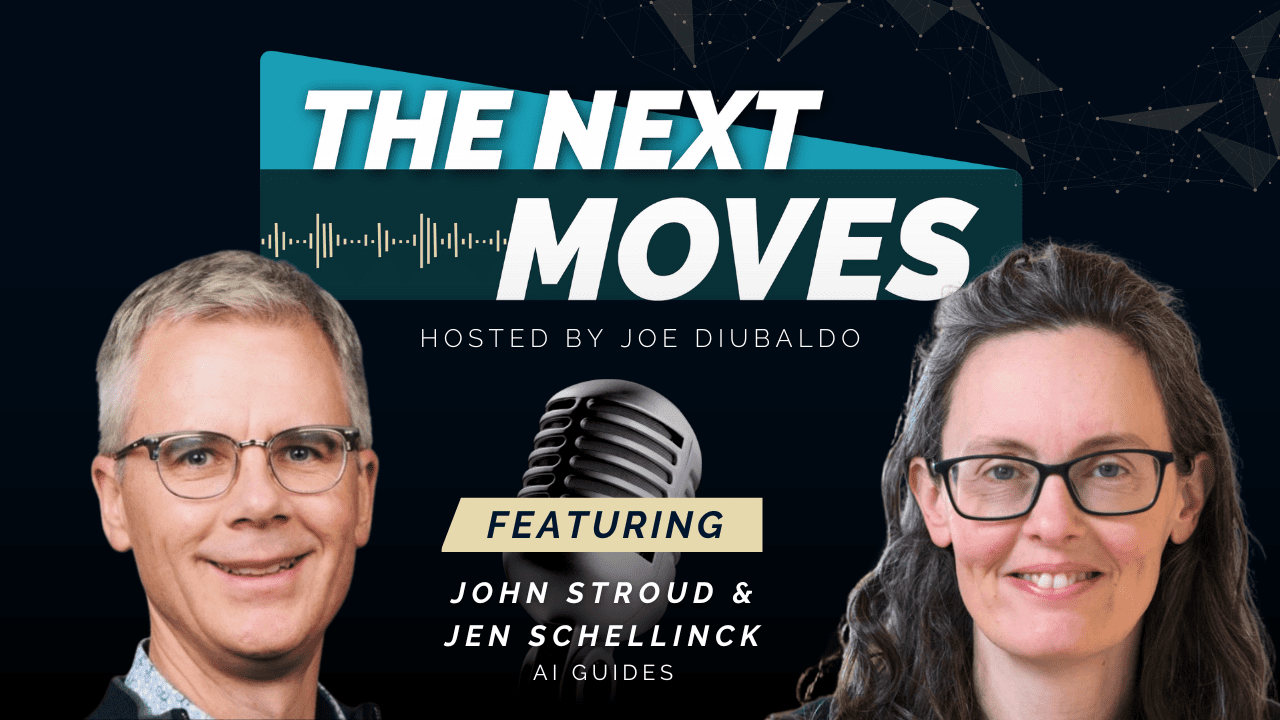
On a recent episode of the Next Moves podcast, Joe Diubaldo, CEO & Founder of Clarity Recruitment, explored the transformative potential of AI with John Stroud and Jen Schellinck from AI Guides. As leaders in AI advisory and coaching, they shared compelling insights on how businesses can prepare for the rapid advancements reshaping industries.
Jen emphasized the unprecedented speed of AI innovation, urging companies to “get on this train now.” From AI models synthesizing human-like podcasts to advanced predictive analytics, the capabilities of AI continue to expand. John highlighted a future where AI not only answers questions but performs tasks, requiring businesses to rethink roles and workflows.
The discussion introduced the concept of “agentic AI”—tools acting as virtual team members, capable of executing complex, multi-step tasks. This evolution shifts AI from a passive assistant to an active participant in business operations. Jen likened these agents to interns needing oversight, training, and alignment with company values.
The conversation underscored the importance of developing in-house AI expertise. Jen and John shared a success story of helping a client optimize resources across distributed teams by combining internal upskilling with cutting-edge AI solutions. This iterative approach empowered the company to adapt and thrive in a rapidly changing landscape.
AI Guides is evolving its services to focus on coaching leaders to build “healthy AI habits” and foster a culture of curiosity and experimentation. They advocate for leaders to engage with AI tools firsthand, set clear strategies, and communicate changes through storytelling to inspire organizational alignment.
For businesses at a crossroads with AI, John and Jen offer a free self-assessment tool to evaluate readiness and identify next steps. Their pragmatic, tech-neutral approach ensures companies adopt AI solutions that genuinely align with their goals.
As John put it, “The question isn’t whether AI will change your business—it’s how you prepare to harness it.” Visit AI Guides to start your journey or book a consultation with their team for personalized guidance.
This episode serves as a call to action for leaders to embrace AI’s opportunities while navigating its challenges with intention and foresight.
If you need support finding finance, accounting, or data analytics talent:
00:00 Jen: At this point things are moving at breakneck speed and only moving faster. And so this is something I’m just trying to tell everybody — we told it to you, we’re telling it to everybody — is that you need to get on this train. You need to get on this train now.
00:46 Joe: Hey everyone, welcome to the Next Moves. This episode is one that I found quite interesting because I sat down with two people who are really providing guidance on what our next move should be as it relates to the world of leveraging AI in our work, in our careers, and in our companies. The next two individuals — Jen Schellinck and John Stroud — are from a company called AI Guides, who I’ve personally asked to work with Clarity on planning our AI roadmap. I thought it’d be useful for everyone to hear what they had to say about what’s coming down the pipeline for us, the things they’re excited about, and how we might want to start thinking about our own skills and how we build a set of competencies that set us all up to take advantage of AI. I think this is a wide-ranging conversation. I would love to have feedback from everyone to see if you want them back and what questions you might want to ask. So let’s tune in. Jen, I want to ask you a specific question around how fast everything is moving. When we first engaged with you, you let us know that there was a rapid evolution in everything happening in this domain and that we had to be ready to move quickly. So my question is — what have you seen in the past three months, what are you excited about, and how does that tie into the clients that you’re talking to?
02:02 Jen: Yeah, great question. So first, right off the bat — I can’t believe I’m saying this — things are only moving faster. And I’m saying this as someone who’s been in this field for almost 15 years. That’s a long time in this space. Prior to the last few years, things were starting to move along but they weren’t moving at breakneck speed. At this point things are moving at breakneck speed and only moving faster. And so this is something I’m just trying to tell everybody — we told it to you, we’re telling it to everybody — is that you need to get on this train now. In terms of the things I’ve been seeing over the last few months — and John’s really great at this too, so John feel free to jump in — just this increasing ability to transform information and synthesize information from multiple sources but also in an increasingly sophisticated way. Probably one of the best examples of this is this sudden ability — and John you’re gonna have to help me with this — is Gemini, right? They can now create sort of instant podcasts, convincingly human-like podcasts, from basically a few documents. Suddenly you have a 20-minute podcast with people talking that sound like people, created almost seemingly out of nothing. That’s just one small example of the extent to which we’re starting to be able to process, synthesize, and then create new types of material and content. And behind the scenes increasingly there are capabilities relating to predictive analytics, the ability to ground some of these models that are right now very detached from reality — object recognition, reasoning skills. There’s a ton of things happening behind the scenes as well. But just some of the immediately accessible results are pretty incredible as well. John, did you want to add to that at all?
04:22 John: Yeah. I guess the one way to think about it is like two years ago we got the ability with ChatGPT to get answers. It’s a chat interface, back and forth in natural language, so it explodes. So it’s answers to questions. I think in 2025 what you’re going to see more of is tasks — they’ll be able to do work for you. So it’s not just answering a question but it’ll be able to go out and do some work. If it’s around marketing, you might have an AI agent that is delegating work to other AIs to do things like draft social media, review feedback on your post, create a video. You’re going to need managers to oversee what these agents are doing. And then after that — Jen and I have been talking about this, we’re not really sure what the right term is — we called it slow AI. Because right now our interaction is very instantaneous. You ask a question, you get an answer. But what if you had agents who are doing tasks for you, and instead of responding right away you said “take this report on a potential client and give me an analysis of it in 30 minutes” or “next week” or “just take a look at my calendar and see what’s coming up, and 48 hours before any of my meetings if there’s something you think I should know about that meeting, proactively suggest it to me.” So I think this is kind of where we’re going to be going in 2025 and beyond.
06:13 Joe: The things that you’re talking about — agents organizing the activities for you and organizing the activities of other agents, and thinking through over an arc of time in a more detailed way — some sort of analysis and production of information. That’s a little haunting. It’s a little intense.
06:39 Jen: Yeah. The really hot term right now is “agentic” — that’s what you’re talking about right there. This agentic modality where you have your team of agents doing things. And it is, as you say — I like the term you use, haunting, and a little mind-boggling. So we update the metaphor that we talk with people about — think about it as your intern. And so now the intern cannot just give answers but can do tasks. And then you need to think about in your company — who’s going to be managing these people, who’s going to be the bot manager? And from an HR point of view, thinking about the analogous tasks of recruiting the bot, onboarding the bot, training the bot, measuring its performance, giving it feedback, but also teaching it your company values — “this is what we want you to do and this is what we don’t want you to do.” So it doesn’t necessarily mean that people are going to be replaced, but it does mean change and augmenting as opposed to just straight-up automating the work. It’s new roles for people.
07:54 John: And on the haunting side — I hear you, but I also get excited about some of this stuff, about what’s coming. But remember, it’s been two years since ChatGPT came along and I saw a survey this fall — only 4% of people are using it every day, which seems crazy low to me. I can’t believe more people aren’t. But it just takes time for this stuff to happen. And the expression is — it’s Amara’s Law — we overestimate the impact in the short term and we underestimate the impact over the long term. In the 1990s people had these great business ideas — they were going to see movies over the internet, you could buy pet food online — and all of those companies went bust. They were good business ideas, they were just too early. So this stuff is coming, agents are coming, but we’re now pretty used to ChatGPT and we’re pretty adaptive. So I guess I’m more on the optimistic end of the spectrum when it comes to how work is going to change.
09:05 Joe: I think within that, the concept of haunting is that initial reaction we have — how is this a threat to what we do, as opposed to what are the opportunities that this presents. And I think the framework of looking at the technology and how it solves a business problem, and then what you just suggest — how does it behave as it solves that business problem in interactions? And that behavior — how do you cultivate it and train it along the lines of what you want within your organization? Which in many ways becomes a force multiplier for how your brand is perceived, to the upside and the downside. But if you really focus on risk mitigation and maximizing the upside, you can probably train it to behave the way that you want — or at least train it over time and make sure it’s doing the things that are lower threat and you’re getting that incredible value out of it. What I look at is the frontier models too. You had everyone saying that OpenAI was walking away with this, you had Gemini having real problems. But I also saw NotebookLM — for anyone listening to this, give it your website as an input and ask it to write a podcast. We’ve done that and it was actually a dialogue between two people that were completely believable, talking about Clarity Recruitment. The next thing you see is Grok about to be trained on — I guess the largest training supercomputer in the world right now. When you look at that and think about what that might represent for an evolution in the models — Jen, do you see that as something you’re watching closely? Do you think that having this 100,000 GPU supercluster out there is going to make a huge difference?
11:07 Jen: That’s a great question. I tend to be a bit on the conservative side, funnily enough. My default suspicion is — well, there’s a data problem. Where are they going to get the sufficient amount of fuel, meaning data, to make that something new and exciting and different? That said — full disclosure — if you had asked me five years ago if deep learning was going to do what it’s doing now, I would have said no. So I feel a little reluctant to try and predict. I think what we will see with this is that it’s going to show us the limits of what this particular type of AI technology can do purely. The scale to 100,000 GPUs and then the doubling to 200,000 and then scaling up to a million — which is apparently the plan — can only get you so far. And then there’s the data as the input and the algorithms as the other one — that triad that they sometimes talk about. So it may not be the scaling law of larger, better compute that gives you the outcome. Although I’m also saying I could be wrong. I think we’re all open to being wrong. The reason I’m saying that is because there’s the size of something, but also — when we think about data itself, we talk about small data and big data. If we think about something in the physical world like a bridge, the rules of how larger bridges work are different from the rules of how smaller bridges work, but one of the reasons for that is structure. We have to use a different type of structure to get results in one type of functionality than for another. In this case they’re scaling it up but the underlying structure is going to be similar. So that’s why I’m hedging my bets — I don’t know if we can get profoundly different results with the same structure, just larger.
13:35 Joe: I was talking with John in the brief moment that you were gone and we were having a bit of a debate around what AI Guides is doing — how it started really with consulting and advisory and helping people look at their roadmap and understand it, and how there might be an evolution in the way you’re thinking about it — almost a bit of a coaching model for people. Can you explain that and why it might work?
14:06 John: Sure. So with the consulting model, it was like we would come in and when we talked with you we gave very specific recommendations about what options to consider in your environment. And what we’ve been thinking about is that from a leadership point of view, as you move up in the organization, more attention needs to be paid to behaviors as opposed to the technical skills. What are the behaviors that we would recommend people have at an individual level, as a leader, when they’re thinking about AI? Trying to divide those into healthy AI habits and unhealthy ones, and explaining to people what the differences are. Helping them understand the questions they should be asking, so that we’re teaching them to find the solution that makes the most sense in their particular environment. And so then we become less of the person you turn to for an answer on what’s the latest on this tool, and more about how do you think about it, how do you frame it, how do you communicate it with your team.
15:26 Joe: Within that, the idea of getting an operational plan — “do these things” — feels tangible. And what you’re talking about when you’re coaching people is there’s often the leadership coach which is seeking to understand what you want to accomplish and how you’ll develop fully. And then there’s an equal importance for people on the operational coach. I have leadership coaches and sometimes I actually need those bigger questions on what do I want. And the other one is like “hey, I’m going into a meeting in 10 minutes and I don’t know what I’m doing so I need to plan right now.” So I think my insight on that is it’s both — the leader needs to know what competencies they need to have, what behaviors they need to get, and then sometimes as part of the coaching model they need to ask a question that is fairly direct and you may or may not have the answer. That’s just my thought on the model. Because I know having this specific plan for me was great — I can even check back on it and say “are we actually making any kind of progress towards this?” Which we are. And what have I not done within my own ability to enable that plan? If you can replicate that for the individual I think it would be quite valuable. Because I think every leader is like — what am I supposed to do with this right now? And what competencies must I have? I agree curiosity is one of them, but what does that look like tangibly? What steps do I take to develop that and how would I demonstrate that?
16:53 John: And so we see people, they’re often struggling at the same point. I’m surprised — around curiosity, that’s where we really recommend a lot of people start. They’ll express an interest in AI but when you ask them “have you actually even tried ChatGPT?” they’ll say “I’ve tried it a couple of times and then they stopped.” And this is a technology that you really need to play with in order to understand how it’s going to work. So once you play with it and get a feel for it, then you need to look at it as a leader and say “so how is this going to change my business?” Because with ChatGPT, answers are now easier to get than they were before — it’ll give you an answer to a question. So if it’s solving that problem of giving answers, then you address one bottleneck maybe in your organization. So then as a leader, what’s the new bottleneck that you need to solve? And then once you figure that out and you set your strategy, we suggest you want to talk to people about it — and do it in the form of a story. “This is how we’re going to change, this is how we’re going to be at our best. Let me tell you about a really specific example that I saw yesterday and I want to see more of.” So you paint a picture for people about what AI is going to mean in the organization. You want them to get a sense of experimentation — that people suggested good ideas and not only did they not lose their job, they were rewarded for it and it helped others. So embodying the values and strategy that you want through a story just makes it easier to align people on what it is that you’re trying to do.
19:03 Joe: This feels like something where providing those examples in a rich environment — “here’s what I saw, here’s the recording of how it was done, here’s how you can try it right away” — which is an ongoing learning and teaching model within the company. And I don’t think we’re doing enough of that. When I say “we” I’m specifically talking about me — how do I continue to do that, because I’m in this every day and I’m experimenting and I’m finding some limitations, like I talked to you about earlier with sharing the threads and the information. What I’m not doing is taking that and showing people the limitations I’m experiencing and how I’m actually tackling those limitations and trying to move it forward. As an aside — there’s a joke about me in the office. The person that runs my life in the company made a Christmas card that says “dear ChatGPT, please craft a holiday message to my team” — and the card actually says “ChatGPT, please craft a holiday message” with my picture on it. Which is probably what I would have done if I had to craft that.
20:17 John: What that shows is — thanks Joe — humility and openness. If they didn’t trust you, if they didn’t think you could take the joke, they wouldn’t have done it. So I would score that as a positive for you.
20:34 Joe: One thing I want to talk about — give me an example. I think this is a story — here’s your story, guys. You get to tell me about a client. You don’t have to name it but give me an example of the analysis you did, the recommendations, and the success story. Because I think that makes it tangible for people. What have some of your clients done? Jen, do you want to go first?
21:05 Jen: Yeah, I’ll take that one. And I’m going to tell the story of a client that we worked with multiple times, which gives me an opportunity to talk about what I’m now calling classic AI as well as the new kid on the block — large language models, generative AI. Because this was a client we started working with prior to the big AI breakthrough and worked with across the AI breakthrough. This is a company that had satellite offices and, as is often the case with these satellite offices, all of them were like “we’re really busy, we need more resources, please help us out.” So they had this problem of how to best allocate resources — very classic problem in this space. What was cool about working with this client is that they were very committed not just to solving this pressing problem, but also to growing internal capacity and building up their own internal team so they could run with what they had done and expand upon it. We didn’t work with them just to say “here’s a technique you could use” — we really started to work with them and say “okay, have you really nailed the business problem?” And this is such a classic business problem that that went in a relatively straightforward fashion — yeah, we need to do this human resource optimization problem. But then we could really work with them — first of all to stand up the team they needed internally to create and maintain this new functionality. And second, we really helped them — and I want to throw it over to John on this front too — to figure out how to interact with the rest of their organization. This new team with this new technology needed to work with the organization. We taught them also how to talk to the rest of the organization about what they were doing. And then what was cool was when these new technologies came in — the large language models — they took what they were already doing in the more classic space, they had already built up the team, so they really latched onto these new technologies and immediately started being able to incorporate them into their optimization algorithm and functionality. That was just one of my favorite projects because there was the technical piece but there was so much synthesis with everything else they were doing, and it was well received.
23:37 Joe: What was the industry, Jen?
23:44 Jen: I can’t say.
23:44 Joe: Got it. But it’s about resource optimization with all these distributed teams. That is a common problem. To get them ready for that — did they have the data, did they have the competencies, did they have what they needed at the outset and just weren’t organizing properly? Or was there a need to get people, structure information? What stage were they at?
24:20 Jen: It was really cool because when they started — and it was really driven forward by one person who had a really strong vision — she was like “I’m going to stand up this team, I’m going to make this happen, this is going to be really valuable to my company.” And she said “we have just enough data to get this off the ground.” Using this data to get it off the ground — with that kind of experimental, evolving mindset — “we’re going to show the organization that if we had more data we could do better.” Her attitude the whole time was “I’m going to start with a really small team and then we’re going to show this company that with this small team and this small amount of data, look what we can do — and if you give us more and let us have more data, we can do more.” So it really was this iterative process where she had just enough to get it bootstrapped and then was able to grow it from there. She was really working hard at “where can we get this data initially and how can I make this happen?”
25:15 John: And you were really teaching them to fish, right Jen?
25:21 Joe: Were they organized with enough people internally or did they have to bring in some external experts? Because that’s always the question — do we have internally the team or do we need to go get some consulting hires, do we need to make a full-time hire? That’s investment. For certain companies they may need to do that. So what did you see as the landscape on the competency side?
25:46 Jen: Yeah, so it started out by saying — “who internally has an aptitude for this and an interest in this?” That was the starting point. And then over time she was able to bring in more people, both on a short-term and a longer-term basis.
26:06 Joe: What I’m thinking about constantly as you’re speaking to this is there’s been a conscious decision by so many people to move their technical teams out of the company and engage providers — and therefore maybe in some way not build that level of competency in-house that would allow you to even have a base platform. And what I’m hearing more of is that parts of it are coming back in-house. It may not be something as simple as your desktop support — I know that’s not related — but anyone that is thinking they don’t need some level of data analytics capability in their company now is probably mistaken. And that should be brought in-house. Is that accurate?
26:49 Jen: I think so. I mean, I know that’s hard for companies to hear sometimes, because as you say it can be really beneficial to be able to go outside the company and find resources on an as-needed basis. But right now because things are moving so quickly and because there’s a lot of potential here — John and I are both really aligned on encouraging people to think about internal resources.
27:15 John: And teaching them to fish, if possible. Right.
27:22 Joe: I’m not driving at this to try to get more placements for Clarity — it’s just something I think is happening.
27:27 John: I might be driving it a little bit. I mean, they can also get external coaches — that’s also a very valid option.
27:34 Joe: That’s right. So I think what I want to do is give people a chance to reach out to you and have a conversation and understand what their next step might be. The whole thing we’re trying to do with this podcast is talk about the next moves. I think what you gave us as an organization was a set of moves that we could make and prioritize. So how do people get in touch with you and if they do, what can you do for them in the near term?
28:07 John: Sure. The easiest way to get a hold of us is just Google AI Guides — we’ll probably come up on top in your search if you’re looking for us. It’s AIGuides.co — not .com but .co. And you can email us directly. So john@aiguides.co or jen@aiguides.co. And if you go to our website you can book a free consultation with us. We’ve also created a tool around this idea of habits and how you can do a self-assessment. It’s a resource we can make available to you — you go through and assess how you’re doing across 10 different questions across five different categories, and it’ll give you a sense of your baseline. And then we can have a conversation about where you are and where you want to go. We really want to make it something that’s valuable to you and grounded in whatever particular problem you’re trying to solve. We’re in no way affiliated with any tech — it’s just giving advice. And if we don’t think AI is the solution for you, we’ll share that as well. But it’s just for people who feel like they should be doing something, they’re not sure what to do, and they’re at that fork in the road and would like some independent advice on what the next steps could look like. We’d be very happy to have a conversation.
29:40 Joe: That’s fantastic. So john@aiguides.co or jen@aiguides.co — and perhaps take a look at AIGuides.co and go through the self-assessment and figure out where you are. And the promise is that if AI isn’t the answer, you’re not going to be sold into some massive project. And I love that. So I want to say thank you — this was awesome.
30:06 Jen: You’re very welcome. It was a pleasure.
30:06 John: My pleasure. Our pleasure.
Here is your link to the 2026 AI Listening Tour Findings:
2026 AI Listening Tour (PDF) ↗Are you hiring? Get in touch with us to talk about better hiring.
Get in touch →
Here is your link to the 2026 Salary Guide:
2026 Salary Guide (PDF) ↗Are you hiring? Get in touch with us to talk about better hiring.
Get in touch →
Here is your link to How Finance Fuels Growth:
How Finance Fuels Growth (PDF) ↗Are you hiring? Get in touch with us to talk about better hiring.
Get in touch →
Here is your link to the Finance Team Org Charts:
Finance Team Org Charts (PDF) ↗Are you hiring? Get in touch with us to talk about better hiring.
Get in touch →