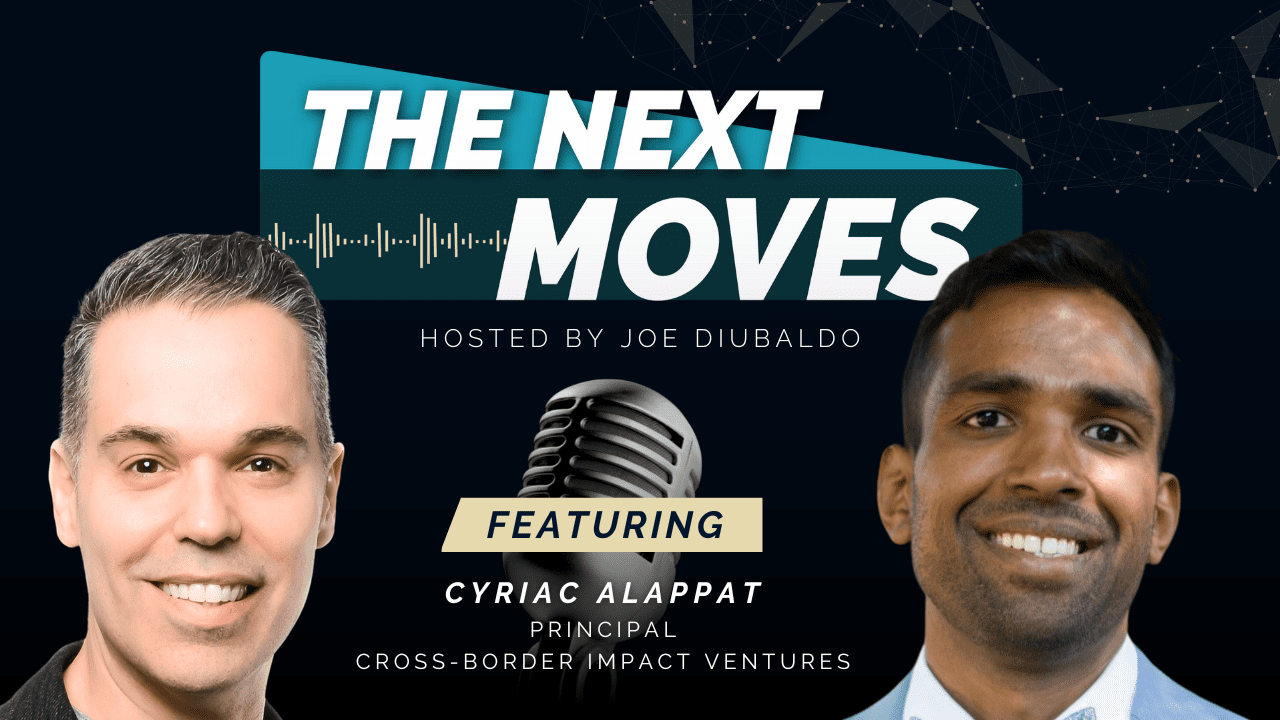
00:09 Joe: Welcome to the Next Moves. My name is Joe Diubaldo and for the past 25 years I’ve been helping people build careers and build amazing companies. The truth I’ve learned is that we all get stuck at different times and I want to help you get unstuck, plan your next move, and the move after that. I think the best way to do that is to look at the choices that some of our guests had in front of them and the moves that they made. So welcome to the Next Moves. I have a friend of mine on who I’ve known for many many years. His name is Cyriac Alappat and I worked together with him starting in 2013, 2014. You’ve built this interesting career and I think you’re someone that, when I look at the purpose of what I’m doing when I’m trying to run these — it’s really to look at what options did people have in front of them and what moves did they make. That’s both when you’re trying to build companies and when you’re trying to build a successful career. So I like to look at this from the starting point of the origin story — walk us through your career, specifically starting where you are now. Start with where you are now and tell us what you do, and then take us backwards to where you started.
01:28 Cyriac: Thanks for having me on Joe. Excited to kind of tell my story and hopefully share some learnings with anybody who’s listening in. So I’m Cyriac. I’m a principal at Cross-Border Impact Ventures. We are an impact venture fund — what we mean by that really is we focus on the same sort of return profile for health tech deals as any kind of biotech or healthcare fund, but we’re also an impact fund, which is a little different in the sense that we also look for commercializing life-saving innovations in developing markets. One of the reasons why we have this impact thesis is we spun out of a global health fund called Grand Challenges Canada. Not a lot of Canadians know about this NGO, but there are several Grand Challenges — the first one initially started by the Gates Foundation with the concept of working on grand challenges like curing malaria, reducing maternal mortality significantly in developing markets. There were several Grand Challenges programs that were initiated globally. The largest is actually in Canada and as of today, Global Affairs Canada — which is the Foreign Affairs arm of Canada — essentially manages that program and provides money. One of the lessons they learned by providing grants to the global health ecosystem was it was not good enough to just provide grants to innovations — sometimes you want to have a board seat and actually invest equity so that you could really change the trajectory of commercializing these companies at an early-stage venture-backed stage.
03:22 Joe: Okay, so you find yourself here now and effectively you’re in a VC.
03:30 Cyriac: It is a VC. I would say the difference is we do look at the same kind of return profiles, but we also look at impact. The way we measure impact is lives accessed, lives improved, and lives saved for each innovation that we invest in — and those numbers are measured in developing markets.
03:54 Joe: Okay. So walk me through the work that you do from the lens of — these are the skills I need to do this job.
04:02 Cyriac: So, being one of the first employees — and the management almost calls me a founder of the fund, one of the founders — is that you had to have a very broad skill set, at least at the beginning, because we were setting up the actual financial instrument that is now Cross-Border. But as you know, when I look at today’s role, it’s very much focused on investments predominantly, because we’ve grown the team now and we’re allocating. An average day for me is looking at pipelines, doing deal meetings, and then potentially starting to evaluate companies financially, also using technology assessment, and then doing our impact assessment. The second component of my job is growing the network at Cross-Border Ventures. We’ve developed a pretty good scientific advisory board, and we expand on those board memberships as the VC continues to grow.
05:06 Joe: So if we take a look at this, you’ve had a journey now that’s taking you from public accounting through to recruitment, through to a startup that you tried to found yourself and got going, and then into Grand Challenges, before now launching the Cross-Border Impact Fund. How does someone start here and end up where you are? What happened? And I’m assuming that there were some pretty — I call them the desperate choices — which are “I don’t know if I want to do this but I feel like I need to do something.” So talk to me about how you ended up doing what you’re doing.
05:46 Cyriac: It’s a great question Joe. Maybe I’ll go even before university. Even though I grew up in Canada for most of my childhood, I did my high schooling in Dubai and was able to actually travel to many markets that we now serve, which is India and sub-Saharan Africa. I really got a taste of understanding some of the nuances of operating in these markets, and that really kind of gave me a global view versus just a Canadian or US-centric view — knowing that these markets are very large markets. But that’s not how I started my career. I started my career as a CPA. I graduated from Laurier University — a little bit following my father’s footsteps. He was a CPA, he was in accounting, and then moved on to being more in a CFO role. So that’s kind of initially how I got into this. I always had a real interest in medicine — I was even thinking of going into pre-med, but for whatever reason it didn’t work out. But one of the great things about EY — which is relevant for my work today — is you walk into a client’s office, you do the audit, you do due diligence on the company, you get comfortable asking for documents that might be more confidential, and you understand how to do due diligence. I think that’s the key lesson I learned in auditing. And I was able to take that skill set and move it into Cross-Border. But one of the things that I did not really have was understanding of startups and how technology evolves. And that’s kind of how I got to work with Clarity and obviously yourself. In that role I had some exposure to developing the Lumify platform, but I think the real work was actually growing the network — doing the recruitment, doing a little bit of BD — and that really taught me a lot about how to grow a network, which is something I do at Cross-Border Ventures. And then at that point I started to think about launching my own venture fund — which is interesting, a blend of finance but also being able to grow your own network. So I essentially co-founded an accelerator with the idea that we would put a $10 million venture fund as part of that package. But we quickly learned that it’s difficult to raise a venture fund. We went to the final stages of getting investment from a sovereign wealth fund through some of my brother’s contacts — he was an investment banker in the Middle East — and they pretty much told us “you have no track record and I don’t think you should be doing this.”
08:52 Joe: So at that point, interesting enough, you’re like — right, okay, I’ll take that feedback into consideration. Thank you. So — don’t do this then.
09:00 Cyriac: Yeah yeah. But you know, the idea back then was bringing startups from Canada to the Middle East where the sovereign wealth fund had an interest in bringing innovations into their market. It kind of dovetails with the work that we’re doing at Cross-Border, which is bringing innovations into different markets but specifically focused on healthcare. I think that was really good learning. And one of the interesting things — you never know when you start these things how it can snowball into something else. So we had an adviser, her name was Annie Terio. She was actually looking to start her own venture fund in the impact space and she had a lot more experience than myself. What was interesting between Cross-Border and the fund that I tried to form — one of the things we had was very little institutional backing. When Annie had come to me about her thesis, she was working very closely with Grand Challenges Canada and was joining as their chief investment officer. That really brought a lot of credibility to the fundraising of Cross-Border. As of today it took us about two years to raise our fund, but we’re about a $90 million USD fund. We are a Series B investor — so typically commercial stage entities — and a lot of our initial success has been from the initial backing and incubation of Grand Challenges Canada, which provided us a lot of credibility.
10:30 Joe: So being asked the question of how do you find yourself where you are now — I think we try to fit our story to what we know currently. But you were in a place where someone said you had no business doing this because you don’t have a track record, and now you’re doing this with a team. I want to take you back to that moment when you had to make a decision. Did you have an option to keep going and trying to raise the capital, or was it really done? And how do you move forward from that point to where you are?
11:03 Cyriac: That’s a great question Joe. I tell people that I have an exit — it’s a minus $50,000. The number one question on how to end a business is looking at your bank account going to zero and saying “I gotta get a job at this point.” But other than that — one of the things is when we were kind of at the end stages, we had a couple of collaborators with us and they had more track record than I did. Those collaborators were moving out and said “there’s only a certain time frame in which we could potentially work on this and at that point we need to move on as well.” So I think it was at a point where both myself, my brother who was also a co-founder, and our collaborators were like — this probably is not going to work. But interestingly, that whole journey really dovetailed into this new role. Because Annie, who was our advisor, had seen us — we went and built all the kind of prospectus documents, the offering memorandum, all the legal documents required for a venture fund. She was actually part of that and we actually rolled some of that documentation — at least the templates and some of the thinking — to the new fund. So even from that level of granular work, there’s always some sort of overlap if you’re lucky enough to move into a role that’s in a similar space. And then the second thing is I learned a lot about how to get deal flow. Because as part of raising a venture fund, you need to show that you have deal flow — these are three or four investments you’re going to make, build out the investment thesis, do a bit of financial modeling, really build a snapshot of why these investments can make money. A lot of that work actually rolled into Cross-Border as well. So in some ways yeah, it was heartbreaking to stop your own business. But in other ways I think it was much more formative in terms of experience.
13:13 Joe: There’s always the line that the end product is you — because you’re building a set of competencies that you can use in the future. If you think about it — the skepticism that comes from being in public accounting, the ability to approach senior people and ask for information that other people would feel uncomfortable doing when you’re in audit, and then moving that into an understanding of finance and becoming a recruiter and someone who looks at technology on how to accelerate recruitment and improve decisions. So you’re actually leveraging the finance background, building the network, and learning how tech can be implemented and change the way businesses work. And then using that to try to start your own fund, and using what you learn while you’re starting your own fund to support the launch of another one — because you met the individual you could partner with in the future. There’s always the idea of how do you connect these things, but I always look at it from — what skills are built each time and what do you move forward with.
14:13 Cyriac: I find that quite interesting. Just one point to add — if it wasn’t for my prior experiences I really don’t think I would be in this role. I 100% agree with what you’re saying.
14:21 Joe: Well there’s the path that gets you there, and there’s also the path as you’re walking in life. Forward momentum creates opportunities, and if you’re not moving forward and trying things then you’re just stuck where you are and opportunity doesn’t show up. But if you’re actually saying “okay, I’m going to try this next,” you at least have a chance of uncovering significant opportunity like you did. So there’s an idea right now — venture is really really hard and the business model for venture funds has dramatically changed. Can you comment on what it’s like now relative to what it was before?
15:00 Cyriac: I definitely think the venture market, especially in Canada, has matured. There are multiple players. In the early days the government of Canada actually provided a lot of leveraged financing to stimulate venture capital — some of the larger venture funds you see today are really beneficiaries of that program, it’s called the VCAP program. Fast forward to 2024 or in our case raising in 2022 — you really need to have a differentiated thesis in terms of raising for venture funds. Almost everybody will say they raise entirely on returns and they do technical analysis, kind of the MBA type analysis. It’s highly unlikely you’ll be able to get a fund size over $10 to $15 million if you’re a first-time fund manager. And I see fund managers who do that. I think where the real difficulty is when you start raising more than $100 million — which is a medium-sized venture fund — you really need to have a differentiated thesis. In our case we’re focused on women’s and children’s health, which is considered an underserved medical market. The second thing is we are also an impact fund, which is kind of the thesis of Grand Challenges Canada, and that attracted a lot of global health fund funders who are our LPs as of today. Even a pharmaceutical company — J&J is also there. We also had a thesis around bringing products into developing markets which are considered underserved, and have the credibility to say that we could do this because we’ve done this work before at Grand Challenges. In terms of global health and technology transfer, we’re probably about the third fund in this space doing this work. And just to give you an idea — some of the investors in our funds are invested in the other global health funds as well, so it’s a small community but I think it will be a growing community going forward. The measure of success for Cross-Border is if there’s not just one fund like us — and we get big — but there are probably multiple funds in the space.
17:21 Joe: When you say there’s three funds, you’re talking about three funds globally or three funds in Canada?
17:29 Cyriac: Three funds globally that work on the type of investments we do — in the sense of bringing technologies from high-income markets into developing markets. There are about three of them so far.
17:37 Joe: So talk to me about what’s in the fund in terms of portfolio — are you able to discuss them?
17:45 Cyriac: Yeah, we can definitely discuss them. So as of now we’re about 90% allocated for the life cycle of this fund. We’ll probably do 10 investments — we are very close to closing our ninth investment and will likely do one more investment for Q1 next year and start looking to raise our second fund, probably around Q4 next year. In terms of the portfolio at this point it’s almost completed. I would say a lot of the portfolio is weighted towards maternal health, which, if you think about it in terms of dual market — what the developing markets’ needs are — there’s a huge disparity in maternal mortality in these countries. There’s actually a lot of financing in terms of health ministry priorities that go into this particular health vertical. So we tend to stick to the health verticals that can potentially commercialize in these markets.
For example, we’ve invested in a company in San Francisco called Radiant Oxymetry. They have produced an FDA-approved device called the Daisy, which is a cervical drain for C-sections when there’s postpartum hemorrhage. In developing markets, C-section rates are increasing right now. There are various tools for postpartum hemorrhage but none of them work really well — it’s a very complicated issue to solve and a very critical health crisis. C-sections are an area that is increasing and postpartum hemorrhage for C-sections is a lot more nuanced. This device is actually used as a cervical drain. One of the reasons why we did that investment is that in India, for example, about 35-40% of women now get C-sections — so these are large markets and they’re underserved as well.
The other investment we’ve made is in a company called Pendulum. They are essentially a supply chain demand modeling AI company. What really interested us is that this company has what we call reverse technology transfer — they’re based in the US but most of their contracts are with ministries in sub-Saharan Africa and a lot of the global health funders where they work a lot around health supply chain in contraception, around basic medical supplies. So much of the supply chain in these countries is critical for health management — if you don’t have a robust supply chain you’re not getting the materials or the pharmaceuticals to the people who need it. That’s one of the reasons why we invested in that company.
And maybe just a third one to give you an idea of the flavor of companies we invest in. There’s a company called Enol Lens — they’re a virtual tumor board company focused on oncology. What they do essentially is a digital multidisciplinary tumor board in which multiple specialists can discuss cancer treatments for patients that have failed standard treatment regimes. Usually during pre-COVID this used to happen in the office in the hospital where you have the radiologist, the cardiologist, the immunologist all coming together to figure out a treatment regime for a patient. Now after COVID this all became online. One of the things that we’re really interested in working with them on — because their business is predominantly in the US — is how do we talk about technology transfer and physician education in developing markets, by connecting the developing market institutions. In this case we’re running a trial for pediatric oncology in Mexico, where they’ll be discussing their patient treatment pathways with the Phoenix Children’s Cancer Center in Arizona. A lot of the discussions are really interesting — around how do we use the new agents and therapeutics in our market effectively to improve treatment profiles. This is an example of physician upskilling, not just bringing a new technology into the market.
22:30 Joe: And I guess what I’m grasping at is — is that a technology play, is that a learning platform, what is it? As an uninformed person I’m thinking about — okay, a virtual tumor board that would be looking at this and saying what’s failed, what interventions are available, what should we come up with? And then the second part of that is developing the capability of people locally to deliver that. Is that what it is?
22:56 Cyriac: So the way it works — the Enol Lens platform is almost like the conversation we’re having right now, but they’re also tied into the EHR systems, the electronic health record systems. Keep in mind we can’t have Zoom conversations about patients — there’s confidentiality and a lot of rules around that. They’re HIPAA compliant and all those other things. They also tie into the regulatory bodies on how to prescribe these treatments on a per-country basis. And then there’s a treatment follow-up component where you can log your notes and everything. That’s their standard business. There is a whole AI component too — because they do thousands of tumor boards on their platform every day, you start getting real world evidence on how oncologists are prescribing medication to their patients. These are typically transcribed into their ML algorithm and you essentially get insights into how these medications are used, which is very useful for pharmaceutical companies. Pharmaceutical companies are under a lot of pressure to measure the real world data on how their drugs are used in market. The second component is clinical trial matching, which is extremely important for pharmaceutical companies because they’re always looking to recruit patients that fit certain inclusion and exclusion criteria. The patients discussed on the platform allow you to identify the ones that are fits for clinical trials. But the more important use case around the impact side — using the Mexico pediatric oncology initiative as an example — the discussions on the platform will be transcribed into a report that the health ministry will start to understand: where are the challenges in pediatric oncology in terms of the care pathway, how are our doctors responding to it, and what are the medications that they need on the ground level?
25:16 Joe: I think there’s something that everyone at one point wanted to be a VC, and there’s an idea of what it is versus what it really is. You and I were talking the other day and literally people come to you with ideas looking for funding — from the idea stage “here’s what I’d like to do” — and you then go through a whole series of validations in terms of proving it out. How does that happen? Someone comes to you, how do they get in your door, and then what do you do with that if it looks interesting? Because you can’t allocate capital against something that is flawed but you might not know. So give me that chain of what you do next.
25:57 Cyriac: Yeah. So first in terms of pipeline — we’ve built a good funnel at Cross-Border at this point. We do get some inbound deals that hit your desk, and those are probably maybe 30-40% of the deals that we look at. I would say the majority of deals we look at are through VC referral networks or conferences. Our teams travel all the time around Europe and North America, going to healthcare conferences, women’s health conferences, etc. — really looking at deals that are of interest to us. And given that we’re now almost two years into doing this, some of these deals come back — you might pass on them two years ago, they made a lot of progress, and they come back. Our CRM is constantly being updated and resurfacing deals we haven’t looked at in the past.
In terms of due diligence — keep in mind we are in healthcare, which is a highly regulated industry. We typically focus on deals that are commercial, which means they have regulatory approval, and they also have clinical evidence to back that. Because I’m not a medical professional, I work very closely with our scientific advisory board to do that due diligence. There are really two pieces of due diligence — first, is there a return profile and a return case to be made in North America and Europe? And then second, is there a developing market application? Because what you don’t want to do is bring an innovation into a market that just leads to excess cost and instability, more complication for the patient — that doesn’t do anybody any good. So it’s really finding the right deals that are transformative versus incremental. What we find in these healthcare systems in lower-income countries like in sub-Saharan Africa is they’re looking for transformative change — they’re not really interested in incremental changes that cost $100,000 to extend a patient’s life by 30 days. So it’s really finding the companies that are truly transferable in terms of that thesis.
28:29 Joe: Got it. Okay. So let’s take you back in time and let’s talk about recruitment — so where you were. You were my boss, by the way.
28:44 Cyriac: Where I was your boss — how bad was that for you? I hope it was okay.
28:44 Joe: No, it was good, it was good. So talk to me about how you come in and how you leave — what happens? The idea is simple to say there’s the ability to build a network, but there’s almost a series of gates you get through where you become better at certain things. How did that set you up for this role?
29:08 Cyriac: I had gotten my CPA designation and I was working at Ernst & Young. I kind of realized it wasn’t for me in terms of long-term career objectives. I was really fascinated by the technology space. My initial thinking was maybe to join a technology company as an accountant and then perhaps move more into an operational role. So I actually walked into Clarity as a candidate — I think that’s where I met you at the time, Joe. And then you talked really about Clarity’s mission, which is not just recruitment but bringing technologies that can be leveraged to improve the recruitment process. In some ways Clarity at that time was almost like a technology startup — I think you probably had seven or eight staff. I really saw an opportunity not just to leverage my CPA strengths in the sense that I understood the industry and could potentially help on the candidate recruitment side, but also to help operationalize the technology — Lumify. So I was involved in that. I think the lessons learned there were to not just work with a technology, but to see a company through its growth trajectory, to really understand being part of a company that is able to grow and all the difficulties and opportunities that come with that. The second component I would say is really building out the network but also building your BD skills. As an accountant you don’t really pick up the phone and call people — but as a recruiter you must. Really having a real focus on growing your network, which eventually gave us candidates and in my case now gives us deals and implementation partners and those kinds of things. Those are really the great lessons I learned at Clarity.
31:13 Joe: I always wonder though — when you look back, where were you stuck and where did you feel the most trapped, and how did you take that next move?
31:21 Cyriac: I would say where I felt probably the most lost was at EY, because I quickly realized that going to become a partner and doing audit wasn’t really for me. I took a bit of a different trajectory from some of my colleagues. Sometimes I talk to them and they’re like “wow, you took a completely different trajectory.” But then I also look back and say that experience was very formative — because I’m in the financial industry, I do due diligence on companies. Maybe at that time I didn’t think that experience was going to be as relevant to my career, but now when I look back at it, it’s quite formative.
32:09 Joe: So the idea of walking away from that — with a father who’s a CPA and a CFO — how was that? What was that conversation like?
32:18 Cyriac: Well, the funny thing was my dad also tried to get into pre-med and decided not to. So he had some understanding — it’s kind of interesting how it goes in the same cycles even though it wasn’t connected by anything. So he understood. He was very supportive, to be honest. I think his initial thinking was “Cyriac’s going to focus on what he wants to do — he’s fairly young in his career.” He did have some questions about me joining Clarity, but overall he was quite happy I did.
32:57 Joe: There’s always the idea that our parents are in the background evaluating what choices we make — and with the best of intentions most of the time — which is “pick something that you’re going to be successful in and happy in, and try to find the intersection of that.” So I would guess recruitment would have sounded quite foreign to him at that moment in time.
33:14 Cyriac: Yes, yeah. But I think as things have evolved in Cross-Border, both they and I think that the experience at Clarity was also quite formative in the work I do today.
33:29 Joe: I’ve had your brother on this and he’s been someone who’s been quite enlightening to talk to about AI. And I know that he supports you in the fund — what kind of work are you doing to leverage AI?
33:46 Cyriac: That’s a great question. A lot of the deals we see — almost 90% of them, if it’s not just a med device — have some sort of AI component to them now. One of the things that we are leveraging Abraham, my brother, for is really just popping the hood of these AI companies and making sure that what they’re saying in their deck and what they’re claiming to be true is actually possible. The companies that we do a lot of due diligence on — we typically invest in companies that have a good syndicate, so they have some sort of VC backing and there’s been some due diligence done on them. But where we do a lot of work is when they make claims on platform plays. Sometimes they’ll go through a regulatory process for a certain indication — let’s just say a prediction on heart failure or something like that — but they’ll make claims that they’re able to use the same AI model to expand into other indications. That needs a lot of work, because a lot of them — the enterprise value, the valuation of the business — is sometimes based on this assumption of platforms. And that needs to be checked. The field of AI is really evolving and we’re just now building the frameworks to actually assess it — that’s something we do with Abraham as well, to build the frameworks to assess these technologies. I don’t think a lot of VC funds are doing it now but they will be doing it soon. There have been some early movers that have really taken off on the AI field — they’ll hire PhDs and things like that. In our case we’re not going to be the specialists at AI, but we do want to have a framework and thesis around it.
35:44 Joe: Is there anything that you want to add that we haven’t talked about?
35:52 Cyriac: I would just say the lessons I’ve learned at Grand Challenges and Cross-Border is that Canada is a respected country in global health. I don’t think a lot of Canadians are too aware of those things. But this country and the innovations that come out of it have been very meaningful. I hope that Canada as a community — the VC community — can come together and continue this tradition of bringing life-saving technologies into developing markets. I think it’s a very worthy cause.
36:23 Joe: So do I. Well said. Thank you — this has been awesome to learn about what you’re doing now and how you got here.
36:29 Cyriac: Appreciate it, Joe. Thank you so much.