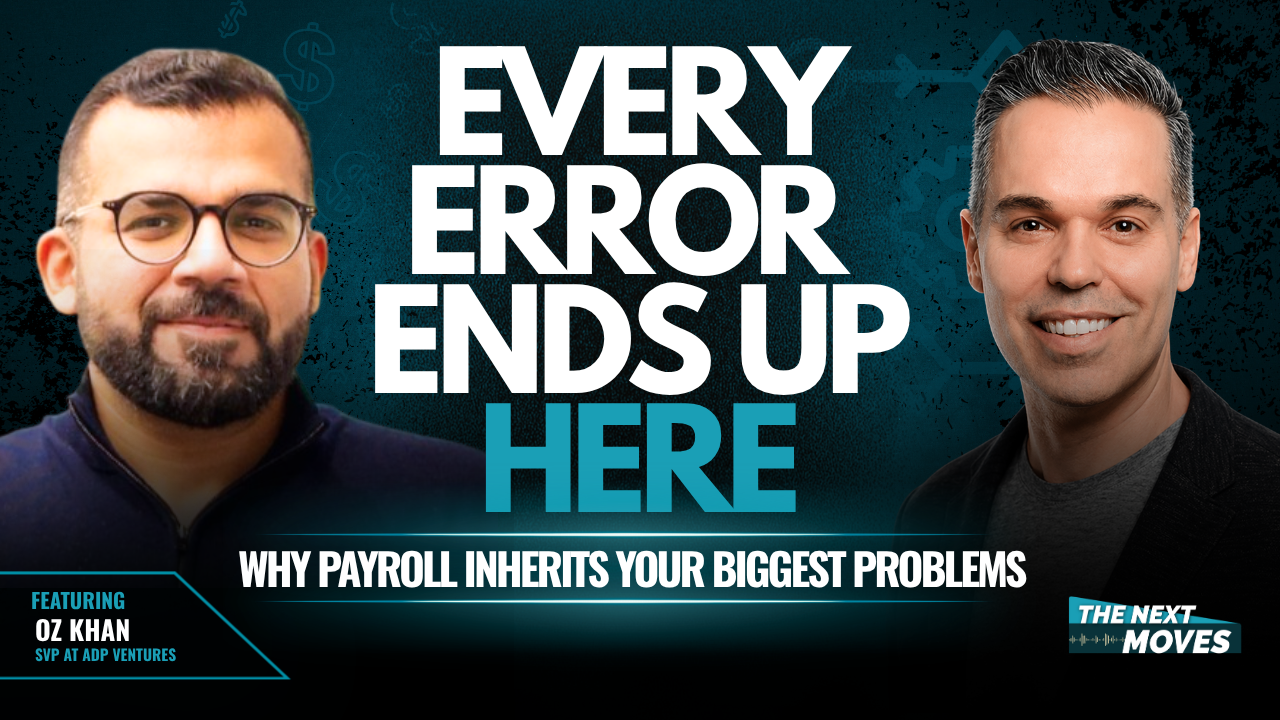
The payroll team absorbs the entropy of the entire organization, under a deadline they don’t control, with data they don’t create.
Most leaders treat payroll problems as a payroll team problem. The late-night fixes and backdated corrections make it easy to blame the people closest to the run. In reality, payroll is where every other system’s mistakes show up. On Episode 26 of The Next Moves, Joe Diubaldo, Founder and CEO of Clarity Recruitment, sits down with Oz Khan, who runs ADP Ventures, to unpack why payroll breaks, why AI alone won’t fix it, and what that means for the finance leaders and teams companies need to hire now.




Payroll problems are multiplying because more companies are growing through acquisition. Joe sees it across Clarity’s clients: private equity roll-ups, acquisition sprees and fast site openings, each adding another system and set of jurisdictions to reconcile. Meanwhile, leadership teams are being told AI can absorb the work. For CFOs, the real question is who on the team can fix it.
Payroll sits at the bottom of the funnel. Oz explains that it is the last step before money leaves the building and lands in an employee’s bank account and on the government’s books. That means the payroll team inherits every upstream error, has the least time to fix it and has no ability to push it back. You can’t tell an employee to wait for the next cycle.
In Oz’s words, the payroll team “absorbs the entropy of the entire organization under a deadline they don’t control, with data they don’t create.”
The root cause is the stack. Oz compares the typical back office to a model built from Lego, Lego Technic and Duplo at the same time. HR bought the HRIS, operations bought time and attendance, and finance runs the ERP. Each believes its system is the source of truth. Even “employee” means something different in each: a tax ID, a record, an IT ID.
His example: on Tuesday, a manager approves time cards a day late and one person’s overtime lands in the wrong week. On Wednesday, HR backdates a corrected PTO code. Neither thinks they touched payroll. On Thursday night, the payroll lead is reverse engineering 40 upstream changes before a midnight deadline. It happens at 50 employees and at 5,000, and every added entity or tax jurisdiction makes it worse.
Payroll is a poor fit for loosely applied AI because it carries both business liability (lost money, trust and people) and legal liability (fines, audits). Most payroll systems were written before modern APIs and AI. They have moved to the cloud, but they don’t self-heal.
“If somebody has a massive system of record that they claim is self-healing,” Oz says, “I have a bridge to sell you.”
AI is probabilistic. An agent checking a series of numbers might be right five times out of six, which is unacceptable in an industrial workflow. Oz’s fix is code and strict guardrails underneath the model, which gets accuracy closer to 99 out of 100. Companies can then place a logic router at each node where payroll typically fails, flagging data that doesn’t reconcile and carrying that audit trail downstream.
Joe raised the risk on the other side: the uninformed leader. He described a CFO told to replace three people on a team of seven with AI, when the CFO still needed at least two of them to execute. Oz frames it as a deliberate choice: fix the back office, or staff up to keep the registers balanced. Either works, as long as you don’t break the covenant of trust with employees.
The people who fix payroll have lived the pattern before. Oz says the most valuable hires have seen the sequence of failures, know the seams between systems and have converted 10 years of payroll history after an acquisition. They design processes and train the team under them. There aren’t many of them.
The bar is also rising. Oz says finance professionals can no longer hand workflow building to IT. In Silicon Valley, AI-native companies such as Ramp and Cursor run finance teams small enough to fit in a living room, staffed by people who built their own subsystems to automate the reconciliation grind. Joe’s view from Canada: the demand is clear, but the talent pool has to be created.
Clarity’s listening series with 16 senior leaders points the same way. Leaders want the functional expert first, a finance, HR or operations person who can build workflows, paired with an engineer who partners with them. Oz agrees, with one condition: the two have to build together. “If you’re co-building with them, that outcome is five times better.”
Inside ADP Ventures, Oz built that culture by hiring curious people and shipping code alongside his team. The result is an investing team of five that sources hundreds of companies a month while doing no more than four deals a year. Joe adds a second signal to hire for: curious people who are deeply frustrated with a broken process.
Before you cut headcount in the name of AI, use the tools yourself. Oz says the biggest risk is leaders who have used AI only shallowly and assume it is a magic pill, when it drifts and hallucinates. Map where payroll data crosses systems, decide whether you’re fixing the plumbing or staffing around it, and hire finance leaders who have lived a messy integration and already build their own tools.
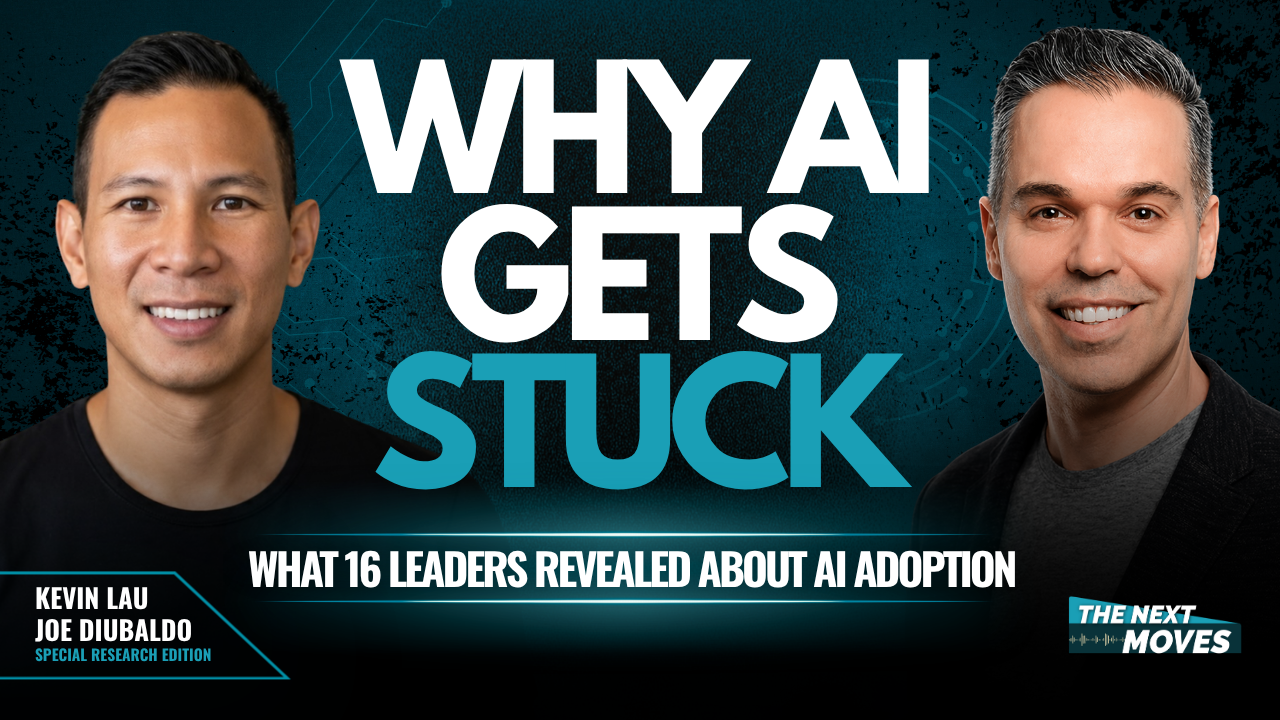
Watch the full conversation between Joe Diubaldo and Oz Khan on YouTube and read what 16 leaders told us about why AI adoption is stuck. If you’re hiring a finance leader to get payroll and systems under control through growth or an acquisition, please reach out to us about your search.
Because the tool arrived before the conditions for using it. If people don’t see what AI does for their own work, don’t have permission to experiment, and weren’t part of naming the problem it solves, the licence sits idle. Adoption is a leadership and process outcome, not a software feature.
Mindset, then people, then structure, then AI. Set the expectation that curiosity is part of the job, make sure you have people who work that way, redesign the process around what’s now possible, and bring the tool in last. Most companies run this backwards and lose the users before they ever get to value.
Separate the small tools from the funded projects. Personal productivity tools like Copilot and ChatGPT show up as cost and rarely as measurable savings, so fund them as the foundation rather than trying to put a number on them. Reserve the measurement discipline for the larger use cases, where you name the business problem and attach a value before anyone builds anything.
No. It will run the broken process faster. Automation on top of a workflow nobody has redesigned produces the same errors at higher volume, which is why the data cleanup and process mapping have to happen before implementation, not after.
Curiosity, resourcefulness, and persistence, weighted above tool experience. Teaching a curious person a technical skill is far easier than teaching a technical specialist to be curious. Screen the behaviour rather than the résumé, since AI now writes a growing share of applications and interview answers.
Joe (00:00)
When you said payroll sits at the bottom of the funnel, what does that mean?
Oz (00:03)
Everything
flows to those people and it stops there. Right? They’re the last step before money leaves the building and lands in the real person’s bank account and on the government’s book. So they inherit every upstream error. They have the the least time to fix it. they have zero ability to push it back. And you can’t tell the employee, you know, we’ll get we’ll get we’ll get it on the next cycle or or or wait for the next cycle, we’ll have it fixed by then. and so the parallel team unfortunately
absorbs the entropy of the entire organization under a deadline that they don’t control, with data that they don’t create, they’re kind of the catch all for everybody else is good enough. And so that essentially means that they have to they have to work really hard at reconciling it all and making sure that they they get it right.
Joe (01:00)
Every company that I work with has a story about payroll, and these are not good stories. It’s the late night scrambles, it’s manual fix, it’s the payday that has to happen on time no matter what. And it often lands on one or two people’s desks with zero margin for error. And I’ve watched my clients spend a small fortune untangling this problem. I’ve watched it break the same way many times, and sometimes in a completely different way.
It happens with new sites that you’re opening. It happens during an acquisition. And for the longest time I couldn’t figure out why this is happening to something so important. Why is it so fragile? I actually went and asked someone who knows about this. And his name is OzCon. I’ve known him for over a decade. And right now he’s running ventures at ADP. So what that means is he spends his days inside the future of how people experience work, including how they get paid. He’s building these things, he’s investing in them, and he’s thinking about where it’s all headed.
So with someone who spans strategy, product development, MA, new ventures, I thought he’d be the right person to ask. I sent him this blunt question over a text. I said, Why is payroll such a mess for so many of my clients? And the answer he sent back was one of the clearest and cleanest explanations I’ve heard for anything in a long time. It stuck with me. So I asked him to come in and talk through it properly with us. So this conversation
It’s about where payroll breaks. It’s about where the technology underneath it tends to make things harder instead of easier. And what it’s evolving into in the way that what’s it going to take to trust a machine when there’s no room to be wrong? You’re going to find out like I did, that it ends up being more than about payroll. It ended up being about the people you need running your finance team now and building your technology. Oz, welcome.
Oz (02:48)
Thank you.
Joe (02:49)
I’m gonna start with very simple question. Here’s the thing I can’t figure out. Why does this one function, the payroll function, drive otherwise capable companies, really capable people, crazy?
Oz (02:58)
If you have any kind of lapse in payroll, all hell breaks loose because you have unhappy employees, you have regulatory fines, you’ve got all sorts of lapses that happen and then when you when you have to fix it, the patches aren’t exactly straightforward. Right. There’s true ups, there’s accruals, there’s all sorts of things that you have to deal with. And so anybody that’s lived through this, in any organization, regardless of whatever system that you you use,
it just gets extremely painful because then you’re actually running a ledger full of mistakes that you’re having to fix and and and correct for in in subsequent cycles.
Joe (03:39)
This a technology problem. I mean, you were talking about the Frankenstein stack. Like look, companies evolve, they kind of replatform themselves with whatever they’re doing, whether they’re taking on new regions or they’re doing acquisition. Like, what is what’s going on with this Frankenstein of systems? Like, why don’t they actually interoperate effectively? Why do they have to grow into what is something very painful?
Oz (04:02)
Well, the way I would liken it is you have you have young kids. I have young kids. Yeah. when they put together a Lego that’s put together with Lego Technic, Lego and Duplo all all together. that’s exactly that’s exactly what what what the what the back office looks like, right? it was never meant to be one system. They’re all bought at different times by different people, solved different problems.
HR bought the HRIS to manage people. Operations bought time and attendance to manage Shift. Yeah, sometimes HR does, but generally ops ops has a big big say in that. They’re both, you know, certain about those systems and then finance has VRP, which is which is yet another different system. Every team runs each one. Every team believes that that is the system of and source source of truth. And then when you put everything together, they barely ever reconcile. I mean they do, but not easily. It’s just what people inherit, right?
And there’s no there’s no clean, eleg elegant way to sort of say like, hey, it’s just one data layer and it’s one definition of one thing and it’ll all work together. You know, an employee can mean several things. An employee is a tax ID, an employee is an employee record, an employee is an IT ID and and so on and so forth. And so all these things they’re custom coded together and oftentimes when there’s translation from one system to the other, people are sitting at the seams of it. And not easy.
Joe (05:23)
So when you said payroll sits at the bottom of the funnel, what does that mean?
Oz (05:27)
It means everything flows to those people and it stops there. Right? They’re the last step before money leaves the building and lands in the real person’s bank account and on the government’s book. So they inherit every upstream error. They have the least time to fix it. they have zero ability to push it back. You can’t tell the employee, you know, we’ll get we’ll get we’ll get it on the next cycle or or or wait for the next cycle, we’ll have it fixed by then. and so the peril team unfortunately
absorbs the entropy of the entire organization under a deadline that they don’t control, with data that they don’t create, they’re kinda the catch all for everybody else is good enough. They have to work really hard at reconciling it all and making sure that they they get it.
Joe (06:09)
Right. Okay, so when it breaks and it doesn’t go right, you’re inheriting the entropy of the organization. Like what’s it telling you about the business? I guess let’s think of as the scales, like the number of times it breaks, the novelty of the problems. Like tell me what it tells us about a business right now.
Oz (06:26)
It tells you that there’s complexity in the business, right? it it it tells you that the business is not necessarily simple and that you you see this get get harder and harder for organizations that are larger, right? Like I mean you could you almost take a very, very practical example of you know, picture it on on a Tuesday, floor managers slammed, they proof time cards a day late, one person’s overtime lands in the wrong week because it’s just a day. nothing flags it.
Wednesday HR fixes the PTO code. Somebody’s vacation was marked unpaid and now it’s paid and backdated two weeks and it it’s totally reasonable to fix. Neither of them thinks that they touch Peril. Each each one fixed a small thing in their own system correctly. and then payroll runs it Thursday night and the and the and the gross ERP is expecting you know something that matches that doesn’t matches what the time system says and that cruels off overtimes wrong and for one person in a way
nothing catches and they got the wrong pay. Right. The peril lead is reverse engineering which forty upstream changes broke the number with the run due at midnight. And it’s just like it’s it’s nobody’s fault. It doesn’t say anything about the organization. It just it just means that there are several machines and systems stip stitched together that just are not designed to to w work in sync. And and you can have this problem happen at a small company with fifty people or you could have it happen at scale with a company that has
5,000 employees and still have the same thing happen, right? That’s the complexity of this whole thing. and then you throw legal entities into the mix, you throw other controls into the mix, you throw tax jurisdictions into the mix, and it just keeps getting worse and worse and worse. And and all of these systems are designed as calculators without any flexibility in it. And so human beings have to sit down and actually calculate all of that on spreadsheets on the side, because many tables multiplying many tables, and human beings are the ones that have to make sense of it.
Joe (08:22)
does this get fixed? And if it’s at the the inheritor of all the mistakes and the complexity increases with the jurisdictions times the number of people times the number of individuals touching the systems and implementing new tools, like I don’t see a way out of this. I see it as natural. So is there something that when you look at this?
You can say there’s a fundamental shift needed that will resolve some of it.
Oz (08:56)
Most software carries some kind of risk. Peril carries two risks. it carries business liability. You get it wrong, you lose money, you lose trust, people quit. And it also carries legal liability. Broken broken wage in our law, jurisdiction rules, fines, audits, and it’s just something that you can’t afford to get wrong. And so how do you start to fix this? it’s not easy. It’s very, very, very unsexy work. I would liken it.
going into a very old factory and just redoing all the pipes and the steam valves while while the place is running, which is not easy. It’s a problem that people have thrown a lot of consulting money at, built custom workflows, check checks and and guardrails, custom software on top of existing systems, and and still things go wrong. But you know, people have solved it. Think about the complexity of a company like Amazon that has white collar workers, that has warehouse workers, that has contract workers in in highly
complex rotating schedules and so on. And they built their own custom stack on top of payroll they get from companies like ADP. and and and so it is doable. It’s just a lot of work. And it’s not something that you could get a CEO to invest in readily because you know they want to invest in sales. They want to invest in marketing. They want to invest in growing the top line rather than solving for a cost center. But that doesn’t mean that, you know, you’re stepping away from the liability. And so the
pain has to be big enough for for an organization to to get off their chair and say, okay, fine, five million dollars that we’re gonna go into something else, we’re gonna put it into the into the back office now to make sure that it runs better. If you’ve inherited all of this, there’s no there’s no getting away from it. if you’re building it from scratch, you actually have an opportunity to do things a little bit differently. And I think the some of the new tech that’s coming up in the in the in the world of work, I think it leads to exciting possibilities because that’s where the plumbing can be written slightly differently.
Joe (10:55)
Payroll is like a broken promise when it doesn’t work. And I can tell you that as someone who missed payroll when they first started their company, because the person I was actually helping, having helped me missed the timeline and I wasn’t sure what my calculations were. You get to do that once and it was only delayed by a day. I’m dealing with clients now, and when I say clients, they’re bringing multiple resources to fix these problems. And they are spending money and to dig themselves out of where they are.
Is taking far longer than anyone expected. And I’m trying to understand if it’s a competency issue with the people that are brought in, an interest issue in the people that are currently working in the organizations, or if there’s just a technical miss that the software doesn’t solve for. And I’m curious what you see as the most common thing. And it’s the people, process, technology.
People have competencies tied in them. So how do you see this thing most often playing out? Because the conversations you’re having must have a ton of stuff loaded in it. Where where’s the issue?
Oz (12:03)
Everyone tries to solve for their corners of the world. And so with ADP w where we’re spending a lot of time is is on pay payroll and anomalies, which but you’re at the staging level, right? When all the data has come in, when you know you kinda have everything loaded into the system and now the now the practitioner downloads a C S V file and they go through the C S V file and they go you know, they they start doing the reconciliation in terms of whether
where the balances match, whether the the accruals are right, whether the the time the time in attendance and all that stuff is is correct. What we at ADP can’t solve for is like if something was wrong in the ERP ERP, right? now if you bought our time in attendance system, it gets a lot better because that is designed to talk to the payroll register and and relay data across evenly. But but like as I said, you know, if somebody misses a step, a human being misses a step, it creates a compounding problem. And
Because these systems were you know they were they were written pre AI, they were written pre A API. they’ve modernized significantly over time, they’re cloud native, but you know, they they they’re not self-healing. So somebody has a a massive system or record that they claim is self-healing, you know, and if you buy that, I have a bridge to sell you.
Joe (13:26)
Sorry, guys, what does self healing mean?
Oz (13:28)
Self healing means basically system that systems that self-learn, right? they they they start to catch the anomaly and and then and and they and they start to surface that to the people that either design the system or run the system so you can actually start to put guardrails and fixes in. And that’s not a thing yet for legacy systems, but for new systems it is, where people talk about the you know, magic in AI. There’s no real magic in AI. AI kind of works a lot like how how our brains are designed to work, where it’s it’s a function of memory and reasoning, right?
And so your memory and reasoning is only as good as your training and your own competence or some, you know, inherited genetics, if you will. And that that goes back to the model training companies, but but without any frame of reference or any any kind of guardrails, it’s also lost at sea. And so if you are going to r to write a a self healing system, you actually have to do the the hard work of redoing the the plumbing and the wiring. or you have to set up the plumbing and the wiring that, you know, it’s like it’s very, very easily accessible. Think about a very, very elegantly designed
vehicle where the ease of service is just very, very clear. Right? Everything is clearly labeled, everything is clearly marked, everything is accessible. And if you want to swap out parts, it takes five minutes. Right. That equivalent of a modern system is is what is what’s being pursued right now or has to be pursued right now. And and then when you put AI with very, very tight guardrails on top of that, then you can actually see w at what node the fail failure happened or or failure is about to happen. So with
You know, that that time card thing that I was talking about, you know, a self aware system, the minute that time card entry went up would put up would put up a flag and that flag would carry through downstream all the way to till it hit payroll. And because issues are happening in several different places, I’m assuming these companies are are are also MA rolled roll ups or or or have, you know, multi
Joe (15:16)
Massive massive expansions growing very quickly.
Oz (15:18)
Massive expansions. Exactly. And this is exactly why why all this stuff happens, because you grew too fast, and and your systems were brittle and now it sucks.
Joe (15:30)
That’ll be the tagline opener. And now it’s up.
Oz (15:33)
Ha ha ha.
Joe (15:34)
I’m dealing with a ton of companies that are buying other companies. That’s what’s happening. Yep. A lot of private equity activity. You also have companies that have decided on their own to go on acquisition sprees. This problem that you’re talking about is compounding within those organizations. So let’s actually give them some advice in this moment. What should they do as they look at acquiring these businesses?
Like be a consultant. I’m pushing you back to your strategy days, Oz. Be a consultant. What’s the approach? How does it need to change from the typical MA value creation playbook that we’ve all seen in order to fix this? Not just at a payroll level, at a bigger level, because we can’t have these Frankenstein systems, from what I’m hearing, and get the efficiencies and wins and effectiveness that we want from AI. Can you develop that for us?
Oz (16:25)
Hygiene and talent essentially means getting people that have lived the pattern, have seen the pattern. That means all that sequence of problems that I just described, they have dealt with it before. And if they’ve dealt with it before, they’re not just operators, but they’re also thinkers that are able to develop processes to deal with it. Right. Think about even manual checks that you could you could you could you could you could put into
where wherever your time and attendance data gets staged. Think about knowing the seams between the systems. If you know dynamics, if you know the stack that the company’s using and so on and so forth. When when you buy a company that might have been on a different parallel system, which means you have like 10 years of parallel history to now convert to whatever your your parent is using. People that have lived that before. And they can create processes and subsystems for you that you will still have pain, but they’ll run the shop for you. Sad part is there are not that many of them.
Joe (17:23)
They’re more senior because they’ve been through these cycles a
Oz (17:27)
and and and the good ones they’ll they’ll they’ll train up the right team where they’ll get the right team under them to deal with it. Crazy thing now with but at least we’re seeing with with a lot of organizations is like if you’re AI fluent as an operator or as a functional professional, you actually now have the ability to build systems for yourself. I build tools for myself at work. My team builds tools for themselves at work. And so this whole notion of sourcing companies to doing due diligence, all that.
We built, you know, Asian factories that write software for us once we decide what the product roadmap should be. And and it’s no different in in in in some of the newer AI native finance companies where they’ve built extensions on top of ERPs that essentially ingest data from the ERP, stage it, clean it, fix it, and and then pass it on on behalf of the ERP to something else. It costs more.
But you’re but you’re actually creating you’re you’re using the data of the system of record to to to you know power something that has a lot more intelligence in it. And and AI, by the way, is you know, there’s a little bit of a trap because it is probabilistic, right? It it it predicts what’s gonna happen based on patterns that it’s seen, exactly like human beings. Unless you actually give it very, very tight guardrails, again, that knowledge comes back of having seen those things to say, if this, then that.
Or like here here’s like a scale of one to ten. You must pick a number based on parameters that we’ve def defined. If the problem merits the scale, then I think a lot of these companies are going to start to build their own solution stacks on top of the systems that they that they have. And you can, because generally everything to today comes with connectors and APIs. And so you could you could you could essentially place
a logic router at every node where you know failures happen in the payroll value chain. Right. and and that can essentially look at the registry and basically be like, this stuff doesn’t reckon reconcile, so stop. Or or flag and then the flag carries through so that at least there’s an audit trail of what went wrong and then adjustment can be done rel relatively qu quickly at the end. There’s no magic bullet here. You could choose to step back and solve it. and it might take you a a little bit and
have something a lot more scalable and sustainable. Or, you know, you could be like, I have a business to run. Yeah. I’m just gonna staff AUG and make sure that, you know, the the the books balance, the parallel registers look good and things keep running, it might be a mess in the back end. And that’s a choice that I’m going to deliberately make. There’s nothing wrong with that, by the way, as long as you don’t break the covenant of trust with your employees.
Joe (20:09)
I will say the danger comes in the uninformed leader though. When it comes to when I say leader I’m talking typical the C CEO, C O O and we have multiple times where CFO loses a headcount, loses two and they’re sold no, just do it with AI. Do it with AI, like the pronouncement of
Oz (20:31)
Yeah,
okay, yeah. Well why why don’t you ch ask Chat GPD raise your kids? Yeah. See how that goes. It’s
Joe (20:34)
Yeah. And
it’s it’s brutal because like we can get to a place where portions and not small portions of these jobs can be managed by a CFO, but he still needs headcount to execute his job. And I just felt so badly for this person. We’re talking, gonna be careful on this, we’re talking to three people underneath them on a team of seven, and they see this as a cost cutting opportunity, a cost savings opportunity. He’s like, No, like these need to be there.
I can probably replace portions of their job, but I still need at least two people. So I think I think the uninformed leader is quite dangerous because they’ve been at a few conferences and they’ve heard people talk and they they haven’t and entrepreneurs are the worst for this because they’re dabbling themselves and say, Well, I replaced created chief of staff, right? And it’s just it’s a little bizarre. And the right thing is you may get there, but you should staff Og with specialized skills and then potentially decide to roll those people off.
If they aren’t necessary.
Oz (21:35)
It’s not a great way to operate, but just because it’s a choice doesn’t mean you should you should do it. But it is it is a choice at the end of the day. You can put together all sorts of cutesy tools on email reminders and calendar stuff and all that sort of other right like but to actually have an agent look at a series of numbers and decide whether it’s right or wrong, it might be okay deciding if it’s right or wrong four times out of six.
Or five times out of out out of six. But it’ll get it wrong one time out of six. Right. And and we even see this with with with MCP’s model con context protocol where where there’s like there’s some degree of variation that can that can sometimes happen because the model reasons and it and it decides based on the pattern, I think that’s not that’s not correct. And you could allocate the same sort of, you know, error to human beings because sometimes we make judgments and they’re incorrect. but if you’re
If you’re actually using a model as as as sort of a cog in an industrial workflow, you can’t afford that. Right. And so what you actually need to do is you actually have to write code underneath that model for the model to reference the code, look at the strict guardrails that w that it was given, and then be like, My reasoning says this and by the way, the code that that I was given and and the guardrails that I was given say say that. Therefore the answer. And then you’ll get like, you know, ninety nine out of a hundred, right? And the one percent, yeah, it happens.
There’s no no machine that’s perfect.
Joe (23:04)
So you told me the next generation of leaders and specifically finance leaders look different than before. Yeah, and I’m I’m curious what you’re seeing because we’re seeing it as well, but how do you kind of set that up and describe it?
Oz (23:19)
I mean look, you know, it’s it’s it it’s absolutely necessary to to be cloud enabled in Excel at the very at the very least. Right? It actually has more to do with with writing and building your own workflows out of your ERP. Things that you used to delegate to IT, that doesn’t cut it anymore. You gotta do it yourself. And by the way, that should be a highly competent finance team, right? Because if they’re actually truly AI native, they’re also tenx more productive.
Joe (23:46)
You’re you’re saying though that you’re seeing it. Like I think there’s a massive demand for it. And since we’re in the space, we know there’s demand. We aren’t seeing the level of competence that you’re talking about though. And we’re in the market all the time. Like we are actively trying to find it. I think we’re we’re gonna have to create it. We’re gonna be training some people on foundational work. And I think we’re gonna have to create the Canada pool. So are you seeing this right now in volume in Canada? Or are you seeing it in the US? Where are you seeing it?
Oz (24:12)
Spend a lot of time in the valley. Okay.
Joe (24:14)
In the valley.
Oz (24:14)
there’s a selection bias because all these companies that are so-called AI native that are growing at some of these valuations, they have very thin finance team. Look at Ramp. Their finance team is tiny. Cursor, which you know, sold for Yeah, exactly. They had they they had a finance team that you could you could fit into a living room. And of course there’s a the there’s a difference in talent profile, but but at the end of the day, I mean these people
They’re they’re the same finance professional but but they’re the ones that that actually said, you know, I’m gonna open up a c command line interface and and in plot and actually learn how it can build a subsystem for me and I’m going to test it, iterate on it, break it and and and essentially s start to automate bits of all these things that just have me running around reconciling stuff. Yes, you can buy tools as well. There are AI native AR and AP and billing tools that that
are phenomenal. The office of the CFO is exploding with with fantastic toolkits that really take the p the the pain out on reconciling and grooming your ERP. The ability to use them and and and learn them is going to be at a at a massive premium. And I think Canada would it’s is a little bit, you know, like the the US is also pockets, right? You know, like on the East Coast, it’s a slightly different situation. There’s a lot of companies that have to organize and change. But it it’ll probably be like
Like any technology wave where where you have early adopters and then sooner or later it starts to become the norm. But I do think that every profession, whether you’re in Metro Capital or you’re you’re in software engineering, whether you’re in fire or yeah. I mean you you have to the the nature of your work has has has started to change because the grind of some of these things, you know, proactive people are starting to take take out of their their work so that they can do more.
Joe (26:06)
We’ve been doing really interesting listening series where we’re meeting with CIOs, CEOs, COs, CFOs, and I think we’re through 16 of them. And we’re asking them a series of questions and we’re bringing the data back to them at the end of it. What everyone wants is they want the functional expert. So we lay out six, we’ve we’ve done the research, we’ve actually broken out six key roles that people are typically looking for when they’re starting to AI enable their organization. but they want they all want the functional expert.
Right. Everyone, to your point, everyone solves for their own corner, which is like, get me the finance person who understands how to build these workflows. Get me the HR, get me the talent acquisition, get me the ops, right? Get me like customer success who understands this. So they’re all talking about what they want functionally first, but they’re all acknowledging that they’re lacking an engineer to support that person. So like a forward deployed engineer to take what’s their name’s Palantir’s words and say, someone that partners with you.
And either implements and builds their own stuff or builds what you’re looking for. So I’m I’m trying to understand when you’re saying this, these are not individuals that you’re seeing in the valley that are engineers and finance people. They’re individuals that are actually running experiments themselves to try to build out their own workflows. They’re curious people with probably a frustration level, right?
Oz (27:24)
Correct. Correct. Okay. By and large. There are also organizations where the IT shop has figured out how to give them the right level of access but within their own sandbox that they can build safely. I do think that having someone who is who is great at putting together systems could be a huge augment because the massive unlock I found is that people that actually have high functional expertise when they actually pick up this toolkit, this is not something that you can throw over the the fence. I mean if you’re functional expert and you’re throwing it over the fence.
And you have someone really good on on the on the other side to catch it, sure. I’m I’m sure you could create some sort of decent outcome. But if you’re actually like co-building with them, that outcome is is five times better. Right? Yeah. And and I do think that there are more than enough young people out there that have picked up how to build tooling that can replace SAS that you could, you know, with the right level of training and con contextual supply of information will will be able to build stuff for you.
Joe (28:24)
What are you doing in your team? Let’s talk about what you do to enable this and create this culture that you love that is innovative. Tell me what’s happening, tell me how you got it there, because I think this is a great story.
Oz (28:37)
I think I think it started with just hiring incredibly curious people, incredibly driven people. It’s just absolutely critical to have people that will just go, I’d really like to learn that and and just spend time on it. Right. And it’s it’s not like you know, we’re asking them to work more because that’s not the intent. The intent is when you’re curious you will pick up a new new toolkit that you think will make your life better. and it also comes from from just embodying it yourself, right? The one of the
first few things that I did was like I started to ship code alongside my team, which I’m sure they they rolled their eyes. But it was necessary to to learn and also send a signal that, hey, I care about this as a leader and so you should care about it as well as as part of being on my and my team. And all of a sudden it’s just like everybody’s every everybody’s tuned and and they’re all thinking about their workflows. They’re all thinking about things that are grindy that they could automate because
The work doesn’t stop. There’s there’s way more work than we have people. we we like to operate in pizza sized teams, even though we have a significantly large group in ADP ventures, it’s changed the game. The the the pace and velocity at which we’re shipping code, the pace and velocity at which we’re able to source and actually build TCs, even though we take our time investing in in companies. We don’t do more than four deals a year. Hundreds and hundreds of companies that we’re sourcing every month. And you can’t do that with an investing team that’s only five people.
Joe (30:06)
I actually think there’s one other thing that will catalyze the behavior that you want. Curiosity is one of them. The other one is environmental. It’s and this came out. I’m like, I was asking a CIO, I’m like, why did this person take action? Because it’s very simple. Look for people who are curious stuck in places where they’re immensely frustrated. So like frustration with a process where something is taking a week and they’re like, I can I’m just I’m gonna fix this.
And he accesses these data pipelines, I’m gonna fix this and takes down to two hours and gets that feedback loop, right? And the dopamine thing goes, Give me another one, give me another one. Like wherever people are curious and super frustrated with something, and you give these tools, I think they’re gonna start hacking away at solutions and building. I’m sorry, we shouldn’t say hacking, we should say building. We’re gonna start building.
Oz (30:54)
My intrinsic hope is that is that the level of productivity this unlocks, we’re able to do more with, right? Have a more productive economy and and and and and have better healthcare outcomes and create more more wealth and you know, hopes and dreams always don’t come true. But every industrial revolution has yielded betterment. And so in the hope of that you have to you have to embrace the change.
Joe (31:21)
I think we’ve always had these moments of despair when we saw the capabilities as they were evolving and then
Because you felt on the sidelines. And if you weren’t using and you weren’t building, you didn’t see how the next thing could come to you. And I think that that forward momentum of trying and getting engaged will make you feel like you’re more in control. And obviously I don’t have a crystal ball. I don’t know if everything gets massively disrupted on a very short scale. But you you quickly learn the limitations in this stuff, and you also learn how it can benefit you. And I think that companies have to do a better job at.
Looking at this and maybe that’s natural selection, that’s competition, like they will they will not be on the field much longer if they don’t, but they have to look at it as like how do you actually augment your team so they’re more effective? That’s the approach I’ve taken. Like
Oz (32:14)
The biggest problem is leaders that haven’t felt it and seen its limitations who’ve just used this in a shallow manner. and assume that it’s a magic pill that solves everything. Really doesn’t. Because it doesn’t. It drifts, it hallucinates, it comes up with stuff, and it’s just not at a place where where you can you can blindly trust it. and you you learn these things the hard way if you put your own fingertips on not just a chat bot, but actually trying to do something
that creates a tangible out outcome out of out of AI. And when when you do do that, then you actually become very informed about hearing this from your team and hearing this from your executive committee. Because otherwise you’re just reviewing decks and you’re you’re you’re you’re speculating on heirsay and you’re not equipped to deal with it. I think forget the workforce, I think there’s like a massive leadership ch shift that that needs to happen because unless you actually have AI informed and AI ready leaders, in some industries it’s not gonna make a difference.
But in others it’s going to make all the difference. I think that is the positive tone we should take.
Joe (33:19)
Awesome. Like we came here talking about payroll and we went somewhere bigger and we talked about AI and we talked about hiring and curiosity and you gave a very clear endorsement that people should hire more people, which I love. And I just want to say thank you. And I want to be able to do this again with you. And I’m thinking along the lines of your experience, you said selection bias, but you’re dealing with companies from everywhere, including the ones you run into in the valley, but also the ones that you run into everywhere. And I would guess that you have this broad spectrum on
the Trailblazers and the Laggards. That would be valuable one day to hear. Okay.
Oz (33:52)
Yeah, totally. Look, there’s there’s there’s a there’s a divide and you have to respect the divide because there are organizations and employees that prefer paper checks in the United States and and it really in in the millions, yes. and and there are some that, you know, still do not want to have a mobile app that has all their pay and all their information on it. and then there there are others who who just want an API with all the information so that they can write their own AI application on top of it. Being in an organization that has to serve them
the the needs of the the the widest spectrum. I think the the approach that we publicly take is is a relatively conservative one. because I think, you know, responsible AI has been our mantra since day one. But that doesn’t mean that you actually don’t apply it in places where you get a lot of agency in running your business. And and we have and it’s been tremendous and the the throughput really, really goes up. And I think a any function will will will benefit from that. So it’s been a pleasure talking and
I like talking about this stuff, so happy to happy to take you up any time.
Joe (34:56)
So everyone, if you’re listening and you’re just seeing a clip, the full episodes are on YouTube. I want you to send comments. I want to hear what you want to hear next from Oz. And I want to say thank you again. It’s been great.
Oz (35:09)
Thanks.
Here is your link to the 2026 AI Listening Tour Findings:
2026 AI Listening Tour (PDF) ↗Are you hiring? Get in touch with us to talk about better hiring.
Get in touch →
Here is your link to the 2026 Salary Guide:
2026 Salary Guide (PDF) ↗Are you hiring? Get in touch with us to talk about better hiring.
Get in touch →
Here is your link to How Finance Fuels Growth:
How Finance Fuels Growth (PDF) ↗Are you hiring? Get in touch with us to talk about better hiring.
Get in touch →
Here is your link to the Finance Team Org Charts:
Finance Team Org Charts (PDF) ↗Are you hiring? Get in touch with us to talk about better hiring.
Get in touch →