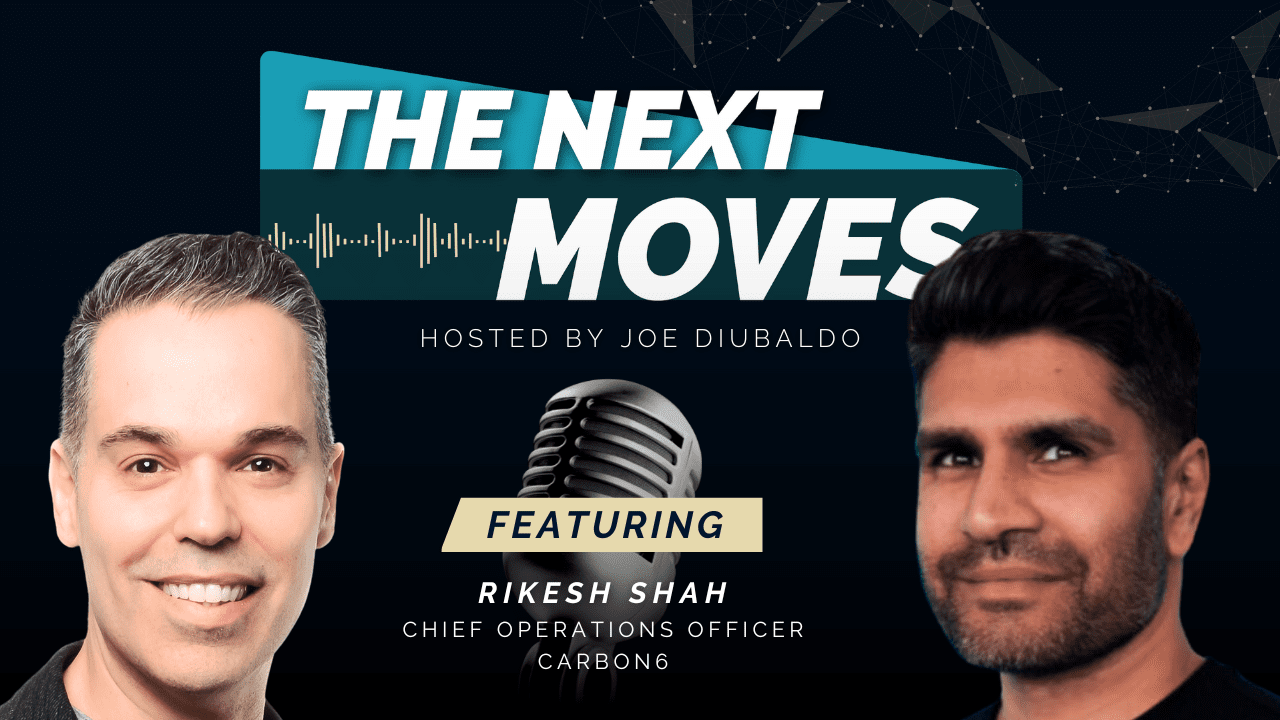
00:00 Rikesh: When you compensate your high performers to average, then what you’re telling them is that they should deliver to the average. That’s counterintuitive. There’s a contradiction.
00:24 Joe: Hello everyone, my name is Joe Diubaldo and welcome to the show. For close to 25 years I’ve been a recruiter, I’ve been an entrepreneur, and I’ve been someone who’s made it his life to help people build better careers and better companies. I love this job. This job is addictive and it’s addictive for the simple reason there’s so much learning — I get a chance to learn from people who invite me into their lives and into their companies during times of massive transformation. Along the way there’s one key lesson that always stands out — we all get stuck. We get stuck as we think about what to do next. And I think that’s where I might be able to help you get unstuck, to help you plan the next move and then the move after that. And for that reason I’m inviting people in to speak about the big moves, the decisions, the changes, and the setbacks. And we can listen to them and see what we can learn. I’m sitting with a friend of mine who I’ve known for over 15 years. Welcome Rikesh.
01:28 Rikesh: Hey, happy to be here Joe.
01:28 Joe: Awesome. So Rikesh Shah is a CFO in the esports industry. He’s the Chief Financial Officer at OverActive Media — this is Canada’s largest esports organization and group. Rikesh has a distinguished career marked by contributions to high-value organizations including the Canadian Olympic Committee where he served as the Executive Director of Finance. The way that I’ve known Rikesh is he’s always been innovative and pragmatic at the same time, which is a difficult thing to balance in the way that he’s moved these organizations forward — very rational, very analytical, but can inspire people to take action when needed. I want to talk to him today. His expertise spans international operations, taking a company public within this organization, and public company reporting, but also really business strategy and supporting the teams that are executing go-to-market throughout his career. Rikesh has demonstrated a commitment to excellence, building high-performing teams, and fostering collaboration across different sectors. Since I’ve known him for 15 years I’ve watched him grow and it’s been a pleasure. I think people are really going to enjoy the discussion.
02:46 Rikesh: Yeah, well I hope so. Welcome my friend. Thank you. Thanks Joe. I would say the same things about you — you should go on at length, in 10,000 words or more, compose how much — I’m just kidding.
03:02 Joe: Yeah, just copy and paste the section. So I want everyone to understand where you’ve come from. I think a lot of time is spent in the origination story, but let’s talk about your early career and some of the significant transitions that you made. Let’s frame it for the audience.
03:10 Rikesh: Yeah, sure. Moved to Toronto in August of 2008 to start a role in search with you actually. And you should tell the audience what that means — search, recruitment — and we were of course focused on finance professionals and particularly designated accountants. We moved into — I moved in at a peak market in August of 2008, plenty of opportunity in the world, and then the minute I started there was a global financial crisis. And there were a lot of candidates and not a lot of roles for them. So not only did I transition cities moving from Montreal to Toronto, but then bam — I’m moving from the best market ever to a total freeze within global markets, within companies, within hiring. And I had done this transition from being an accountant and a professional accountant to being in the sales industry. And that lasted about a couple years and it was as challenging as it gets. But there’s something to be said about not knowing — you don’t know what you don’t know. And so for me that was always the normal: selling in a very difficult or challenging environment where you had to prove your value, prove your worth, the why of it all. That’s trial by fire. And again, I didn’t know any better. I was young and inexperienced and those are two things that served me well because you didn’t know any better.
05:04 Joe: Yeah, otherwise you would have just turtled.
05:04 Rikesh: Absolutely. And frankly a lot of industries and a lot of companies in that time had a lot of challenges and people had a lot of challenges because you’re used to good times. But it’s really the most challenging times that’ll forge who you are. I was in university when 9/11 happened and then you come out of university and you’re really starting your career and then the global financial crisis happens. In short order. You need a bit of runway and I didn’t necessarily have that. But in some ways I was better for it.
05:55 Joe: Most people try to transition one thing. But you moved cities — which means you’re abandoning a network that you’ve built, and networks create opportunity. You’re leaving a friends group. You’re changing your career, so you’ve built the foundation in finance, accounting, audit. And you’re like “forget it, I’m just going to go and be customer-facing and do it in the greatest financial crisis in over a hundred years.”
06:29 Rikesh: Yeah, yeah, absolutely. And again you don’t know what you don’t know. So I started selling into a very challenging market. I did it for a couple of years — not only in recruitment but in sales overall. And I’m all the better for that experience. When I was in it it didn’t feel that way.
06:43 Joe: No.
06:43 Rikesh: But I can look back on it and say that being able to listen — and truly listen, not to myself but to others — is a skill. Being able to sell into a challenging environment is a skill. And having that experience, I’m richer for it.
07:07 Joe: It’s awesome. Let’s track quickly through — you exit the recruitment industry and what are you thinking at that point?
07:23 Rikesh: Actually one of our old friends called me for a role — a 60-day contract at the Canadian Olympic Committee. Now if anybody knows anything about taking on roles, a 60-day contract is as short as it gets. Usually at a minimum you’re taking at least a three-month contract. I took a 60-day contract and parlayed that at the Canadian Olympic Committee into close to a decade. I was promoted into their executive — one of the — which rarely ever happens. Because the opportunity presented itself. I was able to stay in the game long enough. And as you and I both know, when there’s displacement that’s opportunity as much as it is change — which can be a little something you navigate, of course. But getting to the Olympic Committee — which was, by all intent and considerations, a dream job. Going to a new country and a new place, seeing athletes at the peak of their performance — it’s like summer camp for adults. There’s nothing better. I would have never left except that I was getting to a place where the growth was going to be limited for a period of time. There were some changes there and I had this small window. I had a relationship with folks that I’d met there who were going to start a new company in a new industry with many similarities to high performance sport — which is esports. The best of the best in gaming, with a much larger player base than, let’s say, skeleton or bobsled. And at this very small window I was able to go from a national not-for-profit to what today is a global publicly traded company — which is something, from a profile standpoint for a finance leader — you tell me how often that happens.
09:53 Joe: Not often. I think the thing I want to drill into for one second that you said — and I thought it was insightful — this has been said by other people in a far more particular fashion than I say it, but: chaos is a ladder. When things are chaotic people tend to panic. We go through this perspective like “what’s happening and how do I cope and where do I stand? Am I going to be part of this thing going forward or not, am I out with the old or in with the new?” And you’re in purgatory. So I find this fascinating — you come to Toronto, you step into an industry that is going through some chaotic times with recruitment. Having run the teams in that organization, you and I sitting close by, knowing that was a very hard time because no one knew what was going to happen. Would the taps just turn off? Were clients going to need the kind of talent, were they going to invest the way they need to? You exit and you get a 60-day opportunity which turns into how many years?
11:04 Rikesh: Nine years.
11:04 Joe: Nine years. And you said something which is these promotions don’t often happen within that organization. Why did it happen for you?
11:21 Rikesh: There was change at the leadership level at a given point in time. I had no part in the decision-making around that, but that change meant that there was a vacuum and that was the opportunity. And I had to go in and I had to ask for that opportunity. I remember asking the CEO at the time to have breakfast with me — he’s an early riser — and I went in there and I said “I want the next thing.” And he said “I appreciate you asking me. Either I can help you with this one or I can help you in your next role.” And I said to myself — wait, wait, wait, wait. We were not here talking about another role. But you shoot your shot and you’ve got to live with the outcomes as well. And so that was my first opportunity to see that at the executive level — you take your shot but you don’t know which way it can turn. And if you’re not part of the plans you’ve got to live with the outcomes for that. But you only miss the shots you don’t take.
12:46 Joe: So I think you’re living that concept. I’ve heard it said by multiple people — there’s the idea that there’s a time for you to invest and learn and there’s a time for you to monetize. And you were getting paid to progressively develop. I think you took on more than what your role had been defined as at that moment in time — so you basically said “I’ll take on more.” And I remember this conversation we were having, and the idea is like “this is what I want to do” — you ask for it and then you just start doing it. And you check the boxes that are necessary on that path to CFO because you’ve gotten more and more experience. So that time there — that nine years — was pivotal in shaping you?
13:28 Rikesh: Yeah, I agree. It sounds like summer camp at times.
13:28 Joe: Yeah, at times.
13:35 Rikesh: For sure, it was pivotal. I always had prove-it deals — I would put it to you that way. Prove-it opportunities. It was never laid out. There was never a path that said “Rikesh is going to be this in X amount of time” and so on. So you have to go out and prove it, and then have the evidence and the case to say — and because of which, it’s not a fair world. You’re going to see people around you who don’t have prove-it deals. They’ve got the right deal and then they’re like “okay, we’ve given you what you wanted and now you can go out and we’ll see if that reflects where we think you should be.” And you can look at that and be bitter about it or jaded, or you can just say that’s sometimes the way the world works. There’s always going to be that and it’s not personal. There is no conspiracy, there is no grand plan. The world or the universe is indifferent and these are just the set of circumstances.
14:43 Joe: I like that idea — I’ve always had prove-it deals. Can I use that?
14:50 Rikesh: Yeah, prove-it deal.
14:58 Joe: So map the path from Canadian Olympic Committee to here, but from the lens of “hey, I managed to do these different things. Coming over here I understood that a lot of it was going to be this but I knew I had these gaps.” I’m very curious about how people identify these gaps and do they know?
15:21 Rikesh: You know, people can always be surrounded by people who know your flaws but don’t know your strengths — I’m willing to point them out for you if you want. What behavioral analysts will tell you is that if you focus on your strengths they’ll override your weaknesses. People have this tendency — and maybe we get into management style a bit — but I don’t like focusing on people’s weaknesses because that is a road to disengagement and frustration. What I like to do is focus on strengths, because if your strengths far outweigh your weaknesses and the weaknesses are not a hindrance, you can get by with what you have. There’s no perfect candidate out there. You can checklist this all you want but what you really need are people who can do the job and fit in well. If you want a thousand requirements, well you’ll always be searching for your God but they won’t be coming.
16:42 Joe: Well said. Your time here — how long now for OverActive Media?
16:51 Rikesh: Five years. And those are dog years — it feels like 35.
16:55 Joe: Well, in this industry especially, because this was a nascent industry in Canada for sure. And you were wrapping a business model around it.
17:08 Rikesh: Yes, yeah. And a business model in the five years that I’ve been here that has gone through a complete transformation, which today leads us to a path for profitability and sustainability in a way that we didn’t truly have view to or clarity — see what I did there — when I first started. So very much the case that it’s been periods of catching your breath, upheaval, catching your breath, a marathon and a sprint, and all of the clichés that go along with a pirate ship really.
17:50 Joe: So what — when people enter into an industry like this that’s shaping, what are the assumptions that change? Because you have to look at what’s the underpinning of a market, how do we win? And sometimes you’re trying to guess the underpinning and the drivers because it’s not fully formed. So what changed in this esports space?
18:07 Rikesh: I would say you could take esports as a reflection of the late 2010s — you start like 2018, 2019 — where every idea was a good idea. There was a lot — it was a low interest rate environment, you had a lot of money being raised. And people took a business idea and the fact that they were able to raise a significant amount of money and said “well, that’s a successful business model, that proves out some aspect of what we’re trying to build here.” And what you saw over the course of four or five years is a number of companies with business ideas — not necessarily sustainable business models. So what they did was they weren’t able to raise again as they tried to solidify that business model. A number of companies, as we’ve seen on the market, have just said “you know what, this idea doesn’t work and the best option is actually to fold this business because we gave it a shot and there was no model here.”
And people fall in love with their own story — that’s human nature. They think that if they believe in it enough that will make it successful, or if they stay with it long enough. But you know, in the earliest days for anything you have to be adaptable. Many of the most successful businesses never started the way they started off. Netflix was two guys driving around thinking about what would be good for a business model and trying to throw ideas against the wall. If you look at Amazon — the last time I bought a book off Amazon was a while ago.
20:06 Joe: Is that because you don’t read?
20:06 Rikesh: Do I come across as not well read? No, the point being — I like to buy my books from bookstores. But the point being that Amazon started off selling books. Netflix started off sending you DVDs in the mail. The core of what they do still remains but it’s changed so significantly. And we have to do the same thing here. We have to adapt. We’re an esports company but that’s our core. But we are going to be so much more than that. We are going to be a brand and something that resonates with a fan base that is not represented through traditional sport or through traditional entertainment. If you look at the figures on cord cutting, on the fact that Gen Z and millennials — how many of them have a cable subscription package like their parents had? That is definitely not the case. They’re a very hard-to-reach demographic and they’re very meaningful, of course, because you need to be connecting with your consumer who’s going to be making significant life choices — whether that’s getting a mortgage to buy a home or buying a car and so on. So we’ve had to adapt and I believe we have. It’s not as simple as coming in one day and the change is this fluid, beautiful, perfect thing. It happens over days and months. It creates displacement and unease and challenges. And you’ve got to keep the band — and certain members of that band — together. You can’t have that kind of upheaval. You need institutional knowledge. You need folks who are passionate about the thing that you’re trying to build as well.
22:20 Joe: Let’s drill into that people component because when you’re starting a business, where you end up is not how you started. What you’re saying is “we believe that this business will exist and get revenue from these areas, we believe our cost structure will look like this, we believe we are in this market” — so therefore you go to market and you pull in the right kind of people that, according to your best guess, will be able to execute a plan. And then suddenly what you start to do is disprove some of those assumptions. And then the people strategy changes because it has to. So is that the turmoil that you’re talking about — what our promise was to the market is slightly different than we expected, and therefore our strategy is slightly different, and therefore we need different people to bring this forward?
23:13 Rikesh: Yeah, 100%. And somebody who’s been here for five years and has seen us go through those stages — that stark realization that this is not what we thought it was going to be, but it can be something really meaningful — things will need to change for us to be successful. Those are the challenges. I can tell you that we’re in a good spot today, but could I have told you that two years ago or a year ago? No. It’s a question mark. You work every day to get to a place and you can look back and say “well, look at that — the plan has shaken out the way that it has.” But I’d go back and say — you know, life is like Sliding Doors, that Gwyneth Paltrow movie, which will age this podcast right now — you can make an argument that my career has been sliding doors but the wrong door, and it’s all still worked out. If I could always go back and tell myself, whether it was a year ago, two years ago, or ten years ago — what advice would I give myself? I would tell myself both doors are right and both doors are wrong. And it really will all work out. Don’t worry about it too much. Because you can make an argument that my sliding door to come to Toronto was the wrong one — maybe I stay in Montreal. You can say the sliding door to go into recruitment and get the sales experience was the wrong one. Maybe it’s joining the Canadian Olympic Committee and a not-for-profit. Maybe that’s a sliding door that’s bad for someone else or not the right one. But it’s still worked out for me.
25:22 Joe: So I want to ask — to date, fingers crossed, everything’s great?
25:22 Rikesh: Yeah, for now.
25:29 Joe: There are accelerators on our careers — things that move us faster and propel us. And sometimes you’re recognizing it as it’s happening — you’re looking at it like “this is incredible.” And there are times where it only becomes available to you in hindsight. I’m curious — what accelerated you? What were those moments in time that moved you fast?
25:53 Rikesh: When it was happening I didn’t see it as such. But any displacement was an accelerator based on where I was at in my career. Because people that I thought were kind of unmovable and essential — when there was change, in that moment of displacement I did not feel great. I love the people I worked with and that I reported into. So when that change happened I didn’t see it as being beneficial. But it ended up being the case that it was — both at the Olympic Committee and over here. And in hindsight I would say kind of two things — not to sacrifice on these two things — but to work with good people and smart people and not sacrifice on any of those two things. Because if they’re not good, then how smart are they?
26:53 Joe: What do you mean by good people?
26:53 Rikesh: People who are fair, kind, considerate. If you don’t see yourself reflected — if you think of yourself as a good person and you don’t see that reflected in the people that you work with and for, that’ll be the number one sign that you’re probably not in the right place.
27:24 Joe: My father has a line that he uses when he’s talking about managing others — and I also use it when I’m asking people to evaluate the leaders. Because as we’re looking upwards at the people that are managing us, we can get frustrated with how we’re being treated relative to other people. And the line that he uses to clarify my thinking all the time is — you want to be treated fairly, not equally. Because the contribution isn’t always equal, because people are at a different inflection point or starting point in their career. Does that tie to any of this for you when you’re evaluating behavior?
28:09 Rikesh: I think what you said there was you interchange leadership with management. That’s definitely the case. Leadership is not posting your leadership thoughts that you’ve translated through ChatGPT on LinkedIn.
28:24 Joe: I’ve never done that.
28:24 Rikesh: Yeah, why — today in the past 25 hours? There you go. Leadership for me — leadership is management and engaging with the people around you and being human. There’s not a separation between those two functions. Managing is leadership, leadership is management.
28:52 Joe: So there are so many times where people talk about wanting to move companies, and what they really should be considering is they should probably be doing a different job — because if they move to the other organization they’re doing that same job just in a different organization. So how do you think about that? The idea of — am I in the wrong place or am I in the wrong job?
29:15 Rikesh: Fair question. I didn’t start off with a plan to be in this space. But John Lennon said life is what happens when you’re busy making other plans. And that’s really been my career — I was busy making other plans and I ended up having a career in this space. What I’d say to that specific question around wanting to do something else versus be somewhere else — I’d go back to work with good and smart people and it won’t matter as much where you’re doing what you’re doing, because you’ll be surrounded in the right environment. Everything loses its novelty. As cool as being in London and Sochi and PyeongChang was — and it really was, I’m grateful for it, I don’t take any of that for granted — but everything, once you do it once or twice or three times, that newness will fade. And then you’ll look around and what I’ll tell you is that the environment you work in and the people you’re surrounded by are what make it worthwhile, what make it worth coming in on a daily basis. And if you can figure that out, then I think what people are really saying when they want to be doing the same thing somewhere else is that they’re not satisfied with where they are, with the people they’re surrounded by, that they haven’t found their place yet. And that’s okay.
31:12 Joe: So I want you to think through being stuck — like where have you felt stuck? Because everywhere, really.
31:28 Rikesh: Yeah, it’s human to feel stuck.
31:28 Joe: How do you get unstuck? Where have you felt stuck and how do you get unstuck?
31:37 Rikesh: Sometimes you give it enough time and you’ll get unstuck — the circumstances will change, you’ll have nothing to do with it, you just — but you can take all the credit for it if you want. I felt stuck selling in a global financial crisis. I was in my late 20s and I thought “what’s going to happen next, what am I going to do next?” I’ve been out of accounting and this little tiny window opened for a 60-day contract. And then I was there for six years of nine years in total. But in the first six years there hadn’t been much movement or change. I’d grown the area and the organization had grown tremendously — we really scaled that organization on a number of fronts, including being extremely successful on a sponsorship and licensing front. Some of the largest sports sponsorship deals in Canada at the time. But at the six-year mark it’s Rio, it’s 2016 — where am I going then? There’s this displacement at the leadership level and it creates an opportunity for me. In the same moment that it was an opportunity — great — but then they also added layers of C-suite, and then I thought “well what does this mean for me?” So I had a couple years in that role and then I thought “now I’m stuck. Where do I go? What am I? I’m a not-for-profit professional, successful here, love the organization, but if I don’t take that next step I’m going to get stuck.” And you know, if you spend too much time in one particular space without showing that mobility, without showing that growth, without showing what’s next — it’s tough to break how you might be typecast. So I had this window — and it was a very small window — to come in as a VP Finance in this organization. Took a chance. New industry, unproven product, new teams and so on. And as soon as I started — I started in September of 2019 — and again September, that’s a key month. Within six months we have a pandemic and the world’s upside down and I’m thinking “what have I done?” And I thought “well, now I’m stuck. There’s a pandemic — where can I go, what does this mean?” And again, displacement at the C-suite level created an opportunity for me. But I was on a prove-it deal and that lasted a while — that lasted two years. And I took in those two years — I went from producing first year audited IFRS statements to publicly traded in seven months. And I was still on a prove-it deal. So you’re starting to feel stuck and thinking “what more do I need to do to show my bona fides? They know who I am, I’m transparent, it’s not like I’m a pretender in this space, I’m a doer.” And so yeah, I felt stuck. And then there was displacement at the C-suite level and I took those opportunities. So timing is everything. But what I come out of that is — people tend to be really harsh on themselves. I’m harsh on myself as well. And you’ve got to believe in your successes. You’ve got to remember that you have strengths and that those strengths are meaningful. Because there is absolutely this tendency — especially for my colleagues who are professional accountants — to be extremely hard on themselves and unfairly so. They tend to not value what they’re able to deliver and not value that they have a lot to offer.
36:26 Joe: I think at the risk of oversimplification — when you’re talking about displacement creating opportunity, what you’re really saying is there are massive changes in the company on who owns what, and you make the effort to raise your hand and say “I can fix that, I can manage that, I can run that.” And you go from running finance to — right now, if we’re going to look at this — you have a real commercial bent to you in the organization right now. And I think it’s important that people understand that opportunity exists for people even within the finance function, where you would think “I’m not front of house, I’m not driving revenue, I’m not enabling revenue.” So right now you’re not just running the finance function of a public company — what else are you owning?
37:03 Rikesh: HR, legal, IT, our facilities. And we are in Canada — Toronto is our HQ. We’ve got a massive presence — actually our largest presence is in Madrid, Spain. And we also have a significant position and an office in Berlin.
37:37 Joe: But you’d be surprised — are they going to find an English, German, and Spanish-speaking individual who can report publicly and manage the cultural differences and the geographic and the time differences across Canada and Europe?
38:09 Rikesh: They will, if they call Clarity Recruitment.
38:09 Joe: Yeah, no, they won’t. That’s not something you find easily. And so only one constant is change. Rikesh, you have a notoriously high retention rate and your turnover on your team is so low. And there’s real breadth to what you are managing. What do you live and die by when it comes to this stuff — when it comes to hiring, when it comes to teams, when it comes to managing?
38:49 Rikesh: Very early on — my time at the Olympic Committee — not by design at all — I ended up hiring, through my experience as a recruiter, the benefit of knowing what works and what doesn’t work when it comes to hiring. People get this wrong all the time. They think that data will solve their hiring. Data is just one aspect of it. They want the perfect candidate and all of this checklist. But meeting people — I meet all hires. And ended up having — whether it was by design or not — a real focus on diversity and inclusion. That’s women, people of color, new Canadians, and all age demographics too. And what that has resulted in is a very low turnover rate and a number of high performers that work extremely well together and look out for each other and care for each other on a professional basis. However, one of the things that I think has been very helpful is having that high-performing team. My success is a reflection of their success. And the way I’ve kept them together is not by empire building — a number of folks get in, especially at C-suite or executive levels, and think that they need to surround themselves with a number of hires instead of a number of high performers. And what I do is I reward and compensate those high performers — not to the mean. When you compensate your high performers to average, then what you’re telling them is that they should deliver to the average. That’s counterintuitive, there’s a contradiction there. I think people think they’re getting the benefit in the delta — “look how much money we’re saving” — but you’re actually demotivating the person and bringing down their performance.
41:09 Joe: Is that what you’re driving at?
41:16 Rikesh: Yeah. I mean, management theory will tell you that if you don’t have alignment there, then everything around your culture and your values are best expressed with who you promote and how you compensate. It’s not words on a wall. What values do functioning adult humans not share? Saying that you’re going to have respect and transparency and accountability — who doesn’t have that? Who doesn’t share that? You think that if we go into a room and discuss these five things that we’ll put on a wall that presto — if you’re not hiring those things in people, you’re hiring the wrong people. So I think that’s been very helpful and key to my success. The only time folks have left has been for better opportunities or growth that couldn’t be offered — and those are understandable and wanted, and I’ve been their biggest champion. I am still in touch with practically everybody that I’ve ever hired, and most of them are still with me.
42:30 Joe: So roll this back now and think about that nice question that people always ask — which is “I wish I knew this before.” But what they’re really saying is what advice would you give to your younger self? If you had the benefit of that communication, what are the things that you would say at those moments in time that could have had the biggest impact on younger you?
43:03 Rikesh: If I could tell myself — actually, remind myself — a few things to abide by. One is do what’s right and what’s best, in that order. As difficult as that might feel at times, you’ll always be served by that. The second is — if we stopped innovating we wouldn’t have more than the telephone or the phonograph. Today is not the end. Today is just one more milestone on a path. Humans are naturally innovative. We will not — if we stopped innovating at the first MP3 player, we’d have eight songs on repeat on our little Samsung 128 megabyte player. It doesn’t end. Today is just the beginning. And to take a long view on things — every generation tends to be very focused on themselves in some ways, as if their experience is different than the generations before or after. And it’s not the case. I mean okay, you’re unique, great. But just have a long lens on how things are getting better. It might not always feel that way and you might be in a trough, but those troughs tend to be smaller and shorter than they feel. And good times and innovation and growth and prosperity tend to be longer than they feel. So don’t minimize the good and don’t weigh too much on the bad. And again, surround yourself with good and smart people and surround yourself with great ideas. I can assure you that the people I surround myself with are much smarter than me and much more capable than me. And I have strengths that are contributory to the group and to the outcome. But keep your ego in check too. I think one thing I’ve done — and as I speak to different members of my family and friends and everyone’s talking about how intense this moment in time feels — people should take the benefit of looking up the headlines from the past hundred years and seeing how it felt for people at those moments in time. Because this is our time, we’re living this, we feel it intensely without the benefit of history in the moment. Just giving yourself the benefit of history in the moment — so these highs and lows don’t feel as rough — really can help you moderate that up and down.
45:55 Joe: This was awesome.
45:55 Rikesh: Yeah, thanks Joe. Thanks for coming in and taking some time with me. I’d agree with you — literally go back a hundred years to 1924 and people are wondering why they went to war in the First World War. They’re considered the Lost Generation and they just, as soon as that war was over, they went through a global pandemic — at the time what was called the Spanish flu. And the world didn’t end. No. And we’ve come a long way. And there’s a lot more to accomplish in the next 100 years.
46:37 Joe: Awesome. Thanks my friend.
46:37 Rikesh: All right.