
Amazon Music

Spotify

Apple Podcasts
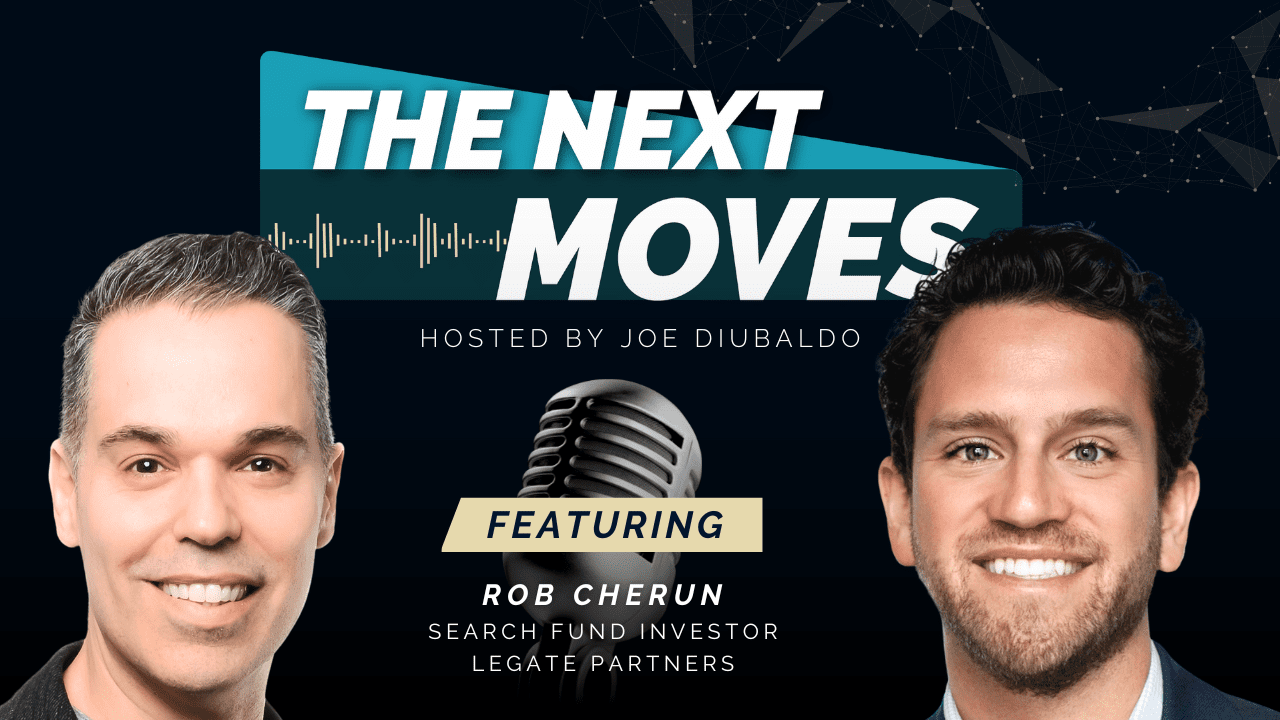
When Rob Cherun started his career at Morgan Stanley and McKinsey, he was on the fast track to a high-powered corporate career. But instead of climbing the well-worn path of investment banking and consulting, he took a leap into entrepreneurship; one that would see him transform a small video surveillance company into an industry powerhouse.
In the latest episode of The Next Moves Podcast, Rob sat down with host Joe Diubaldo to share how he navigated career pivots, scaled a business from $5M to $150M in revenue, and is now investing in the next generation of entrepreneurs through search funds.
Rob’s career began in the world of finance and strategy, first as a consultant at McKinsey and later as part of Morgan Stanley’s executive office, restructuring the firm’s wealth management division. But despite the prestige, something was missing.
“Everyone I looked up to was a business owner or entrepreneur,” Rob recalled. “I realized that the real risk was not taking the risk.”
So, instead of taking a lucrative hedge fund job post-MBA, Rob raised a search fund, an investment model where backers provide capital for an entrepreneur to acquire and run an established business. That business? A Toronto-based video surveillance company called UCIT, which would later become Stealth Monitoring.
Under Rob’s leadership, Stealth Monitoring grew from 50 employees to over 2,000 and expanded from a single Toronto office to 40+ locations across five countries. But how did he scale so effectively?
“The key was focus,” Rob explained. “Our competitors tried to be everything to everyone, but we specialized. We started with video monitoring for construction sites. Nothing else. That focus allowed us to become best-in-class.”
From there, Stealth expanded strategically, moving into industrial and commercial real estate, but always maintaining a clear value proposition. “We had to say no to big opportunities that didn’t fit our model,” Rob said. “That discipline allowed us to scale sustainably.”
Another major factor? Building the right team.
“You can’t do it all. The biggest mistake entrepreneurs make is not knowing how to delegate,” Rob noted. “Every year, I would ‘gift’ myself time by hiring someone better than me in a certain area. That freed me up to focus on what was next.”
After more than a decade of growth, Rob and his team made the decision to sell Stealth Monitoring in two stages: first to a private equity firm, and later to a strategic buyer. For investors, the return was staggering; over 9X on their initial capital, with compounding returns continuing to grow post-sale.
Following his exit, Rob faced a new challenge: what to do next.
“When you step out of the CEO role, you go from getting 500 emails a day to almost none. It’s a shock,” Rob admitted. “I realized I needed to figure out what the next mountain to climb was.”
For Rob, that next challenge is investing in search fund entrepreneurs, helping the next wave of ambitious operators buy and scale businesses just as he did.
Reflecting on his journey, Rob shared a few key takeaways for those looking to build and scale businesses:
🔹 Specialize and focus: Don’t try to be everything to everyone. Be the best at one thing first.
🔹 Hire smarter: Find people better than you, delegate, and empower them to lead.
🔹 Think ahead: The best returns come from patience, discipline, and compounding growth.
🔹 Be ready for change: Exiting a business isn’t just financial; it’s personal. Know what’s next.
Rob’s journey is proof that taking calculated risks can lead to outsized rewards. Whether you’re a founder, investor, or aspiring entrepreneur, his insights offer a roadmap for scaling with purpose.
Follow us on LinkedIn for the latest hiring market insights, and f you need support finding finance or accounting talent:
00:00 Rob: You know, I think in the search fund model the bet is essentially intellectual horsepower over experience. You’re giving someone the keys to a two to five million EBITDA business and you’re hoping that their hard work and integrity will be more than the experience of the former CEO of the business.
00:31 Joe: Hello everyone. This is the Next Moves and it’s a series of interviews done with people who have built incredible companies and awesome careers. I’m doing it for the simple reason that there are so many moments where I’m sitting in meetings in my job as a recruiter talking with a CEO or a founder or a member of their team, and they’re talking about the choices that they’ve had in front of them and how they considered them, and then as they made them — the impact and what happened. And I’m just thinking to myself, this is so valuable for people because we all get stuck. And hearing how people plan their next move and the move after that, it can help us make better decisions. I’m going to be honest — sometimes it feels like people make very logical, calculated decisions. And all the other times it feels like they flip a coin. And I think we can learn from both those scenarios and the outcomes they got. So without any further delay, let’s talk to my next guest.
01:22 Joe: Rob Cherun started his career at Morgan Stanley and McKinsey, but instead of climbing that ladder — which is laid out for you in a very structured way — he took a leap, raised a search fund, and bought a small video surveillance company and transformed it into Stealth Monitoring. It was one of North America’s leading security tech firms. It grew to over a thousand employees and ended up selling to another company for hundreds of millions of dollars. When you look at Rob, he spent a decade in the trenches building it. I knew him at a moment in time which was probably one of the hardest times — when he was scaling this and building out both the strategy and the people side of his business, and I helped him do that. And now he’s decided to step into the role of investing, helping search fund entrepreneurs find their next business and then partnering with them to create something awesome. So welcome, my guest today, Rob Cherun.
02:18 Rob: Thanks Joe, pleasure to be here.
02:25 Joe: I think where we should always start is letting people understand your background and your journey to this point. You can go back as far as you want to, but I think it’s an interesting one. We’ve talked a few times, I’ve known you for a few years and I’ve watched you evolve, and I want people to understand those different stages. Can you just walk us through that?
02:43 Rob: Sure. I grew up in Ottawa, Canada — proud Canadian. When I was trying to figure out where to go for undergrad, Western had one of the best business programs called the Richard Ivey School of Business, so got kind of pre-accepted there and ended up at Western for four years doing business. From there I wasn’t sure what I wanted to do. I knew I liked numbers and there was a firm called McKinsey and Company which seemed to be the best tangible experience you could get out of undergrad — essentially getting to help Fortune 500 companies with some of their largest strategic problems, flying around the globe and working with really smart people. So I did that for a couple of years out of the Toronto office but lived in Zurich for six months, San Francisco, and other parts of the world. From there I thought — I’ve seen how advisory works and I decided to get some operational experience. So I went to work for the executive office at Morgan Stanley, specifically focused on the restructuring of the wealth management division, based out of New York. That was a ton of fun and a great number of learnings. After a couple of years there, I was like — well, I don’t know what the perfect version of Rob looks like, so I should probably recalibrate by going to do my MBA, as a lot of insecure overachievers do. So I applied to business schools and ended up going to the Stanford Graduate School of Business. Had an amazing two years, spent my summer at a hedge fund in New York, and then decided — you know what, everyone I look up to as a business owner and entrepreneur — I might as well just go for it, because the risk is not taking the risk at that point.
04:27 Rob: Dad was a pharmacist, mom was a school teacher, and they always thought it was nuts when I was saying things like “hey guys, I’m going to not take this hedge fund job that’s paying my tuition and willing to pay me all this money to live in a Tribeca loft with a corner office, and instead I’m just going to make no money and become an entrepreneur.” And they were like — why don’t you want stability?
04:51 Joe: It’s interesting when you have a school teacher family — part of it is you end up in a place where you don’t fully grasp business. I say that coming from a family of school teachers. Before I left and had to go do something entrepreneurial — watching your father, I don’t know if watching him manage that small business was a gift that set your expectations appropriately or if it was more like “oh God, I don’t want that to happen to me.” Which one was it?
05:26 Rob: Well, you know, call it being in a middle-class neighborhood in Ottawa — you don’t have much exposure to business. You hear about people like big CEOs but you don’t really touch them if you’re living in Ottawa. What you do touch is the dentist, the doctor, the government worker — those types of employment. And you hear these terms like management consultant and investment banker and you don’t really know what they do. You see Michael Douglas in the movie Wall Street and you’re like “oh, that’s pretty sociopathic stuff” — but you think it’s just a movie and you don’t actually understand what business is. Is it theater? Is it real? It’s all just theatrical when you’re in Ottawa. My experience — I had a very good friend named Derek whose parents owned a Chinese restaurant, and I had another good friend whose dad was an accountant. That was my experience of business. Growing up, my neighbor would get the Wall Street Journal and I would ask him for the day-after versions. So I would collect the Wall Street Journal from him every day — while other kids are reading comic books, nerdy Robbie’s reading the Wall Street Journal trying to get smart on business.
06:44 Joe: Are you serious? That was what you did?
06:44 Rob: And I would also go to community events — I would go to Colonel’s Popcorn, pick up big garbage bags full of popcorn, go to the grocery store, pick up cans of drinks, and then sell them at the community events because there were no vendor licenses allowed. So I had like a monopoly, and no one’s going to turn down a 13-year-old. So I would sell popcorn and drinks at movie nights or whatever the communities would be holding.
07:06 Joe: There’s a line from one YouTuber, Alex Hormozi, who said the best thing for any business is a starving crowd. If you open a hot dog stand where there’s a ton of restaurants, you’re cooked. But if you open where there’s a starving crowd at 4 a.m. coming out of bars, you can do very well. So you had the starving crowd with your popcorn.
07:30 Rob: That’s right. But I also had some other lessons — like I tried to start one of those bulletin board services. You remember when we used to have modems that were squeaking? I bought the first class client and was building it, had two modems set up, and then a big service came into Ottawa with 15 connections and blew me out of the water. And then I had a website called cellphonecompare.com and it would compare all the cell phone plans in Ontario — you could get a link to which provider you’d go with, Bell or Rogers or Telus, and I would get a referral. Then Future Shop came out with their wizard and I was over in a day. So I learned very quickly — you want to have capital and be the big player. It’s hard to play in business being a small player with no capital.
08:19 Joe: And it’s timing. Someone comes in and does something to you and there’s a change in the market. So I want to jump ahead a little bit — let’s talk about your MBA because you took a course that changed your life. What was it?
08:35 Rob: My MBA changed my life for a number of reasons. First of all the network — around 300 students from all around the world from all sorts of industries and disciplines. You could say “hey Matt, what was real estate private equity like?” or “hey Tom, what was it like to be a tech entrepreneur?” And it very quickly allowed me to crystallize what was working and what wasn’t working and how people saw their career paths and why they were trying to pivot or stay in the same career path. In terms of course load, there were a couple of very formative classes. There was a class called Formation of New Ventures that talked a lot about how do you build a new business. There was another one called Managing and Growing Enterprises which was pivotal. And the last one was a course on entrepreneurship through acquisition — which is exactly what I ended up doing — essentially acquiring a business to then run it on behalf of your investors.
09:24 Joe: That one I guess shaped your thinking and helped you get to where you are now because it gave you what — a map, a path?
09:32 Rob: Exactly. It gave me the confidence that I could go out to investors and say “hey, I don’t have much experience but I’m really hard-working and I’ve always kind of got straight A’s — would you like to make a bet on me to go find a business, and then give me money to buy it on your behalf and I’ll run it?” And that was the bet. What I learned at Stanford specifically was you’d have all these huge entrepreneurs or business leaders come in and speak, and you start realizing they’re not that different than us, Joe. It might have been hard work or a little bit more intelligence or right place right time, but they still put one pant leg on at a time. They’re still human and they still made a lot of mistakes. And that confidence made me realize — why not just go for it, just like they did earlier in their careers?
10:38 Rob: So I had all these entrepreneurial ideas, but then the opportunity costs are high — you’re going to raise money, burn it, not sure what it’s going to become. Or do you kind of raise a pool of capital to search for a business for a couple of years, then go back to your investors and say “hey, here’s a traditional cash-flowing business, let’s buy it at a good valuation, good market understanding, it’s been doing the same thing for the last 30 years, you buy it, it’s stable, it produces money already” — and now you just build and enhance as opposed to create. And that’s what my risk aversion led me to.
11:22 Joe: I want to build off what you just said and I want to talk about the search fund model. Can you help us understand exactly what it is and how popular it was when you started versus what it is now, because I think there’s been a significant evolution. Without you, I probably wouldn’t have known as much about it.
11:46 Rob: Absolutely. The search fund sounds like a pretty wacky concept when you first hear it. It’s a model for acquiring a small established company. What it is — a group of investors providing funding to an entrepreneur, or what we like to call them, a Searcher, to go out and find a business to acquire, manage, and grow. This pool of capital to find this business is typically around $500,000 to $800,000 shared amongst investors, and this typically takes up to 24 months. Once the Searcher then buys the business, they’re empowered to take leadership, become CEO, create value through operational improvements, market expansion, and strategic changes. They’re given a board of governance because they’re pretty inexperienced. That hands-on CEO then typically runs it for 4 to 7 years and then they exit, capturing about 20 to 30% of the profits at exit. Typically these kinds of deals are around $1 to $30 million size businesses, with about half of it being equity.
12:47 Joe: And how large was the one that you bought? Give us a rundown of your business that you built.
12:52 Rob: Sure. So I bought a business that was originally called UCIT Online Security — it was a video surveillance business doing $5 million revenue, $2 million EBITDA, with a 40% five-year compounding annual growth rate. Fast growing. The entrepreneur’s name was Sydney Summers — he was living in nearby Mississauga at the time, was in his late 30s, had two young kids at home, and was wanting support and help. I came in with my business partner Erik and said “why don’t we partner, Sid — you can roll over equity, we can grow this thing together, you focus on Toronto sales” — and 15 years later we all have the same relationship to some degree.
13:38 Joe: Let me understand the evolution of the company — the number of people, the geographies it was operating in when you started and the revenue, and then what it ended up being when you left. You see it now called Stealth Monitoring.
13:52 Rob: It was about $5 million of revenue when we bought it, around 50 employees, based in Toronto, focused on construction video surveillance. The business model was we’d go into a construction yard and say “instead of a security guard here at night and weekends, why don’t we put up cameras and watch them remotely, save you money, but also have recordings and do video reviews and strobes and talk-downs and all sorts of stuff to secure your site.” When this construction site’s done, we’ll take it down and move it to the next construction site. Within five years the business was across Canada and then we started entering the US. We made an acquisition in 2016 into the US, and then by 2019 we were like okay, it’s time to provide liquidity — it’s been 8 years for our management, for ourselves, for our investors — and to de-risk the business. So we hired investment bankers, ended up getting a bunch of bids, and we ended up with a private equity fund out of New York and Palo Alto. They bought two-thirds of the business. We kept a third, continued to run it for another 5 years, and then just sold to a strategic named Garda, which is about 130,000 employees — one of those big guard companies you probably see at the airport. When we sold the business to Garda, we were doing about $150 million of revenue from the $5 million we started at, we were at about 2,000 employees from the 50, we were at 40-plus offices from the one, and we were in five countries from one. So lots of fun scaling and some great learnings both in strategy, talent management, and capital structure.
15:34 Joe: Let’s talk about those pieces. I want you to think about what you got right in the early years and what you got wrong. People would benefit from understanding what you see as critical when you’re going from that $5 million business to $50 million and then the step after that. What did you get right, what did you get wrong?
15:59 Rob: What we got right was focus. I’d see a lot of my competitors and they were just generalists in security, trying to be everything to everyone. And we’re like — nope, we’re just video monitoring at construction sites. That’s it. We’re just going to open up new offices. Boring? No, it’s not boring — it’s focus. It allows you to become best in class, create a center of excellence. It allows employees to have a very clean process both on the installation, service, and monitoring of the systems. It allowed us to really refine that product offering. Slowly over time we expanded into commercial and industrial applications — if we’re good with dirty power and internet at construction sites, we’re probably good at it at industrial sites, scrap metal yards, storage facilities, apartment buildings, car dealerships — but again mostly outdoor asset protection. That focus allowed us to thrive. But it also made us very comfortable saying no. “Hey Rob, I can introduce you to Home Depot.” No. “Hey Rob, I can introduce you to TD Bank.” No. Even though you were attracted to these shiny objects or potential customers, you knew it would distract your organization and it wasn’t your center of excellence. That was probably number one.
The second was Dream Team. The most important thing is you can’t do it all yourself. That’s the biggest problem when I look at buying businesses — the entrepreneur has been maxed out and they don’t know how to delegate and they don’t know how to hire talent better than them. That’s what you have to do. You have to find people better than you, put them into a role, and then let them run it as you check in with them every week. That’s what I did. Every year I would look at what Rob is doing this year, and I would give myself those hours back by hiring a superstar, and I would continue focusing on what was next — broken or opportunity in the business. That scaling allowed us to take on more, allowed us to do acquisitions, expanded us across North America and across different countries. Without that horsepower on the team I never would have been able to succeed.
18:27 Joe: That’s excellent. What’d you get wrong?
18:27 Rob: We got a lot of things wrong. The first and most obvious was we were trying to figure out the technology stack. At the beginning you just focus on sales. Then you realize all your processes are broken, so you clean up all your processes and map out the client journey. Then you start realizing nothing works on Excel spreadsheets anymore and everything has to be ERP systems, CRMs, all this mapping tools and stuff that can make your head spin. Then you realize that the industry isn’t growing at the speed you are, so you have to create all these tools in your products or service offerings to actually be the innovator in your space. That’s where we first got it wrong — we tried to do it all in-house. We hired 50 tech-related resources and tried to build it all. You imagine you’re going to be a Silicon Valley tech company. But what you realize is it’s not your core competency. Our core competency was installing and servicing cameras and watching them remotely. So we pivoted within a few years with our CTO and CIO restructuring to focus on outsourcing — we hired teams in other regions and other companies to do that for us, and it was much easier and much more fluid.
The other thing we probably got wrong was post-merger integration. I had learned a lot about this at big firms, but it’s not Excel sheets or org charts — it’s cultural differences. When you buy a business in Dallas and you have a Toronto business, the people think differently. In Dallas you have a sign on the door that says “no concealed weapons.” In Toronto, no one owns a gun. In Dallas you might have political events that Canadians don’t understand and vice versa. We’d make these t-shirts — “one team, one dream” — doesn’t do anything, Joe. What we learned very quickly is you need to respect and honor that, and come up with ways you can bring the businesses together while respecting the differences of how they built their businesses and what they’re focused on.
21:04 Joe: I think that evolution in your thinking requires some mentorship. It’s not just you figuring it out along the way — someone finally steps in and says “hey, I’ve seen you make this mistake once or twice now.” I’m assuming someone was helping develop you. I know that you’ve invested in developing teams before — but who developed you? Why’d you pick those people or were they just given to you?
21:22 Rob: There’ve been a few along the way. Specifically when I think of people who really developed me — a hedge fund manager I worked for in the summer of 2009 has always been a thought leader for me, as well as my first engagement manager at McKinsey, who’s now a superstar C-level executive at a Fortune 500 company. They’ve always been my compass when I’ve had to think through big decisions or question where I am in my career and how I’m performing. The management team as well — I think is a really good barometer and mentors of mine. They brought a lot of expertise that I didn’t have and I felt a lot less lonely in the job by relying on them as I pondered decisions. As soon as we agreed on something, we all rode in the same direction — which was critical. There was no patience for someone disagreeing once we had agreed.
The other mentors of mine were definitely my investors and specifically my board. You know, I think in the search fund model the bet is essentially intellectual horsepower over experience. You’re giving someone who’s probably around the age of 30 the keys to a two to five million EBITDA business, and you’re hoping that their hard work and integrity will be more than the experience of the former CEO of the business. And you can really bet on that when you have good governance structure around it — specifically a board who’s there to talk to the CEO, whether it’s about an acquisition, a talent issue, or just their mental health. My board was extremely helpful when it came to pivotal moments in the business — how I thought about key hires or dismissals, or where the next focus was in the business.
23:13 Joe: Within that then, people are giving you advice and that drives some very tough decisions. I’ve known you long enough to know that you care a lot about people, and the people that you’ve hired are individuals that sometimes started with you very early stage. How do you make those hard people decisions?
23:37 Rob: They can be very hard. There’s always going to be a family culture to every organization and those connections are what drive it. When you think of what keeps you at an organization — it’s obviously the work, the money, the benefits — but it’s also who your manager is, it’s the people you grab lunch with, it’s the culture. So when you disrupt that, it can be really hard on people. As a business is growing 20-30% a year, that means every two to three years the business is doubling. So if someone had five people, within four or five years they now have 20 people working for them. And a lot of people can’t lift that. So what do you do about that? The most important thing we did was look at the silo or process and say — is it a people, process, or technology issue? If we took it down to the people issue, we would talk to the person and say “what’s going on, here’s what we’re observing, here’s what you’re observing — do we want to bifurcate responsibilities, do we want to demote, do we want to counsel to leave?” And we would work through it with them. That allowed us to have that mature conversation in most cases — where you could bifurcate responsibilities and keep the person in a great role in a growing organization without overdoing it on them.
The most important thing you realize is a business is just teams on teams on teams on teams. People are like “oh my God, how did you run a 2,000-person organization?” I’m like — well, you have your six or seven reports and they have their six or seven reports. You know around 50 people and what they’re doing every day. But what you need to know is that those 50 people are making the hires for the next 50 people below them and also holding them up to the standards. My role was making sure those 50 were as many A players as possible, because if I hired a B in that role, they would hire a C in their role, and before you know it that whole section of the org chart is imploding. And it’s pretty easy to find when those things happen because that’s where all the noise comes from.
26:04 Joe: Excellent. So Rob, I want to talk about the asset class of search funds. Not everyone’s had access to this or thought about it. Can you break it down for us in terms of the returns, the way you look at it, its history, where it’s headed now, and anything else you want to develop so we understand it better?
26:20 Rob: Absolutely. The concept came out of around 1984 out of Harvard and Stanford. For the first 30 years this was a Harvard and Stanford concept — one or two students a year out of those schools going to a lot of the same entrepreneurial investors and raising capital from them. Then it kind of blew up. When I started it was still probably early days — it was 2010 and the search fund concept had not been done in Canada, or maybe one or two had been. I then wrote a micro-cap opportunity as a thesis for one of my professors on Canada. He said “I’d be your first investor if you want to do one of the first search funds in Canada.” That’s where I kind of started, found a business partner, and we moved back to Canada. Since then it’s grown as an asset class like a hockey stick. There’s been about 700 search funds, about 100 now a year coming from all sorts of MBA programs and more mature searchers who are farther along in their careers.
The reason for the attractiveness I think is twofold. One is it’s been a proven model of return both for the entrepreneur and the investor. If you look at the Stanford primer, we’re talking about 35% returns with about a 4.5x return on invested capital over a seven-year period. When you look at that compared to some of the other alternative investment classes like real estate or private equity or venture, it’s multiples more attractive. The reason it’s not talked about a lot and the reason why it’s not as known in mainstream communication or media is because it’s very small — these are small deals with typically high net-worth individuals. You can’t really raise institutional money because the checks are too small. And so that’s why it’s stayed in a very niche space.
The trend however has been that it’s growing fast. If you think of about $3 billion having been invested in searchers and search-acquired companies from the ’80s to the early 2020s, 25% of that was in the last two years — about $700 million. The reason for that I think is succession planning being taught more in MBA programs and the success of the asset class from the past.
28:47 Joe: Where does Stealth sit in terms of its success relative to others?
28:55 Rob: Stealth was a good success story because we held it for so long and we grew fast — it was a double whammy. When you have a business that’s growing organically 20 to 30% a year with its own cash flows, that can yield to a pretty good outcome. When we sold to private equity 8 years in, our investors got close to nine times their money. I remember calling one of my investors who was a doctor and saying “okay, you gave us $100,000 and here’s a check for close to a million dollars.” And he goes “well what about your fees?” And I’m like “that’s already been integrated.” He’s like “I thought this was risky” — and I was like wow. And that was pretty fun and pretty meaningful for us, and also for our management team who obviously had great outcomes from it as well. But now think of that — you have a 9x but you haven’t sold, you keep going. It’s year 8, now it’s year 13-14 and you sold again. Well, even if you just tripled, now you’re at a 25x. And I rolled again this time. So in 5 years, another 3x, and before you know it that’s a 75x return on the original dollars. And that’s where I think the attractiveness of this asset class comes from — the compounding returns over a very long period of time. It lends itself to more patient money, people that are focused on culture, people that are focused on long-term building of a business, not just the flip-and-dip type people that are out there.
30:41 Joe: How do you select your great search fund entrepreneur? I know people are going to be coming to you after this. But how do you select — let’s think of it from a demographic, an archetype, a persona. How do you select, what do you look for?
31:03 Rob: This is the hard part. How do you select for success? The problem, Joe, is a lot of the time you meet people and we’ve all met these people — super charismatic, shaking hands, kissing babies — and then they have no substance. And then you meet the introvert who no one really likes but does all the work behind the scenes, and you’re like — well, no one really liked them, so could they corral a team? So it’s actually harder than it sounds. We look at a multitude of criteria. As I simplify it to the highest level — it’s integrity and hard work. That’s what it’s going to take. It’s going to take the humbleness to know if anything goes wrong, you need to talk about it right away and always keep to a high bar, because all you have is your reputation. And then hard work, because running these businesses is not ivory tower work. In my case it was installing another camera, getting a bucket truck out there, monitoring the camera overnight — repeat. And that is real work. That might involve 1 a.m. nights in QuickBooks trying to figure out where that money went, or it could mean jumping on a flight to meet with a client with an hour’s notice. My business partner Erik moved out west for six months because we lost an installer in Vancouver and a salesperson in Calgary, and the board was like “well, who’s moving to the West Coast for six months to fix this?”
When it comes to resume assessment, education is a big piece of it. We want people who have always achieved in life. Skill sets, personal qualities, financial acumen — it’s important to understand numbers and feel comfortable with dashboarding and whatnot. Strategic vision and operational expertise — but a lot of that you can learn on the job. What we’re looking for is someone who’s shown success and a track record as they’ve built their career. What you definitely don’t want is ego. I can’t tell you how many times we meet these prep school kids who went to all the right places — they might be good at bulge bracket stuff, but when you’re running a small business you have to worry about sharing a room. I shared a room with Erik for 14 years. And we asked all of our employees to share rooms, and when you rent a car you’re typing in the discount codes because it feels like your own money. And you want your employees to feel like that. Sometimes these pedigree people don’t have the same street smarts or scrappiness that it takes, and that’s who you’re competing with.
33:59 Joe: I think that comment is going to resonate with a whole host of people. When you look at your partners that you’ve worked with and you think about the start of it all and how you selected Erik to work with — how did that happen?
34:14 Rob: You look back and you’re like “wow, I was so naive in this decision making.” It worked out, but — so I was looking for a business partner as I was building on this investment thesis in my second year at Stanford. I was talking to recruiters in Toronto, I was talking to the Harvard and Western clubs for Canadians, and I was just trying to figure out if I could find someone to work on this with. Because I’m a high extrovert, so I knew it would be a much higher success rate for me to find someone to work with every day. A McKinsey friend of mine and a Blackstone friend of mine — so-called two reputable sources — introduced me to Erik, who was living in LA having come from Canada, having gone to the same Ivey School of Business, having gone to New York for banking and then private equity in LA. We got to know each other and I remember meeting him — he’s in a convertible with an Ed Hardy shirt and I’m like “is this my guy?” I’m a bit nerdy, I wear the collared shirt underneath, the white shirt underneath. But in the end what I realized is that difference is what actually made it so magical. My skills were different than his skills. He was an all-star salesperson, he could make anyone like him, and he loved people. So we agreed — why don’t you become president and chief revenue officer, I’ll be the CEO of the business, you grow the business 20-30% a year and I’ll pick up the pieces. And that’s what we did for the 14-year journey. It was amazing because it allowed that partnership to really trust each other and take on different roles. We were very rarely in the same meetings and we kind of just trusted the other person’s work streams. It worked really well.
36:12 Joe: So we’ve covered off how this started, the choices you had to make, all the moves that you made, and how you thought through the different options. I think the big thing that I like to know is what is next and what are you doing now, and what do you plan on doing?
36:20 Rob: It’s very complicated, Joe. When you run a business it becomes your identity. I was running around three weeks a month flying around to our 40-plus offices, I was still single dating a lot, based in New York City trying to figure out my life, had a dog named Cucumber so I was like “at least I have some semblance of stability.” But it was anything but stable or healthy. And you start to become almost like out of body — you wake up and you have an EA, a PA, a chief of staff. So you have three people dedicated to just making sure your day is easy. That means you have your 12 Zooms scheduled, you have your smoothie waiting for you, your dog’s being walked. You’ve never been to a grocery store in 5 years. Your life is now taken care of. You don’t know where you’re flying to tomorrow but you’re flying somewhere. And you think it’s epic, but what you realize is you’re just on a treadmill. 12 years in, I worked with the board and we agreed that we’d bring in an executive chair who had taken ADT public with Apollo. So we agreed on a transition — I started transitioning out of the CEO role. And before you know it you’re not getting 500 emails a day, you’re not getting 12 Zooms a day, and you become irrelevant basically overnight. You tell a joke and no one laughs because you’re not actually funny — it’s just that people laughed because you were the CEO. And you’re like — huh, now what? And you pick up your dog poop and you’re like “this is kind of miserable but kind of meaningful.” And then you go to the grocery store and you’re like “I don’t know what type of onion to buy for this salad.” All these things happened to me super late in my life — like at 40. And that is what people sometimes forget — you might be epic professionally but then everything else could be a disaster. Or the opposite. Finding that balance is actually really hard.
38:53 Rob: So for the first six months I kind of just decompressed. I was like — okay, I’m not allowing myself to jump into anything. Because the first thing an overachiever does is they try to overachieve. You’re good at this, just jump into something new. All these people are bringing you ideas, you’re good at it, you want to have the inertia, you found meaning in what you were doing, you don’t know what to tell people — are you on sabbatical, are you retired, are you on the board of a business? You start rambling, you have no idea how to explain this, and the whole thing gets a little bit uncomfortable.
One of my good friends who unfortunately was very sick with cancer and has passed away since — which has been really hard on my group of friends — he spent a lot of time with me talking through how he was looking at the last couple years of his life. He had read this book called Designing Your Life — it’s a blue-covered book from Stanford — and it was really helpful for me as well. It allowed me to think about how to navigate the next few months, how to think about my next goals, what’s the next mountain I want to climb. It’s probably not achievement in business. So what does that mean? Well, it means if I want to get married and have a family I better get that figured out. If I want to learn how to make a salad properly with the right onion I better get that figured out. If I want to surf, which I’ve always talked about — well, get it done. If I want to learn Italian — get it done. What am I waiting for? So I pulled myself up and said I’m going to give myself time to do those things. And I’m now happily engaged, getting married this summer, met the most awesome girl — it’s been two years now. I’ve become a decent surfer, decent at Italian, and it’s just been an amazing journey.
40:46 Rob: Now professionally, you still want to have meaning and you still want to make a dent in the world. So I started investing in search fund entrepreneurs similar to what I had done. More and more were coming at me because I had had such a long-term successful journey. And before you know it, friends of mine were saying “we’d love to invest with you if you’d be up for it.” So I took their money and before you know it I have a fund investing in search fund entrepreneurs and helping them grow their businesses. That’s what I’ve been doing now professionally for about a year through Legate Partners, and I’ve been having a ton of fun. It allows me to engage and work with them on boards, work with them on offsites, help them think about growing their businesses — while allowing me to have a little bit more balance than when I was running a multi-thousand person business.
41:35 Joe: Like now you’re looking at people and you’re evaluating them, and you’re not just evaluating them — you really do want to help. I’ve been a part of this process with you for something recently and you’re doing your best to coach people and frame problems properly. Which is the battle that we all face — what problem do we have, and what problem are we therefore solving, and what’s the fastest way to solve it so it doesn’t come back and rear its ugly head again. Pulling entrepreneurs out of that. I think it’s awesome. Rob, thank you, I really enjoyed this.
42:05 Rob: Likewise Joe. So this has been the Next Moves — and we’re planning for not just your next move but the one after that and the one after that. Rob, you gave us some awesome insight into your choices and it’s going to help us all make better moves.
42:13 Rob: Thanks Joe, much appreciated.
Here is your link to the 2026 Salary Guide:
2026 Salary Guide (PDF) ↗Are you hiring? Get in touch with us to talk about better hiring.
Get in touch →
Here is your link to How Finance Fuels Growth:
How Finance Fuels Growth (PDF) ↗Are you hiring? Get in touch with us to talk about better hiring.
Get in touch →
Here is your link to the Finance Team Org Charts:
Finance Team Org Charts (PDF) ↗Are you hiring? Get in touch with us to talk about better hiring.
Get in touch →