
Spotify

Apple Podcasts

Amazon Music
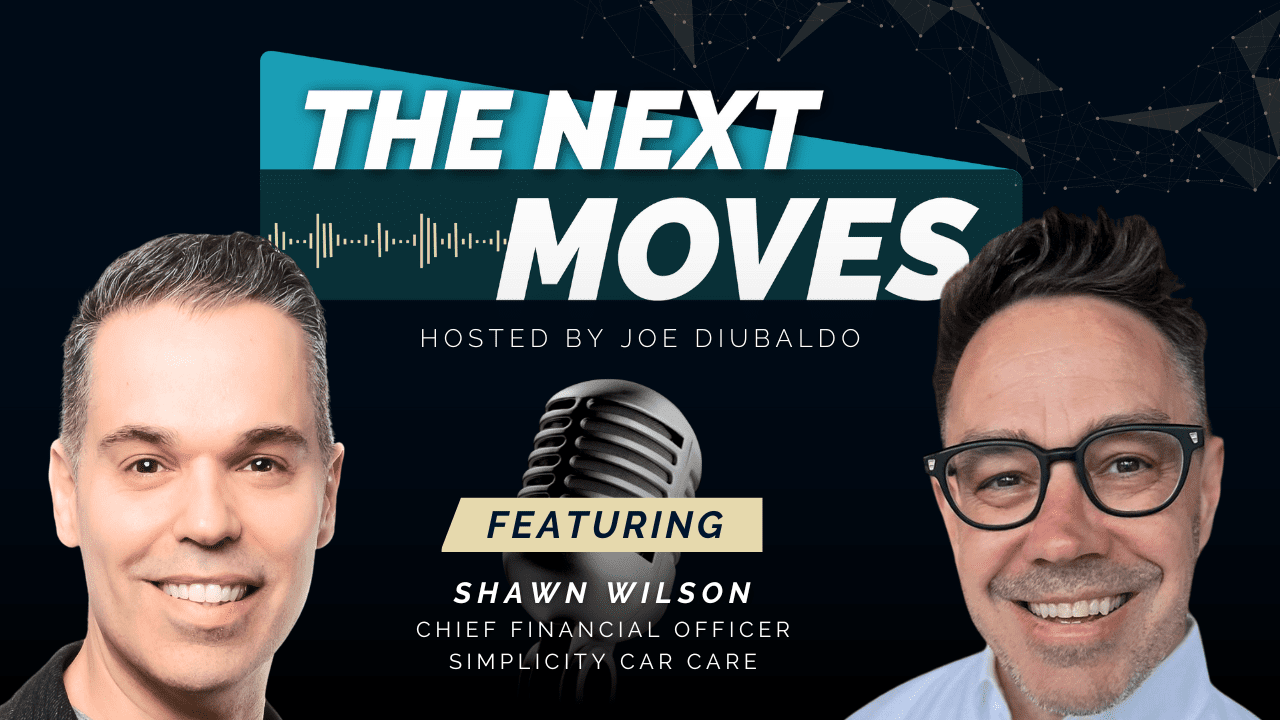
Joe Diubaldo, host of “Next Moves,” interviews Shawn Wilson, a seasoned CFO with a rich background in various industries such as renewable energy, construction, professional services, business process outsourcing, and technology. Joe introduces Shawn as a strategic thinker who has significantly impacted both small and large organizations, with a unique approach to building great teams and a strong focus on culture and strategic development.
Shawn started as a Chartered Accountant (CA) with a large firm but quickly transitioned to a small CA firm where he developed a passion for entrepreneurship by working with pre-IPO clients. After moving into a role as a Controller, Shawn soon became CFO at 29, learning valuable lessons about financial management and resilience during a company’s bankruptcy. Since then, Shawn has held various leadership positions at companies like CanLift and Amp Solar Group where he has guided organizations through massive growth and transformation and cultivated a network of incredible individuals who have helped contribute to his career success.
During the conversation with Joe, Shawn emphasized the importance of honesty, transparency, clear objectives, and accountability in evaluating potential ventures and partners. He stresses the need for discipline and the right team to operationalize entrepreneurial visions effectively. The conversation also highlighted the importance of managing stress, prioritizing tasks, and maintaining a balance between personal well-being and professional responsibilities.
Shawn discussed how transitioning to private equity-backed companies involves significant changes, requiring a more structured and disciplined approach to achieve growth and meet stakeholder expectations. CFOs tend to be programmatic by nature, and the increased accountability and governance that come with working within a PE-backed company was welcomed. Shawn explained that, in the end, the goal of private equity is to create value within an organization and there must be alignment in objectives.
Shawn believes that every organization needs to set clear departmental objectives with effective ways to measure them. He believes that once you have measurement, people can understand their impacts on their department’s objective and how it affects the company’s objective. When you have those two things, it creates transparency and clarity in how performance is managed and creates alignment across the organization.
Listen to the full conversation to hear more about Shawn’s insights on leadership, industry trends, capital raising, personal resilience, and effective communication. Shawn has had an incredible career journey, and his emphasis on work ethic, curiosity, and respect for colleagues underscores his approach to professional growth and team success.
Clarity has worked with people like Shawn Wilson and numerous C-level executives throughout their hiring and career journeys. If you’re trying to find the high-performing talent you need to build your finance, accounting and data analytics teams, we’re ready to help!

00:11 Joe: Welcome to the Next Moves. My name is Joe Diubaldo and for the past 25 years I’ve been helping people build careers and build amazing companies. The truth I’ve learned is that we all get stuck at different times and I want to help you get unstuck, plan your next move, and the move after that. I think the best way to do that is to look at the choices that some of our guests had in front of them and the moves that they made. Today I have the pleasure of speaking with Shawn Wilson. He’s a seasoned CFO, operating officer, strategic thinker, and he’s made significant impact across various industries including renewable energy, construction, professional services, business process outsourcing, technology, and now another services organization. When I look at Shawn, he’s not only a skilled CFO but he’s a passionate advocate for entrepreneurs. I’ve watched him do this within small organizations and massive organizations. Every time, what he’s done is marked by a deep commitment to partnering with CEOs and leadership teams as well as the investment teams that help drive this growth. Shawn’s unique approach goes beyond traditional finance — he sees himself as a builder of great teams, which I care a lot about, and he has a strong focus on culture and strategic development of individuals against the goals of the organization. This journey he’s been on has pivots where he’s led major initiatives, implemented transformative strategies, taken organizations from nascent startups to massive institutions with big exits, and he’s even stepped into the sales seat so that he could be more effective at framing information and sharing it with people. So join me as I explore Shawn’s career path, his love for entrepreneurial companies, and the impactful decisions he’s made along the way. Welcome Shawn.
01:46 Shawn: Thanks Joe, it’s a pleasure to be here.
01:53 Joe: So you and I go back — this is how many years in the making now? How long?
01:57 Shawn: 2006, 2007. That’s my guess.
02:01 Joe: So this is almost 20 years in the making. We’ve worked together before on the same team and I’ve worked with you both as a candidate and a client. I know your background well but can you just do a quick high-level summary on how you started and where you are now?
02:17 Shawn: Sure, thanks Joe. I am a CA — I guess we’re known as CPAs now. I spent my first six months with a larger firm. Unfortunately it was a time when they let go the majority of the new CA recruits. I joined a small CA firm at that time, and I didn’t want to — quite frankly, I liked the large firm, I thought that was the type of firm that was going to take me where I wanted to go at that time. Joining the small firm — it was a firm that specialized in small clients, small clients that were pre-IPO. I started to really understand the mindset of an entrepreneur where I picked up files every day, worked on them, and it was a lot of fun. But I started to become involved in their business. I really wanted to make a change. It set a spark, it set a flame. I knew that once I achieved my designation I wanted to go into the entrepreneurial world. I was lucky enough — or maybe not so lucky — that exiting the CA designation after achieving it, I went into the internet space and I went in as a controller. During that time it was incredibly exciting. It was young individuals, money was flying into the company, we purchased seven companies, and we went through the ups and downs of the internet world where I understood what it meant — the good and bad of creating a company. The company was successful, we raised I believe at that time about $10 million, acquired seven different companies, and then the downswing happened. The CFO left and at the age of 29 I was thrown into the CFO seat. I learned more during that process than any other time because the buck stopped with me. I was doing financial reporting, we did a reverse takeover on the NASDAQ — I’d never done that before — cash flow management, cash was hard, how to manage cash, how to talk to suppliers, how to work under pressure. The company long story short did end up going bankrupt. But I learned a lot during that process. I remember the CFO leaving — the company said “Shawn, I’m leaving. I’m sorry to leave you with this, but I’m going to tell you — you’re going to learn more in the next year than you will in five years.” And he was absolutely correct. A corollary to that is — the company ended up going bankrupt, and in a later career I ended up buying back the shares of that company, doing a reverse stock split, buying that shell. And I became, for a small period of time, selling shell companies on the NASDAQ Stock Exchange. So when people say things happen for a reason, they do happen for a reason. And one of the reasons why I enjoy startup companies is because you never know what’s beyond the next door, what’s around the corner. I ended up from there working for a large company that’s now known as Harris — it’s a multi-billion dollar company. The CFO knew that I enjoyed acquisitions and he put me into the acquisition world. During that time I lived in Kentucky for a while, I lived in Palo Alto for a while, I lived in Kenosha, Wisconsin — some of the least sexy places in the United States. But what I really learned is how to do due diligence, how to buy a company, how to do due diligence effectively, how to be parachuted into a company and immediately earn the respect of a team. I spent some time there and from there — side point — I’ve had the luxury of, I think I’ve written a resume twice: once for my first job, and I actually did for my last kick. But the rest of my periods of employment have been through relationships. I got a call — I believe I was in Kentucky at the time — from one of the board members of the internet company I worked with. He said “Shawn, I’m starting a new company and I want you to come on board.” And there was nothing there. I felt like Jerry Maguire when Jerry left the office and he said “come with me.”
06:36 Joe: And for some reason I was Renée Zellweger in this one.
06:45 Shawn: Oh that’s funny. Just one of my favorite movies by the way. But I jumped on board. I ended up getting there — they had a half-written business plan. Long story short, we finished that business plan. There were three of us and we raised money with the likes of CIBC Capital, Maclaren Securities, CI Funds, and Telus. We were giddy. We had a business plan and at that time I think we had $5 to $6 million in the bank and that was it. We rented a small place, we had tables that looked like we were in a 1970s police movie staring at each other, and we sort of didn’t know what to do next. We ended up selling to a multinational and I can’t remember the return for CIBC World Markets, but it was definitely a trophy in their private equity portfolio at the time. Post that I had another call — it ended up being with someone that I worked with at MCCI, a senior executive at Telus. They had sold to somebody — or actually I had sold to them — the concept of selling equipment with essentially zero down. And this individual moved on to private equity. They called me up and asked me to meet them at a restaurant. I’m not sure if it’s still around — and it is — Trono — it’s a jump and—
07:58 Joe: It is, it is okay.
08:05 Shawn: So I sat down. I still vividly remember this. Love this individual, still one of my favorite individuals. He began to tell me about this concept — how the world is changing, everything’s going renewable, energy is transitioning. He literally pulled out napkins and started drawing his concepts down. And once again I find passion infectious. I said “Dave, who’s on the team?” And Dave said “well, it’s me and it would be you if you accept.” And I said “okay, that sounds like a great team.” I said before I say yes — show me the business plan and show me the financial model. He goes “Shawn, that’s why I’m talking to you today — because you’ve got to build that.” Long story short, I loved the idea. We spent six months with no pay working in my home office building a business plan. We spent at least six to eight months pounding the pavement both in New York and in Toronto on Bay Street to raise capital. We ended up raising — my memory isn’t great but it was somewhere between five and ten million — and once again we had that money in the bank. We had managed to convince two other people to join. Once again four people and “what’s next?” That energy level when you’ve got money in the bank and you’ve got this huge dream ahead of you — it’s so empowering. It’s like a drug to me. People always ask me why I like what I do and I said well I love my job. Imagine being a little boy and you’re going out to a clubhouse with your friends and every day you’re thinking about what do you want to do next. That’s what being an entrepreneur is all about. You go to the clubhouse every day and you try and move the yardstick a little bit further every day. And that was AMP. Long story short, AMP — 10 years forward — AMP raised over almost $400 million USD with the Carlyle Group, arguably the largest private equity in the world. We’ve raised billions of dollars, we’re in 12 different countries, moved from solar to wind to battery to hydrogen to AI technologies. And it goes to show you just that small dream and that small lunch meeting at Trono — the right people at the right time in the right seats can create an amazing success story.
10:46 Joe: Really interesting. You’ve talked about first the idea of looking at an individual who’s passionate about what they do. I know having known you I understand that you are intense, charismatic — but I also know that you’re fairly clinical when you’re evaluating things and you seek sources of information beyond what’s at the surface. So I’m wondering — that decision tree when you’re getting pitched all these different ideas but you’re evaluating “hey, what’s my next move?” — how do you build that personal scorecard when you’re meeting this person? Because there’s some very good pitch and spin that can happen to all of us. You’re talking about making a massive career move and you’re established at this point. So how do you take the measure of people?
11:36 Shawn: I look for honesty. I look for things that are measurable. I do my own research. After that meeting with Dave I didn’t say “yes, I’m in” right away. I started to do my own research to understand — is this really an opportunity in the marketplace? Who are the players? What’s the capital required? After that meeting with Dave I started peppering him with questions — I probably sent him 30 different questions. And depending upon his response, and the clarity and the honesty of his response — that was my decision criteria. He needed to be clear. If he didn’t know, he didn’t know. But there needed to be well-thought-out responses. And there is a bit of gut to it as well. I’ve been in this space for a long time and I’ve seen a lot of pitches and I know how people think. I also like to see them talk about next steps — where they see things as next steps. Almost even though Dave didn’t have a business plan at the time, he’d already drawn out the next steps of what we needed to do. So it was well thought out. I’m not sure if that’s fully answering your question, but it’s definitely transparency, honesty, next steps. I don’t make a decision on the fly. I do ask questions, I do do my own research, and I definitely talk with the people around me. I’ve got a great group of friends — Joe, you’re one of them. I asked my wife, I asked people in the business community what they think about this space and where it’s going. And particularly with this opportunity, there was a resounding “this is the next internet.” I heard people say this is the next internet. And I thought — you know what, I want to be a part of the next internet. I was part of the first — why can’t I be a part of the second one?
13:22 Joe: We want to be part of it without the crash, right? If we can.
13:30 Shawn: Yeah, exactly — without the crash. So Shawn, I’m guessing that when you look at your role and the choices you’ve made, you’ve had some opportunities where you step back and say there’s a consistent theme with the people I’ve chosen to work with and the people that I’ve rejected, and it has a lot to do with the role that you’re going to play. So what are the consistent themes in the role that you’ve played to these entrepreneurs? What’s the common thread in the role that you see yourself playing for those people?
14:01 Shawn: There are words that I have to hear — and some of these are going to be cliche but they resonate with me. One is discipline. Part of my role — and it’s not necessarily the entrepreneur having it, but they need to have elements of discipline — is I see my role as taking the goals and objectives of the entrepreneur and operationalizing them. But they need to have discipline. In life you need to have discipline whether it’s working out or your job or your relationship. The next — there needs to be accountability. The sense that you make mistakes but we are going to measure success by KPIs, we’re going to measure them by numbers. And sometimes it’s not in conversations, it doesn’t come out right away, but people need to say “we’re going to do this by then and we’re going to measure our results.” Clear objectives — one of the roles of a CFO is to interpret the objectives because they’re not always clear by the entrepreneur or the CEO, and turn those into clear objectives and then have those objectives cascade throughout your team. A plan — definitely a plan. Plans change, but you need someone that we agree on — we’re going to create a plan and we’re going to stick to the plan until we’ve proven that we need to augment the plan. Also the belief in getting the right people. I think probably anyone that listens to this or anyone that’s been in a business class has read Good to Great — but the belief in getting the right people in the right seats is going to create the right company. And so I need to feel that. Those are commonalities of all of them — definitely accountability, discipline, the belief in getting the right people, the belief in a plan and measuring our success on that plan.
16:05 Joe: When you look across these moments where you’ve gone through the other side of the curve — the decline — and early in your career. I want you to explain for people that are listening to this what are you learning on the down? Because everyone talks about “I want to go to growth.” But I’ve been in meetings with companies and we help companies that are going through restructuring, and at the end of it — yeah, it’s stressful — but people come out more fully formed if they get through it. So what happened when you’re going through that decline?
16:40 Shawn: You’re right Joe. I probably learned as much on the decline as I’ve learned on the upswing. I’ve learned first of all what can create decline and what creates chaos — specifically in a growth-based company. So I’ve joined companies whether they’re greenfield or they’re at some sort of inflection point, and I find some of the problems. Certainly with my first experience was that it wasn’t the discipline to be the best at something. There’s a term I actually learned from you, Joe — “shiny pennies” — and people take a shot-kind-of approach. They see something over here and they want to do that. And there’s a lot in any space — you’re always going to see certain things that you want to attack. So you end up spreading yourself too thin. And that was definitively one of the reasons for the decline of my first endeavor. But in terms of what I did learn — how to handle stress, how to prioritize. Really sit back and say “I’m going to go insane if I don’t learn how to prioritize.” And in prioritizing, for me it was always closest to the money, it was understanding resources versus reward. And in learning how to calm yourself down in a very very chaotic, hectic downturn — just having a moment of silence, stepping back from it, prioritizing what you need to do and understanding clearly what that objective is. And turning it into bite-size pieces. Because sometimes we get very anxious and we’re not able to move because there’s so many things on our plate. One of the techniques that I’ve learned — I don’t know if I learned it from someone else or myself — I’ve always been someone that on a Sunday I’ll write down my goals for the week, and then I’ll write down my goals for the next day. And sometimes I found that when I was so anxious or my wheels were turning, I would write down — sometimes it would be so simple — “I’m going to pick up my pen, I’m going to open up a file, and I’m going to save the file with a file name.” Just in getting it moving forward. In that chaotic experience it sometimes takes micro steps. And then once you almost get a mojo going, once you get that rhythm going, you can start to achieve some of your other objectives. So in paraphrasing that — what have I learned? How to manage myself within a chaotic environment. How to prioritize. Understanding the reasons for some of the downfalls — and some of the reasons are the lack of discipline in constantly looking at shiny pennies and forgetting that our goal is to be the best at something and taking more of a rifle approach as opposed to a shotgun approach.
19:47 Joe: I think what people — we’re all living our lives and we’re all experiencing things real time. And a company going through distress — we as individuals feel invested in. So it does affect us personally. You mentioned the toll that it takes on you and on the family. When did you come to realize that what happens in the workplace has a dramatic impact, if you’re not controlling properly your own behavior? When, how old were you?
20:29 Shawn: I recognized that a couple of times in my life. And there are certain things that I do very well and there are certain things that I think we’re always trying to manage that chaos. I’m lucky enough to have a fantastic family and a fantastic wife. But there were a couple of times in my life where early on, when I was in the M&A world, multiple relationships failed. Another time in my life was actually just within the last three years where we were growing at an exponential rate — we had massive amounts of responsibility to stakeholders in the multiple billions of dollars. And as a CFO I sometimes take things to a certain degree personally. I don’t know if this was the cause, but I stopped learning how to handle the stress and it became overwhelming. And I do believe this — I think stress causes disease. Three years ago I contracted cancer. I’m fine now. But I think a part of it was my inability to handle stress. I’d lost a little bit of my way in terms of what I discussed earlier — just writing down those goals and doing step by step, stepping away. I became so invested in what the company needed to achieve that I lost that. But I did step back and I went back to what I learned before. A couple of things that I’ve done — I actually enrolled in a course about Transcendental Meditation. You’re meditating twice a day for 20 minutes. It was a game-changer. And when I talked about what I learned before — I stepped away, I was doing my own type of meditation, not in a formal manner. But now I continue to meditate 20 minutes a day, twice a day, in the morning and in the afternoon. And it allowed me to release that stress that comes with a job. I think so many of us bring those stresses home and they affect our relationships. By employing both meditation and revisiting physical fitness, it allowed me to wash myself of those stresses so that it didn’t carry home with me. And it’s been a game-changer. I knew it before but I forgot it, and I revisited those techniques and it’s been a game-changer.
22:49 Joe: There are the inputs that we need to maintain that allow us to tackle these things. And if we forget about those inputs that give us energy and make us feel good and take care of our health, we can suffer on the other side unexpectedly. And what you’re describing reminds me — you said it so well — “I knew it before and I forgot it.” And one of the people I’ve had in my life previously — he’s not my coach anymore but he was my coach — he said the same thing. He’s an individual that coaches people to take care of this because he stepped back into an operating role. He had made his list of all the things he’s going to do as he grows this company to make sure that he stays in the place where he’s collecting the inputs that give him the energy. He was going to work out, he was going to do these things for his diet, he was going to make sure he got sleep. And they all went out the window as he got caught up in the growth, and then it hit him like a freight train and took him down. So these are things we all know, and sometimes we just forget it.
23:46 Shawn: So I like the fact that you framed it that way. One thing I think people forget about — and I’m just writing this down — is we always have to remember to put ourselves first. Everything we are — I mean it sounds selfish, but we’re the only person that can look after ourselves. We need to always remember to put ourselves first. And by doing this you have to get something out of it. I do believe that we can’t forget — we have to remember that physical fitness and mental health are meaningful. Put ourselves first before anyone else. That’s something I forgot, and hopefully your mentor has remembered that. But I’m always trying to remember — put yourself first and do things that are right for you.
24:35 Joe: When you look across your career I always look at the idea of getting stuck, because I think we all get stuck sometimes. And that’s why I want to do these conversations — so people can see themselves at a moment in time in someone else. As I’m experiencing things I can hear this person talk, what they went through and how they got unstuck. We all make choices that put us in certain positions. And I’m wondering where you found yourself professionally stuck and what do you do to start moving forward? How do you take the next step, how do you create momentum of a positive kind to get you out of where you are?
25:18 Shawn: That’s a good one. I’ve definitely been stuck before. We’re stuck every day — there are issues that we deal with every day. But there are times when you feel that you can’t make a change, that whatever you do is not going to be effective in changing the company or the people or the process in the right direction. And you do stumble. What I found is — don’t deal with it by yourself. Ask colleagues. I engaged a sort of work mentor — I’m not sure the right term — to help me look at things objectively, because I wasn’t coming up with the answers. I think everyone in life should know we don’t have all the answers. And sometimes we need others to help us look at things objectively.
26:13 Joe: I find these conversations incredibly helpful too — just like either watching two people talk or doing it with someone else in this format and listening to what they’ve gone through. It’s my own little kind of mentoring that I get for myself. Question for you — I think one thing that I want to ask is related to your experience in private equity. The reason why is you’ve been in organizations that were complete startups, and then small founder-driven organizations that hadn’t taken capital. And then you moved into these private equity-driven organizations. Everyone knows there’s something completely different that happens to someone inside of private equity when they’re in the role of the CFO. So what was different about it? What were the gaps that you had and how’d you close them?
27:05 Shawn: I think almost every company I’ve been involved with has had some sort of influence by private equity. And it is a game-changer. When you’re a growth-based company — either startup or at some sort of inflection point — everyone wants that big private equity check, but you also have to be careful what you wish for because it is a big change. Prior to private equity — I use the term “cowboys” a lot — you feel fairly free. You’re not completely accountable. You’re able to move very fluidly in one direction to the next direction as a CEO or the founder or some of the operational team. This is a beautiful environment to play within. As a CFO we tend to be very programmatic — we like the accountability and governance. So from my perspective it’s almost welcomed. Private equity immediately says “we invested in you for the valuation and all private equity has a timeline — it’s usually five to seven years — and we want to get out in five to seven years.” So immediately they’re looking for that governance, that accountability, that regular reporting. I welcome that. It’s hard because a lot of times your systems are not prepared, you don’t have the processes, you don’t have the systems, you don’t have the right people. But you know deep down that it’s the right thing to do because everything should be measured, success needs to be accountable. And the way to be accountable is through measurement. So from a CFO perspective I welcome it. But it is also a very very high heel to climb. Because you don’t have the resources yet.
On the CEO side, the operating side, the entrepreneurial side — it’s usually pushed away. “Oh, you’re not allowing us to breathe. You want this reporting. We can’t meet every month, we can’t meet every quarter. You want us to tell you about the same thing.” There are a lot of shell games that you’re not allowed to play anymore. So from my perspective, private equity puts a little bit of taming on that entrepreneurial spirit. But I think it could be a really good thing because it makes us more accountable.
29:25 Joe: It’s interesting when you talk about it because often VC — obviously they’re investing and you’re keeping majority control at early stages — but as you step into the growth round and private equity round you’re playing a very different game where you often do lose control. And that’s critical — that the right partner is on board in terms of the alignment of the goals.
29:49 Shawn: 100%. Getting the right partner on board. I’ve had experiences where you thought there was the right partner and then you almost become enemies at the end of the day. And it doesn’t have to be that way. Anyone that’s going after private equity — it is materially important that you’re looking for a partner. They need to have the same vision, they need to have the same passion. It’s almost like you’re hiring a senior executive because you’re going to live with this person for the next five to seven years. So that is of paramount importance. And even if you’ve done that, you have to realize there are going to be ebbs and flows in that relationship. You are going to have fights. But it’s important to maintain those communication channels, understanding their point of view, having them understand your point of view, and ensuring that you’re clear and transparent with them with good news and bad news. Because private equity — it feels at times that private equity is working against you. But at the end of the day their goal is to create value in this organization. Their goal is to get out in five to seven, but it still is to create value. Pull from them. It’s almost like a marriage where your marriage is not always going perfectly — figure out what’s going wrong, rebuild that relationship, and don’t be afraid to ask them for help.
31:23 Joe: Was that made available to you — the access to the teams that support operations within the private equity fund, or also with other portfolio companies?
31:36 Shawn: It is, if you ask. Most entrepreneurs and most groups that have had success — they’re stubborn, they believe that they can do it better, and they’re afraid to ask for that help. And they’re afraid that it would be looked at as not executing on the plan or a small failure. The reality is if you ask for the help, they’re always going to help you — they have a vested interest, their bonus, their portfolio depends on it. And I believe in just being transparent. Like we talked about before — if you’re having a problem with your professional life at work or you can’t address a problem, don’t be afraid to ask for help. And as an organization as well — ask your private equity for help and assistance. Make your problem their problem. Together identify the problem, discuss, and create solutions. Make them a partner.
32:26 Joe: Again, I want to talk about your perspective on talent. You see yourself as a builder of great teams — or actually you’re fairly humble about it, but that’s what you want. You want to build great teams and you want to build great cultures within these teams. And I know that as you obsess about this you’ve gone through your own development. I’m curious — what’s your approach to this? How do you actually approach evaluating what you have, looking at what you need, and then making it happen?
32:58 Shawn: When I do look at the culture of the company — fast-moving company — there has to be the right kind of people that can perform within that environment. I look at differences in personality. I like a team that has different personality sets. And then when I’m hiring, those are some of the criteria. I look at the objectives of a company. Any well-run company should be objective-based. There’s a program I’m running right now called the EOS — Entrepreneurial Operating System — and it starts with creating the objectives of the company. Those objectives then cascade down to every single department. I look at the departments that have the most influence on the corporate objectives. From there I prioritize what does that group need to look like in order to meet the objectives of the company. And then we act quickly and swiftly — short to fire, long to hire — because that’s what private equity wants.
34:03 Joe: That’s an excellent frame. I’d ask the question — how important is it to have that Chief People Officer, CHRO, already in the organization when you join? Do you find that’s important or do you find that you have to make that hire quickly?
34:27 Shawn: I’ve got different opinions on that. It depends where the company is. Having a senior HR professional in an organization in the early days is sometimes self-indulgent — you can’t afford them. And that’s when you heavily rely on the hiring managers and talent agencies. As you get larger I think it’s very important to have those senior positions in place. Maybe that answers your question — I think it’s a timeline of growth of the company. In the early days there’s not a lot of budget, you need to make critical hires. And I may be right, I may be wrong, but sometimes HR gets overlooked. So if you have good hiring managers and good hiring policy and protocol, you can rely on talent agencies. As you get larger I think that position is a key position within the organization. It helps manage culture, helps make sure the culture is within the framework that you want. They help to formalize policies that are somewhat there in the early stages. They streamline the hiring process, they work with the talent agencies. But in my experience the senior HR professional has not been at the forefront — it’s usually someone that comes in a little bit later on. And in my experience I’ve relied on a lot of the external agencies to help us in managing that hiring process.
36:01 Joe: When you look across the landscape and you say these are industries that either AI has interest in them or I have a perspective that they’re going to perform well — you’ve been in so many industries, so I’m naturally curious. What are you looking at now as you look across the Canadian or North American landscape and say “these things look really interesting to me”? Understanding that you have personal interest in real estate — let’s carve that one off for a second. But as you’re looking at it clinically from your lens, which industries are you keeping an eye on?
36:42 Shawn: When I look at a company, I could look at any company and find something intriguing about it — what we can do different and better. But in terms of areas where I personally think there are going to be material changes, specifically with AI involved — ones that I’m looking at are definitely health. I met with an individual two days ago who has a technology that can hook up to your phone that can understand biomarkers by a quick blood test that can be read through your phone. I think AI within health and actually understanding — with the smart watches that we wear, they’re going to start to understand our health positioning and be able to provide that data. So data as a service will start to happen a lot. I see definitely what the industry that I just left is — transformative energies, whether it’s some sort of renewable or battery, definitely on the hydrogen side, but not just in the hardware side of it. Actually bringing AI into the way that we look at energy, how we use energy, where it’s needed — being smart and creating a brain in terms of distributing that energy.
But then again back to my original point — I think what’s this guy from Dragon’s Den said it? He said “if you’re not using AI you’re going to be left behind.” And I thoroughly believe that we should all be looking at our businesses — whether or not we’re making spoons or building cups or in my new endeavor which is in the auto sector. We’re looking at what do we do now that can be done by AI. And I think it’s important that every industry doesn’t just look at AI from you know just the letters AI, but starts to dream and say — look, how can we build this? If we’re going to dream and we put no parameters on the way that we do this, how can we do it better? Does AI address that? And if companies are not thinking about every single process and understanding where AI — whether or not it’s ready yet or will be ready — and monitoring it and understanding when’s the best time to inject it, they will fall behind.
38:51 Joe: You’ve obviously raised capital, you’ve bought and sold organizations. Your last one you raised hundreds of millions of dollars, developed assets — I don’t know if it was in the billions if not close. What’s it like now raising capital to do what you want to do? Because we’ve gone through abundance, we’ve gone through constrained — are we still in the constrained space or is it a set of easier conversations than it would have been 12 to 18 months ago?
39:29 Shawn: My opinion is — and people ask me this all the time, “is it the right time to raise money, is it scary” — there’s something always happening. Either the equity markets are down, we’re in a recession, interest rates are up. Good ideas always get money. They always do. And I think my personal opinion is that you can raise money in almost any environment if you have a good idea and, front and foremost, the right leadership team. So I’ll put that right out there. Have things changed now? Absolutely they have. The biggest change now is with debt rates — interest rates the way they are. A lot of capital opportunities, specifically ones that are leveraged, they’re not getting the same IRR because interest rates have almost doubled from what they were in the past. And what that does to a business model — it changes the return profile, specifically to those companies that are capital intensive, meaning less return to equity at the end. So anything that’s capital intensive right now that’s dependent upon leverage — there will be a marked increase in difficulty raising those funds because equity will see that. On pure equity plays, I do think like I said before — a good idea with good leadership, there’s never a bad time to raise equity. Do I think interest rates will go down? Yes they will. And like anything, good companies with good leadership and good ideas will find ways to work around high interest rates. It could be a different capital stack, it could be short-term debt that looks for a decrease in long-term lending. Good ideas — people will always find a way to see around that.
41:32 Joe: I want to ask you a question. You’ve gone through a recent health scare, and that’s obviously one of these moments in time that can change and reframe your perspective on many things. Without delving too deep into that — what I’m curious about is have you had more than one of those moments in time where everything has been reframed for you? And what are they?
41:57 Shawn: Definitely. Moments that come to mind right now — having children was a big changer. Having cancer was a big changer. There was a time when I was part of a company where we hadn’t been paid and I think every partner’s line of credit was completely on the line, where I had to look at — “what if this does fail and how do I deal with that mentally?” So I have had those moments. Have they changed me? They’ve changed me in terms of the way I think. If I concentrate on the negatives I’ll go down that path. It’s more about understanding what I do have as opposed to what’s the worst thing that can happen. And also looking at it — if it is the worst thing that can happen, I still have all this. And it’s that sort of framing that’s allowed me to go into riskier ventures where I don’t concentrate on the negative. I say “okay, what’s the worst case scenario?” And if it’s not so bad, it allows me to focus on how we’re going to get out of it. Specific to cancer — no one likes to hear that. You hear “you have cancer” in an office and you’re in shock. I remember it was like Charlie Brown — I had to call the doctor back in the afternoon. I said “sorry, I wasn’t even listening, what did you tell me?” But then because I’ve had these experiences in startups — so many ups and downs, and you have to sort of recalibrate, lift yourself off the ground — it actually somewhat made me prepared for having cancer. Because I said “okay, I got this” and immediately I started to create a plan. “Okay, here’s what we’re going to do — we’ve got chemo, we’ve got radiation. Here’s what I’m going to do daily. And here’s the positive things — I get to read more, I’m going to learn Spanish, play guitar when I’m not doing that.” What are the positive things? And I’m going to get out of this. I started to envision myself after cancer — what am I going to look like, what am I going to do? Instead of just concentrating on this. And then I thought about what do I need to do to get through this. And that’s when I started research into meditation, Transcendental Meditation, and made those changes. So the startups actually helped me and prepared me — even though they may have caused it, they helped me prepare for adversity and how just to get back on your feet quickly. Understand it and make a plan to get out of it. And that’s what I’ve done my whole life and that’s how I treated cancer.
44:47 Joe: It’s interesting how you say they’re both causal and informative on how to deal with them.
44:53 Shawn: I don’t know — I’m not a doctor.
44:53 Joe: So we’re dealing with people that would often — when I say “we” I’m talking about my team — everyone’s looking for the accelerator. I think if I’m going to ask Shawn Wilson an opinion on something, what I want to say is for people that are in these non-leadership roles that are looking to make the jump — what do they have to get right to cultivate that leadership skill? Is it about raising your hand when the opportunity is there, or is there a ton of prep that happens ahead of time so when you raise your hand you’re recognized? What are the things that you look at and say — if you want to lead and you want to manage, try to get these things right, try to get these skills built?
45:39 Shawn: Be the best at your job. Be number one at your job. And then go beyond the call of duty on that job. But then it becomes a self-assessment. We all have to do this and we should be doing this every day — just assessing our strengths and our weaknesses. Play to our strengths but address our weaknesses. Figure out ways external to us that can address some of those weaknesses — whether it’s a job mentor, whether it’s a Toastmasters Club. I actually went to Toastmasters — I think when I was 23 years old, I knew that I wanted to be a great public speaker. I’m not sure I am, but I did. And then I also did a cross-country MBA for the Law Society where I went across Canada and spoke in front of 500 people. Scared the hell out of me. But do things that scare us — and you’ve probably heard that — do something every day that scares you. And that’s really looking at ourselves and saying — play to my strengths, look at my weaknesses, and what are the things I can do to address those weaknesses.
46:52 Joe: It’s excellent. And I actually want to ask you a follow-up question because you said “be the best at your job.” What I want to ask is — when, if you can think back to young Shawn, the little lad — what would people say Shawn was awesome at or the best at? What was that domain that you had down pat? Besides entertaining people.
47:16 Shawn: Two things come to mind right away. I definitely — and I would see my father instilled this in all my brothers — have a work ethic. My dad’s work ethic is definitely something that rubbed off. And the next is being inquisitive. Going beyond — specifically in our profession — beyond the numbers. So many people just compile something but they don’t want to know why. Always being inquisitive, asking the questions. “Why is this happening?” Don’t just — if 1 plus 1 comes out to two, really understand why it comes to two. Is it always going to come to two? And that sort of inquisitive nature allows you to build your understanding of the job, build the understanding of the company. Combined with a work ethic — that was sort of young Shawn and that was a big part of it. I was always curious.
48:14 Joe: I find that there’s a moment when I’m speaking with people that they have the conversation with me — like you did about the spoon — which is I can, as well, fall in love with any business. I can seek to understand what moves it, like getting the insights around what drives the business, what’s the commercial model to it. And I think that’s part of what you’re drilling at — that curiosity that just keeps peeling and saying why, why, what changes if we make these changes, and how might it work differently? And combining that with a work ethic lets you do that faster and build an understanding of these companies. I find that addictive — peeling the onion on commercial models and understanding how businesses function and operate. Okay, quick hit for you.
49:01 Shawn: Yeah.
49:01 Joe: What advice would you give to younger Shawn? One thing.
49:09 Shawn: I would say just — don’t be afraid. Put yourself out there. I’ve always put myself out there, but put yourself out there more. Be risky. And risk doesn’t mean just being in a business venture — it means you’re in a meeting and how many times have we been in a meeting where no one asked the question but later on you’re at the water cooler and you go “I really want to know why it was this, I just didn’t understand that.” And someone else goes “yeah, me too.” Well, be the person that says that. Because someone else is thinking it. And I would have done that a little bit more — getting that bravado out earlier on in life.
49:41 Joe: Well, what were you afraid of? Why didn’t you?
49:49 Shawn: I think it’s the same thing everyone is — well, it’s rejection. “Am I going to be the only person?” Now I’ve learned that over time, but it took me a little while to learn that. And I tell my staff that all the time. A couple things I always tell them — one is “I want to hear your voice.” Everyone’s got a brain and I want to hear your voice. I don’t care what it is. There’s a reason why things are cliche — there’s no dumb question. Just say it, just get your voice out there. You’re not obliged to say something, but if you’re thinking it, say it. Because we can all learn from you. And the other thing I always tell individuals — specifically in the finance world — I said “think of yourself as a process engineer.” We are smart professionals. I want you to look at your processes and figure out how you can engineer them — whether it’s AI or other — to spend less time on them. Because you want to switch the amount of time that you’re doing process versus cerebral. I want to see you doing more cerebral and less process. Let’s get your job done — I don’t care if you work fewer hours, but more time on the cerebral side.
51:03 Joe: I love that. These organizations that you’ve been a part of, you’ve taken them through massive transformation. That’s hard. How’d you get everyone aligned? What do you do, what are your thoughts on it — whether it’s looking from change management or design? How’d you do it?
51:19 Shawn: Any company that I’ve been involved with that’s been successful has some clear objectives — what are their objectives, whether measured on a quarter or a year. And every company should have those objectives. We talked a little bit about this earlier but cascading those objectives down to every single department. All those objectives should be able to be disseminated, unpacked, and turned into measurable objectives for that department. Which brings connection. And all those objectives should have a way to measure them. And once you have measurement, people can understand their impact on their department objective and how it affects the company’s objective. Then you have transparency and clarity in how we manage their performance and they’ll have that full understanding. So if you can get that loop, you’re going to have alignment. And when you’re implementing change and you tell them why we’re changing, full transparency, how it affects their divisional objective, what it affects for the company objective — you’re going to have buy-in.
52:28 Joe: I would guess for some people it’ll be the first time they’ve been through that process — experiencing “here’s the organizational objectives, here’s how we cascade these through from leadership to senior management to the associate level to front of house staff.” And that in itself must feel strange for people — “I’ve never had this kind of access before, I’ve never had this kind of insight before.” There’s a line I’ve heard which is no one at the front line has ever felt that they’ve ever had too much information about what the company’s doing — they always feel in the dark. So how do they process that when you’re coming at them for the first time to say “hey, here’s the goal, here’s what we’re doing”? What do you observe — absolute terror? Or “this is amazing”? Or is it a spectrum?
53:15 Shawn: Always empowerment. Always. “Just thank you for making me a part of this.” I was asked to join a growth company and they had incredibly poor morale, massive amounts of turnover, and they felt like they were in a vacuum. I said my job as a leader is to be that conduit between the objectives of the company and make you a part of it. So you understand what you’re doing and how it impacts. And I said “I’m going to share everything I know with you.” I mean there are always going to be some limitations and there are some pieces of information that are confidential, but the majority of it they should know. They should. And they become empowered — “we’re really doing this?” Some people didn’t even understand what the company was doing, how it made money, what some of these decisions really mean to them. Our job as leaders is to empower our folks. When they come into work every day they should feel proud to work there and know what they’re doing every day — how it adds to this objective. “I’m not just punching in this number — this number means this to this.” And that empowerment starts to create a culture, it starts to create an energy. And I’ve never — every time that I’m transparent and create those clear lines between company objective, department objective, and personal objectives within the role — it’s met with incredible enthusiasm.
54:44 Joe: I agree. I think getting understanding on why we do what we do in our role and how it drives an outcome for the company makes us all feel better. And if you’re doing it before the massive change hits, people are just ready to hear and they’re ready to listen because it’s not brand new to them. And I think we just forget to. You had said a little earlier that you’ve only prepped a resume twice in your life, for two different jobs, and that the relationships you’ve had have pulled you along. Can you talk about that? What do you mean, what’s happened to you?
55:27 Shawn: I think it’s back to a question you asked a little bit ago — how do you climb up the ladder? And I said it was hard work, go beyond the numbers. And if you do that, people remember you. All my jobs — it was the CEO that was involved in another gig who hired me, there was someone on a board that hired me from the board for another initiative. It was never burning bridges. But if you do your job well, you’re inquisitive — you’ll make an indelible mark on the people around you. All these individuals that ended up hiring me — they weren’t the ones that I thought would. The calls came out of the blue. “Hey Shawn, loved what you did here. You did your job well, you’re inquisitive, you’re passionate.” They didn’t say that — that’s me saying what they may have said. That’s my own self-assessment. But at the end of the day, by not burning those bridges, doing your job, going beyond the call of duty, being inquisitive and passionate — it’s like an aura around you. And people pick up on that and they remember it. They want you on their team. The other thing is just being a team player. There’s a book that Jack Welch did called — from the hip — and the messages I got from that are just walking the floor, being a team player. So when that individual saw you doing your job well, you were passionate, you were inquisitive, plus other people liked you, and you knew how to motivate a team — in my opinion, after five years that’s the reason why I received those calls. Because people wanted me a part of that team and to build those teams and bring that passion and that hard work to the next venture.
57:40 Joe: And I’ll make a comment about something — I don’t know if you realize that you do it — you speak about people you’ve worked with with real affection. You actually admire them. You understand what they do well. You accept them with all their flaws because you have to. But your memory is long. I’ve listened to you talk about certain people since we first met, almost 20 years ago. So you have an incredible respect for these people. And I would guess that they understand that. And that makes it — they make it easy to hire you when you’re being competent, you’re delivering, and you’re well-liked in the organization. But they also understand that you have a real respect for what they’ve accomplished.
58:22 Shawn: 100%. A huge respect. I believe — if you’re going to say something negative to someone, always say it to their face. I don’t do that behind their back. I’ve had conflicts with people I’ve worked with. But I have a huge respect for the people that I’ve worked with. I’ve had the luxury of having great teams. And what we talked about earlier — how I look at my job — who wouldn’t want to work for a growth company that they have the opportunity to make a real difference? Because it’s being that five to eight-year-old self that you’re in a clubhouse in your backyard or in a forest with your good buddies — the people that I talk about — and we’re building something. And I’m doing really the same thing I did when I was five or six years old, whether it was a treehouse or building a boat or an internet company or a renewable energy company. And I wouldn’t say anything bad about those friends that we built the treehouse with. I certainly admire the skills that they brought to that venture and admire the skills that the folks I’ve worked with throughout the years have brought to the venture. It wouldn’t be the same. And I can honestly say — I like my job. I like showing up at the clubhouse every day.
59:36 Joe: This was awesome, Shawn. We’re going to do this again — we’re going to cover some stuff that we didn’t get to. But for everyone that listens to this, we’re going to do our best to highlight all the lessons and the takeaways here for you.
59:43 Shawn: I want to extend my sincere thanks to you Joe. Thank you. It’s been a lot of fun.
Here is your link to the 2026 AI Listening Tour Findings:
2026 AI Listening Tour (PDF) ↗Are you hiring? Get in touch with us to talk about better hiring.
Get in touch →
Here is your link to the 2026 Salary Guide:
2026 Salary Guide (PDF) ↗Are you hiring? Get in touch with us to talk about better hiring.
Get in touch →
Here is your link to How Finance Fuels Growth:
How Finance Fuels Growth (PDF) ↗Are you hiring? Get in touch with us to talk about better hiring.
Get in touch →
Here is your link to the Finance Team Org Charts:
Finance Team Org Charts (PDF) ↗Are you hiring? Get in touch with us to talk about better hiring.
Get in touch →