
Amazon Music

Spotify

Apple Podcasts
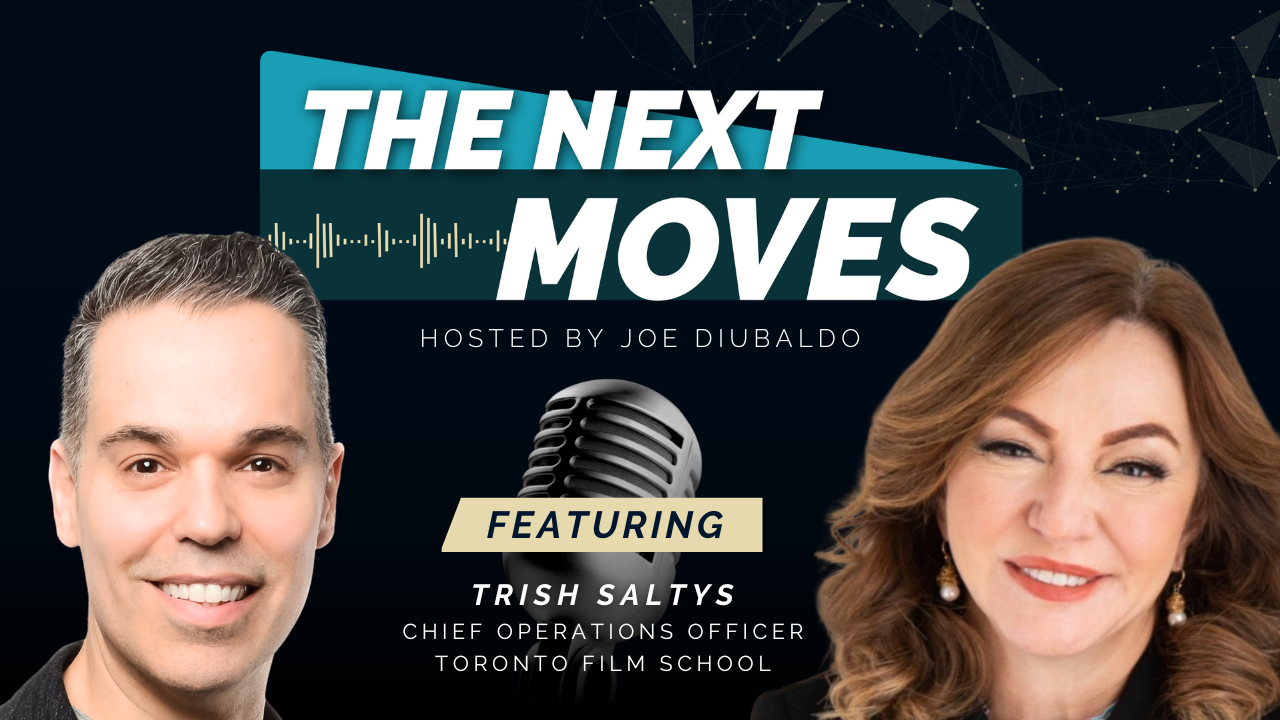
Trish Saltys isn’t afraid of a mess. In fact, she’s built her career on untangling them.
From stabilizing multi-million-dollar businesses on the brink of collapse to reimagining legacy systems in PE-backed firms, Trish Saltys has built her career on stepping into ambiguity and emerging with structure, strategy, and results. Currently the COO of Toronto Film School, she’s a seasoned operator with a finance lens, a builder’s mindset, and a strong bias toward action.
In her recent conversation on The Next Moves with Joe Diubaldo, President & Founder of Clarity Recruitment, Trish shares how her unconventional path from small-town Saskatchewan to leading change across some of Canada’s most recognized brands was shaped by both serendipity and bold yet intentional decision-making.
Trish’s career story starts on a farm in a 200-person town in Saskatchewan, a place where, “community was important and work ethic was tantamount.” That prairie upbringing gave her the kind of grit, directness, and resilience that would go on to define her leadership style in high-pressure business environments.
She trained as a CPA at the University of Saskatchewan and began her career articling with PwC in Saskatoon. But early on, she realized that public practice wasn’t where she thrived. “You’re always looking in the rear-view mirror,” she says. “You’re telling the owner something they already know – how last year went.”
What she really wanted was to be in the business, not beside it. So, she made the jump.
Her first role out of public practice was a culture shock: she joined Bruce Allen Talent, the firm managing music legend Bryan Adams. It was, as Trish describes, “the polar opposite of PwC.” But it also marked the beginning of a long line of roles where she would help companies professionalize, scale, and transform.
With a business partner, she helped implement new systems, processes, and professional standards. “We were brothers in arms,” she says. “We helped the business become more than it was when we started.”
This was also where her reputation as a “fixer” began to take shape. She was the one brought in when a business needed structure, systems, and a steady hand. But her directness, what she calls a Saskatchewan trait, wasn’t always easy to navigate.
“I haven’t always had the finesse needed,” she admits. “But I trust my judgement. I feel it’s important for someone to say, ‘Here’s what I think, and here’s where we can do better.’”
One of the most formative chapters of Trish’s career came at GT Group Telecom under the leadership of Bob Wolf, a former Goldman Sachs executive brought in to stabilize the struggling business. “He was one of the best bosses I ever had,” she says.
Under Wolf’s guidance, Trish was involved in high-impact work including private equity rounds, high-yield offerings, and eventually, taking the business public. “I traded sweat for learning,” she recalls. “It was self-mentoring. If you show up, work hard, and stay humble, good leaders will invest in you.”
This time marked a huge inflection point in her career. “You have to be willing to take jobs that are a little above you and grow into them,” she says. “Those are life-changing experiences.”
Trish Saltys’ time at 1-800-GOT-JUNK is one of the clearest examples of her ability to step into crisis and create clarity. Recruited by a former CFO she had worked with, she was brought in when the advisory board suspected the business was facing issues but couldn’t identify what exactly was wrong. It didn’t take long for Trish to uncover the truth: the business was fundamentally illiquid.
The company had overextended itself with lavish office renovations, expensive leases, and an assumption that rapid franchise growth would continue indefinitely. “We were operating like we still had more upside ahead, but the cash flow told a different story,” she explains.
Working quickly, she restructured spending, tapped into her banking network, and secured mezzanine financing to stabilize operations. Once the immediate financial triage was complete, a new president was brought in, and together they built a more sustainable path forward.
When asked whether she prefers working in founder-led companies or PE-backed environments, Trish is clear: “I wouldn’t go back to a founder-led company without a PE partner at the table.” Why? In founder-led companies, professionalization is often an uphill battle. “There’s a bias toward underinvesting in systems, people, and information,” she says. “You’re often the lone voice trying to advocate for change, and that’s hard.”
In contrast, private equity brings not just capital, but alignment. “PE firms understand that to scale, you need systems, process, and strong teams,” she explains. “They empower you to make the necessary investments. They’re in it for the long game.”
That said, not all PE is created equal. “There are the rip-and-flip types, and then there are patient capital investors who want to build something meaningful,” Trish notes. “You have to understand which one you’re working with.”
At Kraus Flooring, Trish faced a different kind of challenge, one rooted in visibility and morale. The company was in breach of financial covenants, and everyone knew it: employees, customers, the surrounding community. In an environment like that, hiring external talent is tough. So, Trish looked inward.
“I searched for the ‘bright lights.’ Those people internally who were still engaged, still trustworthy, and still wanted to be part of the solution,” she says. “You support them. You stretch them. And you operate with full transparency.” Daily meetings, a steady cadence, and high-clarity communication helped stabilize the company during an incredibly fragile time.
Today, Trish is the COO of Toronto Film School, and it’s the role she says has brought her the most joy despite never seeing herself as a fit for it at first.
“I joined as Interim CFO for Yorkville University, and within two weeks, the CEO suggested I lead the film school,” she laughs. “I didn’t think I was the right person. But it turns out, I love it.”
What she found was a school with immense potential but stagnant growth. Despite dedicated faculty and a strong culture, programs hadn’t been meaningfully updated in years, and leadership roles were misaligned.
Trish went to work. She restructured teams, modernized curriculum, and set a forward-looking strategy. The next chapter? Growth – especially as the film industry evolves with AI and emerging tech.
“It’s the best job I’ve ever had,” she says. “And I would’ve never applied for it on my own.”
Trish ends the interview with a message, especially for women in leadership: “Don’t be afraid to apply for roles you think are too big,” she says. “Every role I’ve taken felt like a stretch. But I worked hard, learned fast, and succeeded. Nobody checks every box. Don’t count yourself out.”
Trish Saltys’ career is proof that success doesn’t always follow a linear path. It’s about stepping into the unknown, owning your strengths, and having the courage to drive change even when it’s hard.
Whether you’re navigating founder dynamics, preparing for a PE partnership, or leading a turnaround, the lesson is clear: It’s not just about managing what is. It’s about building what could be.
Follow us on LinkedIn for the latest job postings, hiring trends and market insights. Need help hiring or finding the next right career move?
00:00 Trish: It takes a while for any founder or entrepreneur to come to the conclusion that what has worked before isn’t going to work anymore. And that is why those situations are very challenging — there’s often a crisis point or a pivot point that is uncomfortable because there’s an underestimation of the point the business is at. There’s an underestimation of the role luck has played and there’s an underestimation of being able to look around at their own leadership team and determine if they’ve got the right people to make that pivot and grow differently.
00:43 Joe: Hello everyone. This is the Next Moves and it’s a series of interviews done with people who have built incredible companies and awesome careers. I’m doing it for the simple reason that there are so many moments where I’m sitting in meetings in my job as a recruiter talking with a CEO or a founder or a member of their team, and they’re talking about the choices that they’ve had in front of them and how they considered them, and then as they made them — the impact and what happened. And I’m just thinking to myself, this is so valuable for people because we all get stuck. And hearing how people plan their next move and the move after that, it can help us make better decisions. I’m going to be honest — sometimes it feels like people make very logical, calculated decisions. And all the other times it feels like they flip a coin. And I think we can learn from both those scenarios and the outcomes they got. So without any further delay, let’s talk to my next guest.
01:39 Joe: Hey everyone. Today’s guest is Trish Saltys. And I’ve known Trish both as a candidate who I’m helping to find an opportunity and as a client. And as you know, I always think that these conversations I have when I’m in the room and people are thinking about their careers or they’re thinking about building their companies — they’re so valuable for all of us. What I want to look at with Trish is that she has been known as someone that you call when there’s a problem to be fixed and when there’s an opportunity that you need to tackle. And that’s across multiple industries like education, manufacturing, and media. She’s currently the COO of the Toronto Film School, which is a departure from the work she had done at Array Marketing and then 1-800-GOT-JUNK?, which are some very well-known Canadian brands. What I like is that Trish’s career has been shaped by a combination of chance and very purposeful choices. And today on the Next Moves we’re going to unpack those decisions that really put her on the path where she is now, what she’s bringing to the table for the Toronto Film School, and how she considers her future moves. So Trish, welcome.
02:41 Trish: Thanks, Joe. Appreciate it.
02:52 Joe: Trish, I think it’s important that everyone understands really where you’ve come from and the work that you’ve done. I even want to take it back to where you were born, where you grew up, and how you find yourself where you are now. Let’s let everyone know because I know your background and I don’t think that everyone else does.
03:06 Trish: So I was born on a farm in Saskatchewan. Community had 200 people in it. It’s not always what everybody sets up for success from, but for me it was a place where community was important and work ethic was tantamount. People from Saskatchewan like I’m from tend to have a certain amount of grit and a certain amount of willpower. And I would say that’s probably pivotal in making me who I am today. So I went to the University of Saskatchewan and left that province and lived in Vancouver for about 25 years. Then moved to Toronto in 2011. My career has been in companies undergoing substantial change — either from a place where they’ve been in financial difficulty or being purchased by private equity and needing to scale and professionalize. And that’s where I found my niche.
04:07 Joe: Born in Saskatchewan. And for everyone to understand, you are trained in public accounting.
04:11 Trish: I am. I’m a CPA from the University of Saskatchewan. Go Huskies.
04:11 Joe: Go Huskies. And you started that part of your career in Saskatchewan.
04:15 Trish: I did. I articled with PricewaterhouseCoopers for two years in Saskatoon and then I transferred to the Vancouver office. So I had about five years of that experience under my belt.
04:27 Joe: I think this is important because based on where you’re trained in a geography, you have a very different experience — even though you’re trained in public accounting. And then people start making moves. They start deciding why they want to go to either a different geography or a different type of client, whether that’s within the structure of the public accounting firm or outside of it. So what were you exposed to working on files in Saskatchewan, and then why the choice to go to Vancouver?
04:52 Trish: The files in a small office like the Saskatoon office are small, and this was quite some time ago. We would deal with a lot of small businesses, a lot of owner-managed businesses, but they were repetitive. Public practice wasn’t for me — at the earlier stages you’re always looking in the rearview mirror and you were telling the owner-manager something they already know, which is how their last year went. That wasn’t my cup of tea. I actually didn’t enjoy it. It was repetitive. It just didn’t fill my cup frankly. So I wanted to move on to something where I was actually in the business. There are really two paths in public accounting — one is to stay through and be a support person for industry, or the other is to get into industry and roll up your sleeves and get your hands dirty. I was much more the second one.
05:39 Joe: And is that the move to Vancouver or did you land in public practice in Vancouver as well?
05:43 Trish: No, I transferred with public practice to Vancouver and spent three more years at PricewaterhouseCoopers there. And then that first opportunity out of public practice is always the hardest one. It’s difficult to frame your experience in public practice as something that an industry or company wants to take a risk on, but I did that and sort of grew from there.
06:09 Joe: That’s why everyone needs recruiters to tell your story. Shameless plug. I watch people as they make that choice — they leave, they move into industry. You’ve moved geographies. Did you receive or get access to larger clients first in public practice in Vancouver, or was it more of the same?
06:25 Trish: No, I was in the small business area there as well, so it was more of the same. That was part of my disappointment — I felt that move to a different city was going to sort of revolutionize my life but it was same role, different city. Still a good move for me to make, but I learned something about myself in that.
06:45 Joe: So we make these transitions, we go from one context to another, and we either make a good choice or a bad choice. Let’s talk about these first few choices that you made — map them for me. You leave with a set of assumptions from public practice, you go into industry. What do you pick?
07:00 Trish: So I picked Bruce Allen Talent, who managed Bryan Adams — which was the polar opposite of PricewaterhouseCoopers, as you can imagine. An incredibly talented portfolio, a well-known entrepreneur in Vancouver, but operated very differently than a professional firm. So it was culture shock, but it was also an organization that needed professionalizing. It had not taken on the role of a CFO before. I had a business partner in Sam Feldman’s office that was another pivotal person for me. So together we did kind of brand new things — we were brothers in arms in changing that business, professionalizing it, and actually helping it become more than it was when we started. It was great.
07:48 Joe: And then we look at the next move after that. You’re really helping professionalize the organization. I’m assuming at that point you’re early in your career. There’s got to be resistance to that.
07:56 Trish: Sure there is. And I would say I haven’t always had the finesse needed to do that. One of my strengths coming from Saskatchewan is being the teller of the truth — we don’t beat around any bushes, we tell it like it is. And if a founder or an owner isn’t ready to hear that, you tend to rub things a little, create a little friction that way. But it’s also been a strength in that I trust my judgment and I feel it’s important for somebody to know what I think and where we might be able to do things better. And sometimes that works and sometimes people really aren’t ready to listen.
08:38 Joe: So highly direct. Very direct. A clear communicator. How has that served you now though as you look back? We all grow and you’re modifying styles. Are there any moments in time where you had that edge filed a little bit?
08:55 Trish: Everybody’s got it — it’s a strength and a weakness. And any strength overdone becomes a weakness. So you watch that, you get good feedback from people that care about you and your development. You catch yourself, you take a bit of time, try and read a room better, read receptiveness. That’s been my journey and where I’ve developed over time. I’m still not perfect.
09:19 Joe: Any coaches or people that really helped you along the way?
09:19 Trish: Oh, several. Phenomenal CEOs at GT Group Telecom in Vancouver. We had a CEO named Bob Wolf who was formerly from Goldman Sachs, who parachuted in to save a business that was really in trouble — again a founder business — and it was a remarkable success story as a result of his leadership. The experience he had at Goldman Sachs, that refined sense of leadership and finesse, propelled me just in an unimaginable way. What I traded was sweat for learning. He was one of the best bosses I’d had to that point. The experience of Goldman Sachs — where the storytelling needed to build and buy and sell businesses was really critical. The number of transactions we did were both private equity rounds, high yield — took that business public. Those were all key transactions I was fortunate enough to be involved in at a young age under his leadership. That was an enormous step up in my skills.
10:24 Joe: So that becomes something — are they sitting down and coaching you or are you actually learning by watching?
10:28 Trish: I think it’s self-mentoring where you’re modeling behavior often. Absolutely it is. Or it’s allowing you to participate in meetings. If you show yourself as a trusted, hard worker that’s got some humility and hunger, a lot of bosses will see that and say “okay, let’s develop you, I’m going to bring you along.” So you participate, you work exceedingly hard in exchange for those situations so that you can learn on the job. And you’ve got to be willing to take jobs that are probably a little bit above you so you can grow into them. If you have the good fortune of finding a leader like that — who sees some talent that needs molding — those are life-changing experiences.
11:11 Joe: We often experience our careers through the lens of the companies we’re in because they act on our skills and the context of the organization forces us into things we haven’t done before. It’s dangerous to connect the dots looking backwards because you fit the data to the story you want to tell. But I’m looking at you now and I’m wondering which of these companies shaped you the most, grew you, or shifted your perspective. What were those changes?
11:42 Trish: I think it’s very hard to name just one. You’re a product of all of your experiences interwoven together. Certainly jobs where my CEO were amazing people interested in me as a human being, and we had a tremendous amount of change to battle through, were very galvanizing — and you’re changed forever. There’s really not one since I left public practice that I wouldn’t put into that bucket, be they great experiences or difficult ones, because the learning is huge from either. What connects all those experiences is a dramatic amount of change — either by design or by misfortune — and the ability to synthesize that change, convince people that change is needed if you don’t have that call from the top, and be able to create a workable plan that people can find themselves in so that you can actually reach the summit. You don’t know what you don’t know at any point in your career. So you’re always looking for an environment that’s going to be rich in opportunities for change in the business, and someone who sees you as participating in it and developing you around it.
13:03 Joe: So if you look then at where your reputation as a fixer began — that’s a transformation in one’s background. You mentioned 1-800-GOT-JUNK? was almost like an incredible business case to think about. How do you solve for developing the skill of having a real operational triage — where you’re like “I’m going to figure this out, let’s categorize these.” This isn’t an ER scenario, this is a serious emergency — how’d that develop?
13:33 Trish: There’s nothing like a crisis to bring out all your skills. I had a CFO that I worked for at Crystal Decisions who was on the advisory board for 1-800-GOT-JUNK? and asked me — at the time I was looking for my next opportunity — if I was willing to have a look at 1-800-GOT-JUNK?. The board there knew something was a little wrong but they couldn’t put their finger on it, and namely couldn’t get information to validate some of the challenges that the business was having. So I joined that business and quite quickly was able to figure out that we were fundamentally illiquid. That emergency situation — and appreciate that we were in a model where we were a franchise, so you had a number of people’s businesses relying on the head office — that’s an enormous responsibility and I take that really seriously. The lack of the rest of leadership understanding the seriousness of the situation we were in was a challenge. So the only way I know how is quite direct and quite quick — assess what do we need to do short-term and long-term to get ourselves sorted. You just have an intense curiosity to be at every part of the business. You start looking at ratios, you talk to the people who are working there — because that’s one of the greatest insights, not so much the senior people but down at the levels in the business. What do you see that’s going wrong? What have you asked about or been curious about where you know something is amiss? In that case it had really just been an overextension of physical place — a very expensive downtown lease, a lot of money put into renovations that were culture-appropriate but that really drained the balance sheet. So we were in some financial difficulty. I got myself sorted, started tapping a network of colleagues that worked in banking that had mezzanine offerings, and resorted the business with a plan forward that someone in the mezzanine business could buy into and feel comfortable we could turn it around. There was nothing wrong with the base business whatsoever. But we had run out of really juicy franchise opportunities, which were a big amount of upfront cash, and we were now in more of a maintenance mode for a pretty large set of franchisors. But the cash flow around that’s quite different. The next opportunity to sell a really robust franchise in Toronto, Vancouver, or New York just wasn’t there. So there’s a pivot point in that business where you identify it and then you have to address it. And those are always going to happen — that’s no different than tariffs or the threat of tariffs or change in regulations. Your ability to understand that your marketplace is changing and adapt.
16:13 Joe: So it sounds like the growth — the organization had gone through that scaling function and was now at a place where it had tapped all those nice franchise opportunities, but was operating like it still had more in front of it with the way it was spending money. That’s a mindset shift though. And at that point are you dealing with a founder? Are you dealing with a PE firm? Who’s owning this? Because there has to be a forcing function that brings you into the fold.
16:45 Trish: That one had no PE. It was 100% founder-owned, founder-led, with an advisory board — so not a board that had ownership equity, and therefore limited ability to influence. And it takes a while for any founder or entrepreneur to come to the conclusion that what has worked before isn’t going to work anymore. And that is why those situations are very challenging — there’s often a crisis point or a pivot point that is uncomfortable because there’s an underestimation of the point the business is at. There’s an underestimation of the role luck has played. And there’s an underestimation of being able to look around at their own leadership team and determine if they’ve got the right people to make that pivot and grow differently. And so through that, the founder — good for him — hired a new president, Lonnie Skinner. She had worked in Starbucks US and had led that organization. A very important business builder. And it was through her, after a year of sorting the business and putting it back into maintenance mode on cash flow and liquidity, that we charted a multi-pronged plan for how to grow differently from that point forward. So it took that realization. It took a new person in a significant role to create that path forward.
18:12 Joe: So you say these things with a smile where you talk about these organizations that are chaotic, under threat. If you look at that as an opportunity in front of you — I can take one that is going through all these changes, or I can take something that is running really well — is there a preference?
18:36 Trish: I’ve never — ah, that’s not true. I have sometimes gone into businesses that are running really well. Crystal Decisions was an example of that in Vancouver — a very well-run business. There was a founder who could very much scale and knew what the strengths were and had a lot of forethought, and enabled that business to grow quite successfully. It was sold to a competitor and went forward from there. I think I am better in areas that need significant change and I am comfortable in diagnosing what needs to happen. I can synthesize problems and create a plan that brings people along. I’m not sure that it’s learned — it’s just where I’m most comfortable. I’ve hit points where the chaos is also too high and there’s been so much delay in bringing in someone to professionalize and create steadiness. Those are challenging as well. I don’t seek chaos, but I don’t mind it. I’m comfortable starting with the question that most leaders do — do you have the right people on the bus? Who are your soldiers in your army against the change? What skills do they have? Are they right for the job or have they outgrown their jobs? Find the right talent — you’ve helped me with that in the past, Joe. And off we go. As soon as you find great people empowered and excited about what’s possible, the chemistry takes on a life of its own.
20:03 Joe: You had said to me earlier though that you weren’t sure you’d go back to a founder organization without the PE partner at the table. And when people are talking — you’ve transitioned into PE-owned assets, you know what they look like. There’s a whole host of people that haven’t, and they’re evaluating these two realms — one is the founder organization that has grown through force of will, and the other is the one that’s transitioned to a PE ownership structure. Why this idea that it’s not one you would prefer — you’d really want to land on the one that is the founder with the PE partner?
20:45 Trish: I wouldn’t do that again — although people may find, as they transition if they’re looking at doing what I’m doing, they might have to do that and be the voice of change. It’s much tougher to be the lone voice of professionalization in a founder or entrepreneur-led company. There tends to be a bias towards underinvestment in great back office, great systems, great information. Those are big step functions — they can be expensive. They’re often comfortable in what I call hub-and-spoke management. They want to be at the center of decision making and have it radiate out from there, rather than creating robust departments that work together harmoniously. It does take some dollars and some extra people to do that. The challenge is you’re going to be on your own — in my case as the CFO, which is your number two to the CEO — to convince them that they need to take that leap and invest. And they’re often unwilling. It feels expensive. “We’ve gotten here successfully without doing that.” So you’re constantly facing that battle and you’re the voice trying to change from below. Whereas PE, for the most part, are there because there’s a scalable operation. They know you need to invest in systems, people, and process. They usually have dollars behind it and they understand what that business could turn into five to seven years down the road. It’s just so much easier for them to join you in those difficult conversations and in fact liberate and empower you to build up those functions that need doing.
22:10 Joe: So I look at the other market that I deal in quite a bit — which is VC-funded assets. I’m talking with people that run the funds and I’m going to compare this to private equity for a moment. There’s been a complete change in VC in terms of some of these fund leaders and owners — they now need to transition from “you’re going to get an exit on this timeline” to further out, and that shifts everything. I’m wondering the degree to which that’s replicated in PE. And if it’s there and they now have to adjust their expectations because of some broader shifts that have happened macroeconomically — are they ready to do that or are they just not experiencing it at all? What’s your thought process on how the PE space is evolving?
22:48 Trish: I don’t think PE is a homogeneous group of investors. They are very fundamentally different than VC investors. But I really enjoy the longer-term PE model where they’re comfortable that the kind of change needed to actually realize their asset value takes longer. So longer-hold people really want to get it right. They have a lot of pride in the product they eventually sell — the exit is wrapped up in a bow, things are working, some of the risk is taken out, some of the uncertainty is taken out, and they understand the timeline around that. Patient capital is a really fabulous thing to be working with. It’s not that they’re not high-performing and demanding high performance — but they understand there are going to be a few surprises and things may take longer.
There is another breed of PE that is rip it and flip it — bolt on a bunch of acquisitions, a certain amount of chaos as that attempts to be integrated, then turn it into something for a higher multiple. You just have to understand the assignment there. But if things are taking too long to fix, they’re less comfortable with that. The question to ask is what’s the profile of the PE firm you’re coming into. I can’t speak as to whether there’s been a change from one style to the other. I think there are circumstances where the business environment changes and timelines naturally get extended. For instance, we’re in education and there was significant regulatory change in 2024 that meant we have to shift our business model and we may have a different growth trajectory than anticipated and might have to focus on different things. But that’s every business — you have to react to the changing landscape all the time to stay relevant and stay competitive. I’m very comfortable with PE partners that say “it might take a little longer, we’re okay with that, let’s get it right.”
25:00 Joe: When everything is changing, the ability to navigate that change is really tied to your ability to map those changes. What fundamentally has shifted in the way that we operate? What’s the impact of each of these pieces? How do they comingle and amplify each other — or are they running in series or parallel? How do we look at this? A great team can map those, consider them, and look at the trade-offs. You’ve had to actually operate under constraints with talent — and you’ve had a chance now to build within Toronto Film School and Yorkville, and Virtual has empowered you to do that. But you’ve also had it on the other side where everything is changing and you’re operating with constraints and scarcity. How do you do that?
25:44 Trish: The greatest example of that was Kraus Flooring. We had PE partners there who were helping us essentially restructure a business where we were in breach of our financial covenants. It was well-known — it was a small community in Kitchener-Waterloo. It was known the business was in trouble. Everybody knew about it internally. The entire community knew about it. And as you would imagine, those are hard things to hire into. People are uncomfortable with going in there and having short tenure or no comfort the business is going to continue. That’s understandable. So then you look internally for what I call the bright lights — people that you find you can trust, that are happy to be part of the solution. In those situations you end up being quite directive in your leadership because the swirl of uncertainty preoccupies far too much time. So you need a roadmap of what’s going to happen. I operate under a high level of transparency — I explain to people what’s going on, I make myself available. We had a daily meeting as to what was going on because the pace of change and the criticality of it was important. And you’ve got to find the one or two people who, if you develop trust and they feel supported, are going to do what you ask them to do. They may stretch and they may mess up on occasion, but there are always a few bright lights there that have just been undermanaged and underappreciated usually. So you find them and you support them as much as you can, because the opportunity to go outside just isn’t there.
27:36 Joe: So what’s interesting about Toronto Film School is that industry is going through massive change — the introduction of generative AI and how people might be making film in the future. I’m wondering how that affects the people level there as you’re coming in to work with them, and are they more receptive because everything is in flux?
27:54 Trish: It’s an industry that is changing — not quite as rapidly as AI generally, but very very affected by it. We have two groups of people. We have people who see this change as another major change — like there have been through history — that you need to embrace, adapt, and bring into the business and include it as part of what we do. And we do have people who are more pure in their point of view and feel that creative work shouldn’t be assisted by technology — purists in their craft. And we have students who fall into those two camps as well. So you need to find the win-win. In our case, we’re going to adapt to it and embed it heavily in our curriculums. Our mandate as an educational institution and a career college is jobs — we are evaluated among other things for the quality of our education but also careers in field once you graduate. That’s a key metric for us. And we are seeing that entry-level positions are disappearing — video game technology is replacing those roles at a rapid rate, and job postings ask for AI-based skills if you’re to join an organization that has a creative industries slant to it. So I fundamentally believe we have no choice but to adapt and actually deliver that as a competitive advantage to our programs. It’s a risk and it flies in the face of those that are pure in what they choose to do in creative industries and creative work. But we’re finding the best way of bringing people along is to sell it as needed and complementary. It’s never going to replace people who are visual storytellers for a living. It will support them. It will make some jobs different. It will eliminate some and it will create many, many others. Not unlike major shifts that every industry has gone through — your ability to adapt and innovate around that means you’re going to win.
30:08 Joe: I’ve seen these major transitions in film. I don’t want to see a film that doesn’t have people in it. I know that might sound naive about where the industry is going, but it’s not something I see myself enjoying as much as the story being told by someone about people who are performing for me. Are you surprised that you were tapped for an operator role like this?
30:41 Trish: I am surprised and yet it’s the best job I’ve ever had. So what does that tell you about self-knowledge? I joined Yorkville University, which is our parent organization, and was placed as an interim CFO. I’ve been a CFO most of my long career and I felt that was a good use of skills. And within two weeks, our CEO at the time said “you’d make a great person to lead Toronto Film School.” And I remember chuckling at that meeting and going “I don’t think that’s true, but I’m just going to smile and nod at this juncture.” And so I did that role for about five months and then contracted to be the COO of Toronto Film School. That was the diagnosis assessment — asking a lot of questions, trying to synthesize why that organization frankly hadn’t grown in about five years, whereas the rest of Yorkville University — the piece that offers degrees — had grown quite dramatically. So I was tasked with understanding why. I proceeded to ask questions, did research, talked to people in the industry and in the organization, and was able to put together a pretty long list of things we needed to execute on better. There were a number of people in the organization in the wrong roles — they had been with the organization for a long time and were not leaders, weren’t innovating, didn’t have the right org charts or people under them. We had not really redeveloped any curricula in 7 to 10 years against an industry that was changing. What I found though were phenomenally dedicated faculty — so committed to the school. The culture was extraordinarily powerful and very engaging. So there was a ton of raw material but people were craving structure, steady leadership, and where the guardrails were. And fundamentally the last year has been about upping the quality of what we deliver. We are a premium-priced offering and we have many really good programs but we’re making them and have made them tremendously better in the last year — to kind of match that product and pricing. The experience when you join Toronto Film School, graduate, and then are supported afterward — because again as a career college one of our great mandates is you get a career in field — we take that really seriously and we’ve heavily invested around that. It’s been a really positive change.
33:33 Joe: I see the operator role really drawing from three pools. It draws from the engineer, it draws from finance and accounting — because it is repeatability, efficiency, and effectiveness, and you have that inside of engineering as well. Rarely do you see it draw from sales — it’s just not the mindset that looks at an organization and says “what enables scale here, are we aligned to that, what will allow us to grow effectively?” So it doesn’t surprise me that you landed there. I want you to reflect for a moment and think about the next moves for you. I’m not looking to say are you leaving your job — what I’m looking to say is what happens next and how do you think about it? You’ve been here how long — year two or three?
34:24 Trish: It was two years in February.
34:26 Joe: So you’re in your third. How do you think about your moves in the future?
34:31 Trish: I certainly will not go back to being a CFO — and no disrespect to my CFO colleagues and friends, I’ve done that my entire life. I am just better suited for fixing and building the business — both the internal workings and the top line. I’m very late in discovering that career-wise, but I’m also very comfortable in that skin and it feels like home. The work’s not finished at Toronto Film School. We developed our go-forward strategy just at the end of last year, having taken a year to get our internal clock working very neatly. So now we’re executing on what the growth strategy is. And in education it’s a bit of a longer sale and regulatory environment — your customers in the future are currently in Grade 10, 11, 12. So it’s got a bit of a longer tail to be able to execute on that. If there is anything next — and there may not be — it would be in this operator role. It would be as a parachuter-in for a private equity firm that I have a ton of respect for and would be happy to work with — where we’ve been able to build such great trust. They could toss me at their next challenge and I would gladly take that on with a broad set of skills. And because I’ve got confidence in them and they have confidence in me, those are the things that would appear on my resume in the next few years if there were some exit and that was the situation. But I’ve found the perfect role for me in terms of what I do every day, but frankly the people that I work with as well. So it’s pretty powerful and very compelling.
36:12 Joe: I think one final question though — we sat down for coffee and you had mentioned that when you first moved to Toronto your goal was to work with Birch Hill. How long ago was that?
36:29 Trish: That was 2011. That was a long time ago and I wasn’t very well connected in Toronto. We moved here because my husband was transferred, so I was really starting from scratch. I tried a few times and I couldn’t get a meeting — I didn’t have a big network to leverage. So I think it’s fabulously serendipitous that at this point I am actually doing what I personally set out to do. It took a bit of time but they are — as I said — when you have partners that you trust and are there for the long game, it’s just a fabulous situation to be in.
36:53 Joe: Anything that you want to add now at the end? Anything that we haven’t talked about?
37:04 Trish: This was fantastic, by the way. I would say two things. One — to professional women in particular — don’t be afraid to apply for jobs you don’t think you can do. We underestimate ourselves and I’m guilty of that as well, and it took other people to see skills and abilities in me that I wasn’t necessarily aware of. I’ve applied and taken some risks in jobs where I read the requirements and go “oh, that’s a little bigger than I have done” — and yet I’ve ended up getting them and enjoyed them and had success. But I’ve been willing to work very, very hard to learn into them. So don’t be afraid of doing that. Nobody’s perfectly aligned to a role. Nobody has every box ticked.
37:56 Joe: I can second that. Rarely. And it’s also that people are happiest at the edge of their competency — you’re stretching to do the job, there’s a gap between all the skill and what you have, and then you’re learning those. We’re always happiest there as long as we’re succeeding — we have enough to succeed and that gives us time to learn.
38:12 Trish: It is. And it’s very rewarding — your personal development grows, you kind of change the outer limit of what you think you’re capable of. But definitely pick who you work for. That is the single most important thing. Well, it’s the second most important, or aligned most important — the company and the situation at hand, and then who you work for and how you create that relationship. It’s really fundamental. And then kind of aligned with your work, Joe — when I look for talent either internally for those bright lights or outside, I’m looking for hungry, humble, and smart. There’s a whole bunch you can actually teach people outside of that. Put those ingredients together and it makes a really powerful set of raw materials in what your team is like. And it makes a big difference.
38:56 Joe: Well, this has been a blast.
38:56 Trish: I’m glad. Me too. We shall do a part two based on Trish Saltys’ fabulous adventures — and I really appreciate this. Thank you for the time.
39:04 Trish: It’s no trouble. I really enjoyed it, Joe. Thank you for the support you’ve given me.
Here is your link to the 2026 Salary Guide:
2026 Salary Guide (PDF) ↗Are you hiring? Get in touch with us to talk about better hiring.
Get in touch →
Here is your link to How Finance Fuels Growth:
How Finance Fuels Growth (PDF) ↗Are you hiring? Get in touch with us to talk about better hiring.
Get in touch →
Here is your link to the Finance Team Org Charts:
Finance Team Org Charts (PDF) ↗Are you hiring? Get in touch with us to talk about better hiring.
Get in touch →